Tree · Fagaceae
Chestnut
Castanea sativa
Set it in well-drained, acidic soil with a compatible pollen source, and this beech-family tree will reward the grower with a heavy yield of roasting nuts.
Full sun
Every 7–21 days
USDA 4–8
49–98 ft · 15–30 m
Overview
The sweet chestnut is a long-lived member of the beech family, valued as both a nut and shade tree and cultivated around the Mediterranean hills for thousands of years. Its deep root system supports a broad crown that reaches 15 to 30 m, a scale that rules it out of small gardens but rewards any site with genuine room. Each autumn it sheds the nuts that have been roasted over coals through winter for generations.
A point of identification matters here, because the horse chestnut, or conker, belongs to an entirely separate family and only resembles this tree at a glance. The edible nut comes solely from the genus Castanea; the horse chestnut produces an inedible look-alike. Its seeds carry toxins and have no place in food.
Soil chemistry governs everything else with this species. It demands acidic, well-drained soil and full sun, and it declines on heavy, waterlogged, or alkaline ground because those conditions impair root function and nutrient uptake. Since the species is largely self-incompatible, a second chestnut nearby supplies the cross-pollen that converts empty burs into a harvest worth taking.
Care
The short version: full sun and deep, acidic, well-drained soil, consistent summer moisture during nut fill, and a second chestnut nearby to overcome self-incompatibility so the flowers set fruit.
Light
Site the tree in full sun, which drives the heaviest flowering and the best nut set. It tolerates partial sun or light shade, but reduced light produces leggy growth and a markedly smaller crop, because flowering depends on adequate insolation.
Water
Irrigate young trees deeply through the first few seasons so the root system establishes. A mature chestnut is fairly drought tolerant, yet it still requires consistent summer moisture for good nut fill, since the developing seed draws heavily on water. Avoid waterlogged soil, which excludes oxygen from the roots and favors root rot.
Soil
Soil is the decisive factor for this species. It performs in deep, well-drained sandy loam held on the acidic side, at a pH of 5.0 to 6.5, where iron and other nutrients remain available. Heavy, wet, or alkaline ground locks up those nutrients and produces chlorosis followed by slow decline.
Temperature
The chestnut is hardy across a broad thermal range, withstanding winter lows near -22°F (-30°C) and summer highs of 95°F (35°C). That tolerance places it securely within USDA zones 4 through 8.
Humidity
Ambient outdoor humidity near 40% to 70% meets the tree's needs, so no atmospheric management is warranted. Site selection and soil drainage exert far greater influence on its condition than air moisture does.
Feeding
Apply a balanced complete fertilizer in early spring as growth resumes and demand for nutrients rises. On naturally acidic sites, withhold lime, because raising the pH above the preferred range reverses the very conditions the tree relies on.
Pruning
Prune in late winter during dormancy, when wounds close cleanly and disease pressure is low. Train a young tree to a single central leader, remove dead, crossing, or damaged wood, and excise any branch bearing a sunken bark canker at once, since prompt removal limits the spread of blight.
Repotting
As a landscape tree the chestnut has no repotting cycle. Transplant a nursery sapling to its final site while young and dormant, before the roots begin circling, because a circling root system stunts top growth after transplanting.
Size & spacing
Allow for a large tree of roughly 49 to 98 feet (15 to 30 m) in height with a spread of 33 to 49 feet (10 to 15 m). Provide that clearance from buildings and power lines, since the mature crown and root spread both demand the room.
When to plant
The species follows a strict seasonal cycle. Establish dormant saplings or stratified nuts in spring once hard frosts have passed, or sow nuts in fall so winter delivers the cold stratification the seed requires. Catkins appear in early summer, and the burs dehisce to drop ripe nuts in September and October.
Northern hemisphere
Southern hemisphere
Typical months for a temperate climate: start earlier in warm zones, later where spring frosts linger.
- Plant: Plant dormant saplings or stratified nuts in spring after the last hard frost, or set out nuts in fall for natural cold stratification.
- Harvest: Catkins bloom in early summer (June to July); nuts ripen and drop inside spiny burs in September to October.
Hardiness
USDA hardiness zones: 4–8
Temperature: down to -34°C
Troubleshooting
Nearly every chestnut disorder originates in one of three sources: an unsuitable site, the absence of a pollen partner, or the blight that has shaped the species' history. The bark, the burs, and the foliage each register a distinct symptom, so close reading identifies the cause. Match the signs below and intervene early, before a setback progresses to tree loss.
Girdling cankers on the bark, dieback above, basal resprouting below
Sunken orange-brown bark lesions identify chestnut blight, the fungal disease that eliminated the American chestnut from eastern forests. The pathogen Cryphonectria parasitica enters through bark wounds and forms a girdling canker that kills all tissue above it, while the unaffected root system continues to resprout. Excise cankered limbs well below the lesion, and on sites where infection recurs, replant with blight-resistant Chinese chestnut or resistant hybrids.
Fix:
- Prune out and destroy cankered limbs well below the lesion
- Replace highly susceptible American or European trees with blight-resistant Chinese chestnut or resistant hybrids
Abundant bloom yet burs that develop empty or unfilled
Heavy bloom paired with negligible nut set points to inadequate cross-pollination. Because chestnuts are largely self-incompatible, an isolated tree fertilizes itself poorly and the burs develop flat or empty. Planting a second, genetically distinct chestnut within about 30 m supplies the compatible pollen that restores nut set.
Fix:
- Plant a second, genetically different chestnut within about 30 m to supply cross-pollen
Chlorotic foliage, feeble shoot growth, and progressive dieback
Pale foliage with thin shoot growth usually reflects a soil problem rather than a pest. Chestnuts cannot tolerate alkaline or soggy ground, since either condition impairs nutrient uptake and induces chlorosis. Acidify the soil toward pH 5.0 to 6.5 with elemental sulfur, correct the drainage, or relocate the tree to a deeper, better-drained acidic site.
Fix:
- Acidify soil toward pH 5.0 to 6.5 with elemental sulfur
- Improve drainage or relocate to a better-drained, acidic site
Toxicity
For households with pets and children, the verdict is straightforward: the true sweet chestnut is non-toxic, and its roasted seeds are an established human food. The genuine hazards are mechanical rather than chemical, namely the spiny bur and the whole hard nut, either of which can cause choking or a puncture. The toxic look-alike horse chestnut, by contrast, must never be eaten.
Safe for
People · Cats · Dogs · Horses · Rabbits · Livestock · Birds
Cats None
The true sweet chestnut is non-toxic to cats, so ingestion poses no poisoning risk. The actual hazard is a whole nut swallowed quickly, which can obstruct the airway or cause minor gastric upset.
Dogs None
Dogs incur no poisoning risk from the sweet chestnut. The concern is a gulped whole nut, whose size and hard shell can lodge in the throat or provoke a mild digestive upset.
Horses None
Sweet chestnut is non-toxic to horses and produces no toxic reaction. The only caution is the spiny bur, which can prick the mouth if an animal bolts it.
Rabbits None
The true chestnut poses no toxicity to rabbits. The dense, starchy nut is simply too rich for a small digestive tract, so it amounts to an incidental bite rather than fodder.
Livestock None
Cattle, sheep, and goats can graze near a sweet chestnut without harm, and the fallen nuts have long served as feed. Difficulty arises only from a sharp bur underfoot or in the mouth, never from a toxin.
Birds None
Chickens, jays, and other birds consume chestnuts without harm, and wild birds assist in dispersing the crop. Offer the nuts in manageable pieces so none is taken whole.
People Safe
Sweet chestnuts roasted, boiled, or milled into flour are a wholesome human food. The single caution is the look-alike horse chestnut, or conker, whose toxic seeds must never substitute for them.
Wear gloves when collecting the spiny burs, and keep whole shelled nuts away from pets since they can be a choking or mild GI-upset risk if gulped.
Varieties
Several chestnut species and hybrids occur in orchards and landscapes, differing in nut size, foliar detail, and the degree of blight resistance they carry. The following are the taxa worth distinguishing.
Castanea sativa (Sweet / European chestnut)
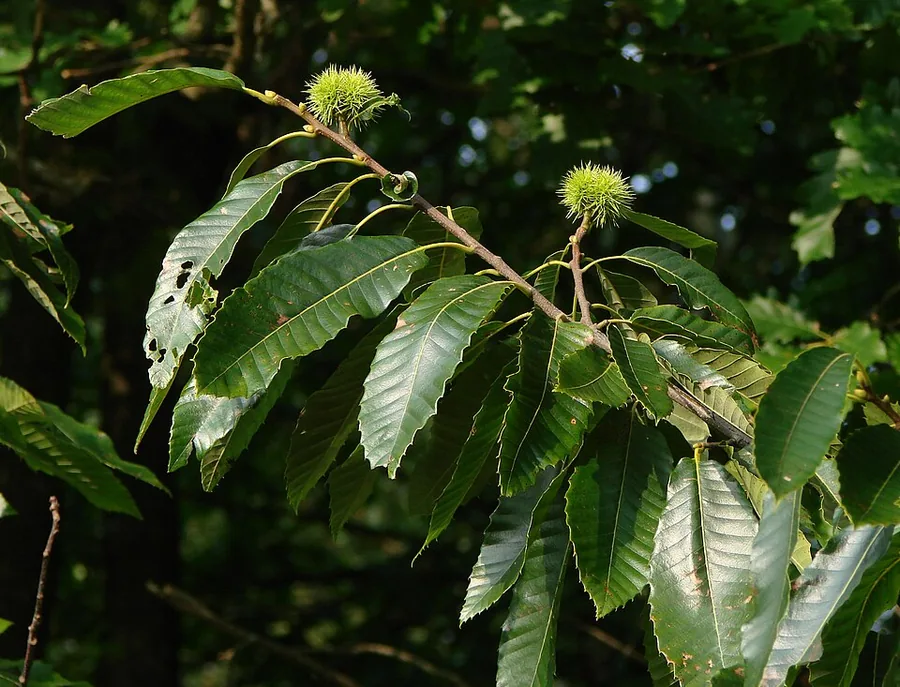
The classic Mediterranean nut tree, grown for large, sweet nuts and identified by long, lance-shaped leaves with toothed margins.
Castanea dentata (American chestnut)
Formerly a dominant canopy species of eastern US forests, eliminated at that scale by chestnut blight, and recognized by its coarsely toothed, hairless leaves.
Castanea mollissima (Chinese chestnut)
Planted widely for nut production on account of its blight resistance, and distinguished by the soft hairs on its twigs and leaf undersides.
'Dunstan' hybrid chestnut
A hybrid of American and Chinese parentage selected to combine strong blight resistance with good nut quality.
Companions
A chestnut's best neighbor is another chestnut, since one tree needs a partner to set nuts, and its worst is the grass crowding its trunk.
Plant near
A second, different chestnut cultivar: Supplies cross-pollen for nut set because chestnuts are largely self-incompatible.
Keep apart
Turfgrass or sod against the trunk: Competes with young chestnuts for water and nutrients; keep a mulched, grass-free zone around the base.
How to propagate
Propagation proceeds either from the nut itself or by grafting a known cultivar, and the method chosen determines both the interval to first bearing and whether the resulting tree reproduces the parent.
SeedModerate
Sow fresh nuts in fall, or cold-stratify moist nuts for about 2 to 3 months and sow in spring. · 5 to 7+ years to first nut crop from seed
Most chestnuts are raised from the nut, but the seed is recalcitrant and dies on drying, so sow it fresh in fall or hold it moist and cold-stratified for 2 to 3 months before a spring sowing. A seedling will not reproduce its parent, and it requires 5 to 7 or more years to bear a first crop.
GraftingDemanding
Graft in late winter to spring onto compatible seedling rootstock. · Grafted trees typically bear in 3 to 5 years
Grafting reproduces a named cultivar true to type and combines blight resistance with good nut quality in one tree. Work onto compatible seedling rootstock in late winter or spring; grafted trees typically bear in 3 to 5 years, though graft unions occasionally fail to take.
Myths
The sweet chestnut and the horse chestnut are a single species whose nuts are equally edible.
The two are not closely related at all. The edible sweet chestnut sits in the genus Castanea within the family Fagaceae, whereas the horse chestnut, or buckeye, is Aesculus, and its seeds contain aesculin and other saponins that are toxic to pets and people. Never eat a horse chestnut or conker in place of the real thing.
The American chestnut no longer exists at all.
Castanea dentata is functionally extinct only in its role as a mature canopy tree, killed by blight before it attains full stature. Surviving root systems still sprout repeatedly, and active breeding programs continue to produce blight-resistant hybrids intended to restore the species.
A solitary chestnut will produce a complete crop by itself.
An isolated tree sets poorly because the species is largely self-incompatible. Two genetically different trees must stand close enough to exchange pollen before the burs will fill out properly.