Tree · Ulmaceae
American Elm
Ulmus americana
A fast-growing vase-shaped shade tree brought back from near-collapse through breeding for resistance.
Full sun
Every 7–14 days
USDA 2–9
60–80 ft · 18.3–24.4 m
Overview
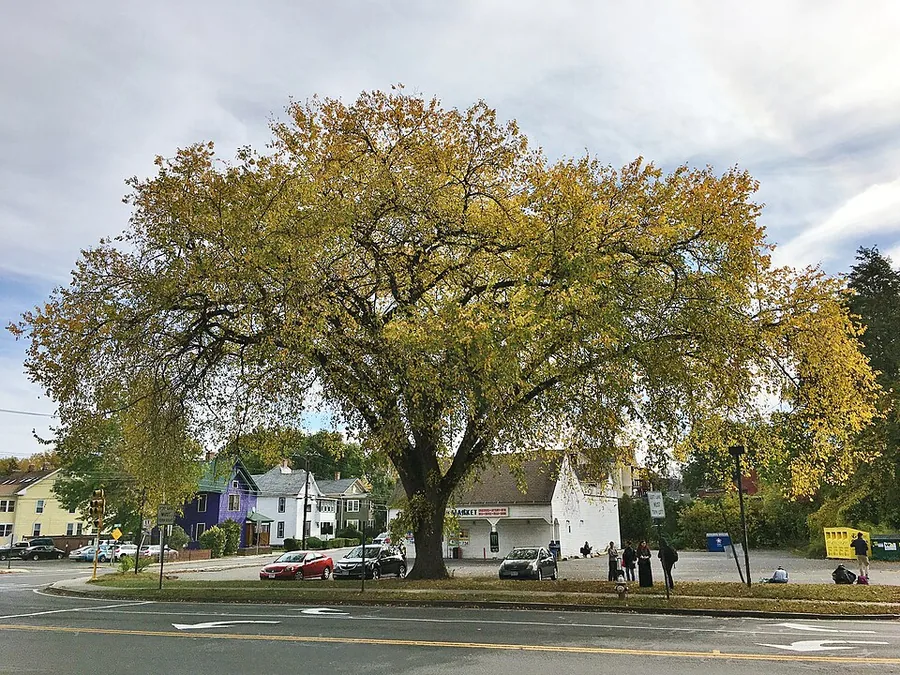
Few native trees match the architecture of the American elm, whose ascending limbs once arched over avenues to form a continuous canopy. Growth is rapid and the eventual scale considerable, reaching 60 to 80 feet (18 to 24 m) in height with a still greater crown width, and its broad edaphic tolerance lets it occupy sites from saturated bottomland to compacted, dry urban soils.
That dominance ended with Dutch elm disease. The introduced vascular wilt spread through North American populations during the 20th century and killed elms in the millions, leaving few mature specimens of the old stature. The species persisted, however, and selection has since produced genuinely resistant cultivars, making the tree a defensible choice for the informed planter.
The return on that patience is a premier shade tree, hardy through zone 2 to zone 9 and indifferent to soil texture and pH. It remains a large, long-lived organism with weak wood and a shallow, pavement-lifting root system, which is why adequate setback from structures, rather than a confined planting site, governs where it belongs.
Care
The short version: site it in full sun to light shade on almost any well-drained soil, irrigate young trees through drought until they establish, prune in late winter to build sound structure, and allocate this large, fast-growing tree ample room.
Light
The American elm develops its fullest, densest crown in full sun, which maximizes photosynthetic surface, yet it tolerates partial shade with little visible penalty. Greater light simply yields denser, more structurally sound growth.
Water
Irrigate young trees to maintain even soil moisture during establishment, supplying water roughly every 7 to 14 days through dry periods until the root system extends. Once established, the species is exceptionally adaptable, withstanding both drought and saturated ground, so supplemental water is seldom required on mature trees.
Soil
Edaphic adaptability is one of this tree's defining traits. It performs best on an average, medium-moisture, well-drained loam but establishes readily on clay, sand, and either wet or dry sites, and it accommodates a broad pH span from 5.5 to 8.0, spanning acidic to alkaline conditions.
Temperature
Cold hardiness is exceptional. The American elm is rated across zone 2 to zone 9 and withstands an extreme range of roughly -51°F to 100°F (-46°C to 38°C), a tolerance that historically underpinned its very wide native distribution.
Humidity
Ambient outdoor humidity is entirely adequate, so no target value applies. As a hardy native, the tree is fully acclimated to whatever atmospheric conditions the site provides.
Feeding
Apply a balanced slow-release tree fertilizer to young trees in spring to support early growth. Mature specimens rarely respond to feeding and are generally best left unfertilized once established.
Pruning
Carry out structural pruning in late winter during dormancy, removing crossing and weak branches to build sound architecture, a priority because the wood fails readily under load. A second, urgent objective applies year-round: cut out and destroy any wilting branch immediately to limit the spread of Dutch elm disease.
Repotting
Long-term container culture does not apply to this tree, so there is no repotting interval. Transplant a nursery sapling to the ground before its roots circle the pot, treating roots emerging through the drainage holes as the signal to plant out.
Size & spacing
Plan for considerable mature dimensions. The American elm attains 60 to 80 feet (18 to 24 m) in height with a spread of 40 to 70 feet (12 to 21 m), so position it at a generous distance from buildings, walks, and paving that the shallow roots will in time displace.
When to plant
Phenology follows the pattern of a temperate deciduous tree. Establishment planting is best in spring or fall during dormancy, anthesis produces inconspicuous reddish-green flowers in March and April, and the winged samaras ripen and disperse over April and May.
Northern hemisphere
Southern hemisphere
Typical months for a temperate climate: start earlier in warm zones, later where spring frosts linger.
- Plant: Spring or fall
- Harvest: Tiny reddish-green flowers in late winter to early spring (March-April), followed by flat winged samaras maturing April-May
Hardiness
USDA hardiness zones: 2–9
Temperature: down to -46°C
Troubleshooting
Two disorders account for the majority of problems on this species, and the more serious announces itself early in the canopy. Recognize out-of-season wilt on an individual limb, and distinguish it from the characteristic defoliation of leaf-feeding beetles. Diagnose from the entries below, then respond without delay, because outcomes in Dutch elm disease depend heavily on early intervention.
Localized branch flagging while the rest of the crown stays green
When wilt is confined at first to one branch and then advances through the crown, the cause is most often Dutch elm disease, a vascular wilt in which the fungus plugs the water-conducting xylem; elm bark beetles introduce it, and grafted roots between adjacent elms carry it onward. The telltale brown streaking in the outer sapwood reflects that vascular blockage, but elm yellows, a phloem disorder, produces an indistinguishable decline, so laboratory confirmation is warranted. Excising infected limbs well below the streaking removes inoculum ahead of the advancing front, severing root grafts breaks the underground pathway, and prompt removal of dead wood denies the beetles their brood material.
Fix:
- Prune out and destroy infected limbs well below visible streaking as soon as flagging appears
- Remove and destroy severely affected or dead trees promptly to eliminate beetle breeding sites
- Sever root grafts between adjacent elms to stop underground spread
- Consult an arborist about fungicide injection for high-value trees
Foliage skeletonized to the veins with beetles present
Browning leaves reduced to a lacework of veins are diagnostic of the elm leaf beetle, whose larvae graze the lower epidermis from beneath while the striped adults feed through the upper surface. Japanese beetles inflict comparable defoliation, so verify the insect before treating. Because a vigorous tree compensates for limited defoliation through its remaining canopy, tolerance is the default; conserve the predators that suppress the beetle, and reserve a labeled insecticide for severe outbreaks on small enough trees to spray effectively.
Fix:
- Tolerate light feeding on otherwise healthy trees
- Apply an appropriately labeled insecticide for heavy infestations on smaller trees
- Encourage natural predators
Toxicity
For animal-keeping households the assessment is favorable: the American elm is not toxic to pets, livestock, or people. No tissue of the tree contains a poisonous principle affecting browsing or chewing animals. The cautions that apply are mechanical rather than toxicological, since the brittle limbs and the heaving surface roots constitute the real hazards.
Safe for
People · Cats · Dogs · Horses · Rabbits · Livestock · Birds
Cats None
Because the species contains no recognized toxic principle, a cat that ingests a fallen leaf or samara is at no toxicological risk. The only plausible response is the nonspecific gastrointestinal upset that follows ingestion of indigestible plant fiber in any animal.
Dogs None
A dog that chews a twig or strips a little bark encounters no poisonous compound in either tissue. Foliage and wood are toxicologically inert, so unsupervised access beneath the canopy carries no chemical hazard.
Horses Safe
Leaves and bark present no toxic exposure to grazing horses. The species is non-toxic, and equines browse it without adverse effect.
Rabbits Safe
Rabbits routinely debark and bud-browse elms through winter with no toxic consequence. Proximity to a hutch or feral warren poses no poisoning risk.
Livestock Safe
Cattle, goats, and sheep browse elm foliage safely, and the leaves have a documented history as fodder. No constituent of the tree is poisonous to ruminants or other stock.
Birds Safe
Birds consume the spring samaras and nest within the canopy with no toxic risk whatever. Ecologically the elm functions as benign habitat for avian species.
People Safe
No part of Ulmus americana is poisonous to humans. The relevant hazards are mechanical rather than toxicological, principally limb breakage and the surface root system.
No special handling is required for toxicity, though the tree's large size, surface roots, and falling samaras and limbs are landscape considerations.
Varieties
Nearly every American elm worth planting today is a named clone selected for resistance to Dutch elm disease. The following are the principal options.
'Princeton'
Dating to a 1922 introduction, this long-established clone retains the species' vase habit and has demonstrated strong resistance to Dutch elm disease.
'Valley Forge'
A U.S. National Arboretum release valued for exceptional tolerance to Dutch elm disease, though resistance falls short of full immunity.
'New Harmony'
A further Arboretum selection combining disease resistance with vigorous growth and cold hardiness to roughly zone 4.
'Jefferson'
A resistant clone selected to express the arching, vase-shaped architecture for which the species is valued.
How to propagate
Seed propagation of the American elm is straightforward, but a disease-resistant tree must be obtained clonally, by grafting or cuttings from a named cultivar, because resistance does not come true from seed.
SeedModerate
Sow fresh samaras in late spring soon after they mature · A few weeks to germinate; several years to establish as a tree
Sown fresh in late spring as soon as they mature, the winged samaras germinate within a few weeks, since the seed of this species is not strongly dormant. Establishment to tree size then requires several years, and because resistance is genotype-specific, seedlings do not reproduce the disease tolerance fixed in the named cultivars.
GraftingDemanding
Dormant season · One or more seasons
Grafting in the dormant season is the standard nursery technique for reproducing a named, disease-resistant clone true to type, since it transfers the parent genotype intact. Union and establishment take a season or more, and the skill involved places it outside routine home propagation.
Stem cuttingsDemanding
Softwood in late spring to early summer · Weeks to root, then years to establish
Softwood cuttings taken in late spring to early summer yield genetically identical copies of a resistant cultivar. Adventitious roots form within weeks, after which several years of growth produce a tree, but reliable rooting in this species demands experience and good propagation conditions.
Myths
The American elm is extinct or no longer worth planting because of Dutch elm disease.
Dutch elm disease did decimate the species across the 20th century, yet it never drove Ulmus americana to extinction. Several resistant cultivars are now in commerce, namely 'Princeton', 'Valley Forge', 'New Harmony', and 'Jefferson', so a planting today has a sound prospect of persisting.