Tree · Ulmaceae
Chinese Elm
Ulmus parvifolia
A fast, adaptable shade tree that performs through poor soil, drought, and urban stress.
Full sun
Every 7–14 days
USDA 5–9
40–50 ft · 12.2–15.2 m
Overview
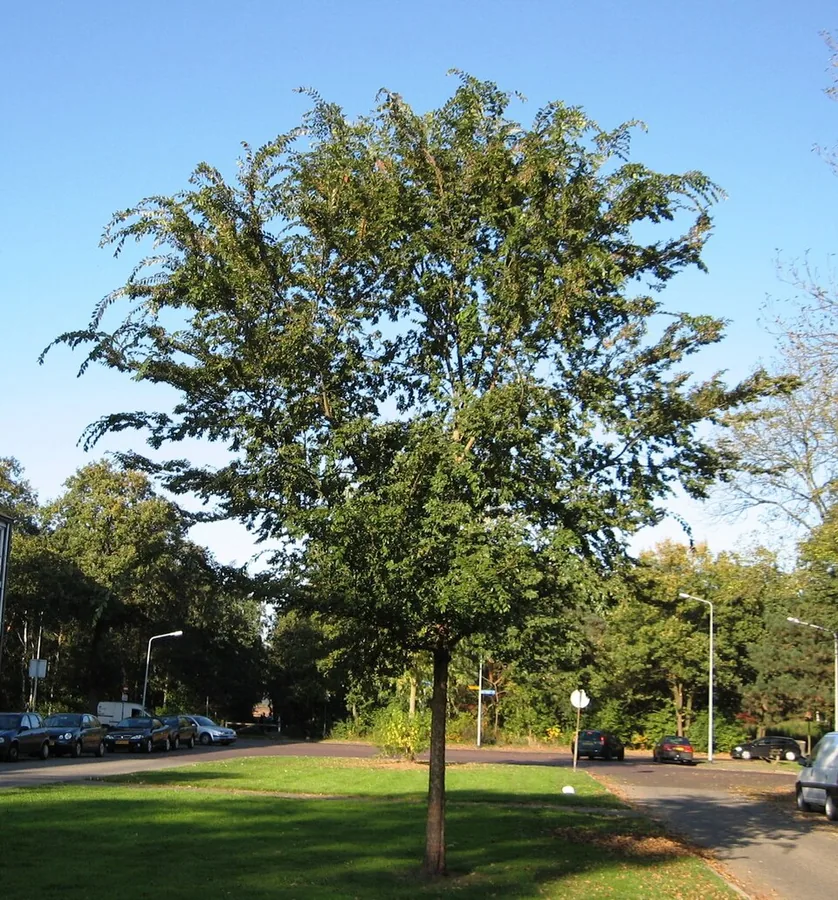
Chinese elm ranks among the more adaptable shade trees in cultivation. It grows fast to a broad 40 to 50 feet and forms a rounded crown of small, glossy leaves on branches that frequently arch toward the ground. Its defining feature is the exfoliating bark, which sheds in plates to expose a mottled lacebark pattern of gray, green, orange, and brown.
Site tolerance is where the species excels. It establishes in clay, loam, or sand, performs across a pH of 5.5 to 8.0, and once rooted it withstands drought, soil compaction, and the radiant heat of paved settings. It also shows good resistance to Dutch elm disease, the pathogen that decimated American elm populations, which largely explains its continued use in difficult sites.
Two characteristics temper that performance. The long, spreading scaffold limbs are prone to failure under snow, ice, or wind unless trained early, and the species reseeds prolifically into adjacent ground. With sound early structural pruning and adequate spacing, however, it delivers decades of shade at minimal cultural cost.
Care
The short version: full sun to part shade in nearly any soil, regular water during establishment and mostly rainfall afterward, and early winter pruning to set a sound branch structure.
Light
Chinese elm reaches its best form in full sun but accepts partial shade. The difference is photosynthetic capacity: higher light supports a denser canopy and stronger growth, while shaded specimens develop a thinner, more open crown.
Water
Irrigate young trees regularly until the root system establishes, then reduce supplemental water. An established specimen is highly drought tolerant and generally needs irrigation only during extended dry spells. Its tolerance of occasionally wet sites reflects a wide adaptability to soil moisture.
Soil
Soil demands are minimal. It grows in clay, loam, or sand across a broad pH of 5.5 to 8.0, favoring moist, well-drained ground yet tolerating poor, dry, compacted urban soils that limit most shade trees, which is what makes it a dependable street and parking-lot species.
Temperature
Cold and heat tolerance is wide, approximately -20°F to 100°F (-29°C to 38°C), corresponding to USDA zones 5 through 9. That thermal range underlies its use across markedly different climates.
Humidity
Atmospheric humidity is not a limiting factor, so no target range applies. The species performs in dry air and humid summers without adjustment.
Feeding
An established tree in reasonable soil seldom requires fertilization. Where growth is poor, a balanced slow-release tree fertilizer applied in spring corrects the deficiency without encouraging weak, excessive flush.
Pruning
Prune in winter to establish a single dominant leader and sound branch architecture, because the long limbs are liable to fail under snow, ice, or wind. Remove dead, crossing, or weakly attached branches, and carry out this training while the tree is young and the wounds are small.
Repotting
As a landscape tree it is not repotted and remains in the ground indefinitely. Bonsai specimens are the exception, receiving fresh soil every 1 to 2 years in early spring to relieve root congestion.
Size & spacing
This is a large tree at roughly 40 to 50 feet (12 to 15 m) in height with a spread of 25 to 50 feet (7.5 to 15 m). Allow generous open space so the wide, arching canopy can develop its full form without interference.
When to plant
Chinese elm enters the landscape as nursery stock rather than from seed sown each season, since named forms do not breed true. Set balled-and-burlapped or container trees in spring or fall, and expect the inconspicuous flowers and winged samaras from late summer through fall.
Northern hemisphere
Southern hemisphere
Typical months for a temperate climate: start earlier in warm zones, later where spring frosts linger.
- Plant: Plant balled-and-burlapped or container trees in spring or fall.
- Harvest: Inconspicuous reddish-green flowers in late summer to fall (about August to September), followed by small winged samaras maturing in fall.
Hardiness
USDA hardiness zones: 5–9
Temperature: down to -29°C
Troubleshooting
A vigorous Chinese elm presents few problems, and its limiting factor is mechanical structure rather than pathology. Most complaints trace to limb failure, periodic defoliating insects, or a stress-induced canker on a weakened tree. Identify the disorder below, since early intervention keeps the response simple.
Branches dying back with sunken cankers or wilt
Sudden branch wilting, sunken or oozing bark lesions, and dieback indicate cankers, wood rots, or wilt diseases, frequently precipitated by drought stress or root injury that compromises defenses. Notably, the species retains good resistance to Dutch elm disease. Prune dead and cankered wood well below the margin, disinfecting tools between cuts to avoid spread, then correct irrigation and restore vigor so the tree can compartmentalize remaining infection.
Fix:
- Prune out dead and cankered wood well below the affected area, disinfecting tools
- Correct watering and relieve drought or soil stress
- Maintain overall tree vigor
Limbs splitting or snapping after a storm
Long, spreading limbs fail mechanically under the load of snow, ice, or wind, and failure concentrates at weak crotches where included bark has produced a narrow, poorly attached union. Remove broken and hanging limbs back to a sound branch or the trunk to leave a clean wound. The durable correction is structural pruning during the juvenile stage, establishing one dominant leader and well-spaced scaffold branches that resist future loading.
Fix:
- Prune out broken and hanging limbs back to a sound branch or the trunk
- Develop one dominant leader and well-spaced scaffold branches through structural pruning while young
Leaves chewed, skeletonized, or spotted
Defoliating insects, chiefly the elm leaf beetle and Japanese beetle alongside leafminers and lace bugs, account for most ragged foliage, with fungal leaf spots and cankers explaining the remainder. Chinese elm sustains less damage than other elms but is not immune. Because light feeding on a healthy tree causes no measurable harm, identify the specific pest or pathogen before treating, and remove heavily infested or spotted leaves to reduce inoculum and pest carryover.
Fix:
- Tolerate light feeding on an otherwise healthy tree
- Remove and dispose of heavily infested or spotted leaves
- Identify the specific pest or disease before any targeted treatment
Toxicity
No toxicity concern applies here. Chinese elm is absent from the ASPCA toxic plant lists and is regarded as safe around cats, dogs, livestock, and people. The only documented effect is transient gastrointestinal upset from ingesting plant material in quantity, a nonspecific response common to many plants.
Safe for
People · Cats · Dogs · Horses · Rabbits · Livestock · Birds
Cats None
Chinese elm does not appear on the ASPCA toxic list, so it presents no hazard to a curious cat. A cat that chews a few leaves may drool or show brief gastric upset, the nonspecific response to ingesting any plant material.
Dogs None
No toxic principle affects dogs. A dog that ingests a mouthful of leaves may pass loose stools or vomit once before recovering, a reaction attributable to the fiber rather than any poison.
Horses Safe
Horses may graze near a Chinese elm without risk. The foliage holds no known toxin, though consuming large quantities of any tree's leaves can disturb digestion.
Rabbits Safe
Rabbits tolerate elm leaves and twigs well, and the bark and foliage are sometimes supplied as browse. Introduce any new green gradually to allow the gut flora to adjust.
Livestock Safe
Cattle, goats, and sheep can be maintained near this elm safely. It contains nothing toxic, so the only concern is the mild bloat or scours that follow overconsumption of fresh leaves.
Birds Safe
Birds face no danger from the leaves, seeds, or bark. Many shelter within the canopy and feed on the winged samaras in fall.
People Safe
The tree poses no poisoning risk to people. It is not cultivated for consumption, so no part is harvested, yet contact with the foliage or cuttings is harmless.
As with any plant, nibbling foliage may cause mild stomach upset in pets simply from ingesting plant material.
Varieties
A small set of named selections accounts for most of what is planted, spanning full-size shade trees through dwarf, small-leaved forms favored for bonsai.
Allee
An upright, arching vase form reaching about 50 feet tall and 35 feet wide that recovers the canopy silhouette of the lost American elm.
Drake
A rounded, weeping selection that retains its foliage and remains semi-evergreen where winters are mild.
Seiju
A dwarf, slow-growing form maturing between 2 and 10 feet with tiny leaves and corky bark, which accounts for its standing as a bonsai subject.
Frosty
A small tree or shrub to about 8 feet bearing small green leaves margined in white.
How to propagate
Propagation method follows the objective. Seed reproduces the variable species, whereas cuttings and grafting maintain the clonal identity of a named cultivar.
SeedEasy
Sow seed outdoors in containers as soon as it ripens in fall. · Germinates the following season; seedlings are variable.
Seed propagates the species in its variable form. Sow it outdoors in containers as soon as it ripens in fall, and germination follows the next season, producing seedlings that differ from one another. That genetic variability is precisely why named cultivars are never raised from seed and are instead maintained vegetatively.
Stem cuttingsModerate
Take greenwood/softwood stem cuttings in the growing season under mist. · Several weeks to root under intermittent mist.
Cuttings are the principal method for cultivars and bonsai. Collect greenwood or softwood stems during the growing season and root them under intermittent mist, where they strike in several weeks at roughly a 95 percent take. That high rooting percentage explains the nursery reliance on this technique.
GraftingDemanding
Graft selected cultivars onto seedling rootstock. · One growing season to unite.
Grafting is the most exacting option, applied when a cultivar must be reproduced true to type. Selected scion wood is united with seedling rootstock and takes about one growing season to unite. It is reserved for named selections that resist propagation by simpler means.
Myths
Chinese elm is the same brittle, invasive tree as Siberian elm.
The name Chinese elm is routinely misapplied to Ulmus pumila, the Siberian elm, and that misidentification is the source of the poor reputation. Siberian elm is the fast, brittle, weak-wooded species that self-sows aggressively. True Chinese elm, Ulmus parvifolia, is a stronger and more ornamental tree with good Dutch elm disease resistance, and it flowers and fruits in late summer to fall rather than in spring, a reliable diagnostic difference.