Tree · Betulaceae
American Hornbeam
Carpinus caroliniana
Give it moist soil and a little shade, and this tough, slow-growing native holds its form for decades.
Partial shade
Every 5–10 days
USDA 3–9
20–30 ft · 6.1–9.1 m
Overview
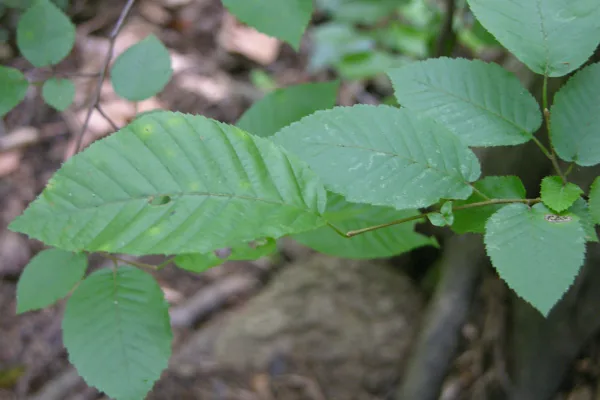
American hornbeam is a small, slow-growing native tree of eastern woodlands that occupies the forest understory, where dappled light beneath a taller canopy suits its shade tolerance. Its defining feature is the bark: smooth, blue-gray, and rippled with muscle-like flutes that gave rise to the common names musclewood and ironwood. Beneath that surface lies some of the hardest, densest wood produced by any North American tree.
The tree carries interest across the seasons. Pendent catkins open in spring, a dense rounded crown fills out through summer, and the foliage shifts to yellow, orange, and red in fall before clusters of winged nutlets ripen and provision the birds. Its restrained mature dimensions make it a practical selection for a shaded lot or a naturalized understory planting.
This species repays patience rather than speed. Growth is slow and demands little once the tree is established, but it will not withstand drought, heat, or soil compaction. Sited on the moist, rich ground it requires, it resists pests, accepts hard pruning, and even establishes near black walnut, whose juglone excludes most competing trees.
Care
The short version: part to full shade suits it best, though it accepts full sun on moist ground. Maintain consistently moist, rich soil, protect it from drought and heat, and otherwise let this low-maintenance native develop on its own slow schedule.
Light
Hornbeam grows best in part to full shade, matching the understory niche it occupies in the wild. It will accept full sun, but only where soil moisture holds steady, since full exposure combined with a dry root zone raises transpiration demand faster than the roots can meet it.
Water
Maintain consistently moist, rich soil, watering on the order of every 5 to 10 days and more often while a young tree is establishing. It tolerates occasional flooding, but it is especially sensitive to drought, so the root zone should not be allowed to dry.
Soil
Plant it in moist, organically rich, well-drained loam, sandy or clay-based, and it will endure ground that floods periodically. It is not exacting about pH, growing across a broad range from 5.0 to 7.5.
Temperature
This cold-hardy native withstands the full span from -40°F to 100°F (-40°C to 38°C). Its limiting factor is not low temperature but heat combined with drought, which strains the water balance.
Humidity
Ambient outdoor humidity is adequate, so no target value applies. Air circulation matters far more, because stagnant, humid air keeps the foliage wet and favors the leaf-spot fungi.
Feeding
In suitable soil the tree needs little supplemental feeding. A balanced slow-release fertilizer in spring, or simply a top-dressing of compost or leaf mulch, supplies what it draws on.
Pruning
As a specimen tree it requires minimal pruning, yet it tolerates shearing and recovers strongly from hard cuts when trained as a hedge or screen. Work it from late summer through mid-winter, outside the period of active sap flow, so the cuts do not bleed.
Repotting
Because it is a landscape tree rather than a container subject, it is rarely repotted. Where a young specimen is held in a pot, pot it on when roots circle, water runs straight through, or new growth stalls.
Size & spacing
Anticipate a tree of 20 to 30 feet (6 to 9 m) in height with a spread of 20 to 35 feet (6 to 10.5 m), so allocate open ground for the rounded crown to develop. Under regular shearing as a hedge it can be maintained far more tightly.
When to plant
Hornbeam grows slowly and resents root disturbance, so timing the operation matters. Plant it in spring to give the root system a full season to extend before summer heat, then expect catkins in spring and clusters of winged nutlets maturing from late summer into fall.
Northern hemisphere
Southern hemisphere
Typical months for a temperate climate: start earlier in warm zones, later where spring frosts linger.
- Plant: spring
- Harvest: Spring (catkins); winged nutlet clusters mature in late summer to fall
Hardiness
USDA hardiness zones: 3–9
Temperature: down to -40°C
Troubleshooting
Hornbeam is notably trouble-free, and most complaints trace to a stressed, water-deprived tree rather than to a serious pathogen. Examine the leaves and twigs for the early signs described below, then intervene before a minor issue advances. Keeping the root zone cool and moist forestalls nearly all of it.
Marginal scorch and wilt under heat and drought
Because hornbeam is especially sensitive to drought, heat, and soil compaction, water loss soon outpaces uptake, and the leaf margins scorch as the crown wilts. A recent transplant, with a root system not yet exploring the soil, reaches that deficit first. Deep watering through dry spells restores the balance, mulch moderates root-zone temperature and moisture, and a spring planting on uncompacted, moist ground gives the roots a full season to extend before summer stress.
Fix:
- Water deeply during dry periods
- Apply organic mulch over the root zone
- Transplant only in spring and avoid compacted sites
Sunken bark cankers with progressive twig dieback
Sunken, cracked bark with dead twigs above it marks canker fungi or twig blight, opportunists that colonize wood whose defenses are already lowered by drought or heat stress. Because the pathogen advances within the vascular tissue, cuts must fall well below the visible lesion, and disinfecting tools between cuts prevents you from inoculating fresh wounds. The durable control is keeping the tree vigorous, since an unstressed hornbeam resists colonization.
Fix:
- Prune out dead and cankered wood well below the lesion
- Disinfect tools between cuts
- Reduce stress by watering during drought and mulching
Dark, angular lesions distributed over the foliage
Defined blotches ringed by darker margins indicate fungal leaf spot, a foliar pathogen that establishes when leaf surfaces hold free moisture and air movement is poor, conditions common in wet seasons. Because infection stays in the leaf tissue, it disfigures but seldom threatens the tree, and defoliation is minor. Removing fallen leaves breaks the reinfection cycle, and an open canopy dries the foliage that the fungus depends on.
Fix:
- Rake and dispose of fallen infected leaves
- Improve air circulation and avoid overhead wetting
- Tolerate minor infections as they rarely harm tree health
Toxicity
For households with animals, the verdict is reassuring: American hornbeam is not toxic. It does not appear on the ASPCA poison lists, and cats, dogs, horses, and livestock can all be around it safely. No hidden compound resides in the leaves, bark, or seeds.
Safe for
People · Cats · Dogs · Horses · Rabbits · Livestock · Birds
Cats None
Hornbeam carries no compound toxic to cats, so an occasional nibbled leaf presents no clinical concern. There is nothing in the tissue to cause poisoning.
Dogs None
The foliage and bark hold no toxin that would poison a dog. A large volume of coarse plant material may produce transient gastric upset through simple irritation, but no toxic effect follows.
Horses Safe
Horses may graze or browse hornbeam without restriction, since no part of the tree is poisonous to equines.
Rabbits Safe
Rabbits can browse the leaves and young twigs without hazard, as the tissue contains nothing harmful to them.
Livestock Safe
Cattle, goats, and sheep can browse the foliage without risk, because hornbeam is not classed as a toxic species.
Birds Safe
Birds consume the winged nutlets as forage, and neither seed nor foliage presents any toxic hazard to them.
People Safe
Hornbeam is non-poisonous to people. No part is grown for eating, yet handling the tree or an incidental taste carries no toxic risk.
No special handling required; as a large landscape tree it is not an indoor or houseplant.
Varieties
Most named hornbeams are selected for crown form or autumn color, and a few European species and cultivars appear wherever a tight, formal screen is required. The following are the selections most often encountered.
'Native Flame'
A selection of American hornbeam valued for consistent scarlet autumn coloration carried on a compact, upright-oval crown.
'Firespire'
A narrow, upright American hornbeam that colors orange-red in autumn and fits confined planting sites.
Carpinus betulus (European hornbeam)
The larger Eurasian species, attaining 40 to 60 feet, planted extensively as a sheared hedge or screen and the source of numerous columnar cultivars.
Carpinus betulus 'Fastigiata'
A columnar to pyramidal European hornbeam long favored for formal street planting and screening.
Carpinus betulus 'Frans Fontaine'
A tightly columnar European hornbeam that retains its narrow, erect habit with age, which recommends it for street use.
Companions
Hornbeam thrives in the shade where many trees struggle, and it tolerates juglone, so it pairs well with woodland plantings and even the difficult ground beneath a black walnut.
Plant near
black walnut (Juglans nigra): American hornbeam tolerates juglone, so it can be planted near black walnut where many trees fail.
woodland shade perennials and ferns: As a shade-tolerant understory tree it pairs well with shade groundcovers for naturalized plantings.
How to propagate
Hornbeam propagates slowly and reluctantly, so nurseries rely on seed and grafting rather than the ready rooting seen in cuttings. Each method calls for time and a measure of technique.
SeedDemanding
Sow fresh nutlets in fall, or stratify for spring sowing · Germinates the spring after maturity; slow to establish
Seed propagation is exacting because the nutlets exhibit double dormancy, requiring a warm phase followed by roughly 18 weeks of cold, moist stratification near 40°F (4°C) before the embryo will respond. Sow fresh seed in fall to let the sequence run outdoors, or replicate the chilling for a spring sowing. Emergence lags until April through June of the following year, and the seedlings establish slowly.
GraftingDemanding
Late winter to early spring · One to two seasons
Named cultivars are propagated by grafting onto seedling rootstock so that clonal habit and autumn color remain true, a union best made from late winter to early spring while the stock is near breaking dormancy. Allow one to two seasons for the graft to knit and the young tree to grow independently.
Stem cuttingsDemanding
Early summer (softwood) · Slow and unreliable
Softwood cuttings collected in early summer root at low, erratic rates, and rooting is slow where it occurs. For that reason most propagators bypass cuttings in favor of seed or grafting.
LayeringModerate
Spring · One or more growing seasons
Layering is the more reliable vegetative method. Pin a low branch into the soil in spring and let it form roots in situ over one or more growing seasons before severing it as an independent plant.
Myths
Hornbeam is called ironwood because the wood holds iron or is poisonous.
The epithets ironwood and musclewood describe two physical traits of the tree: exceptionally hard, dense timber and smooth, sinewy fluted bark resembling flexed muscle. The wood contains no iron and holds nothing toxic to pets.
American hornbeam needs full sun to grow well.
It ranks among the most shade-tolerant trees in cultivation and occupies the forest understory beneath a taller canopy in the wild. It performs in part to full shade and still tolerates full sun where soil moisture is maintained.