Shrub · Betulaceae
Hazelnut
Corylus avellana
Give it full sun, a cross-compatible pollinizer, and room to spread, and the hazel returns a nut crop each autumn.
Full sun
Every 7–14 days
USDA 4–8
12–20 ft · 3.7–6.1 m
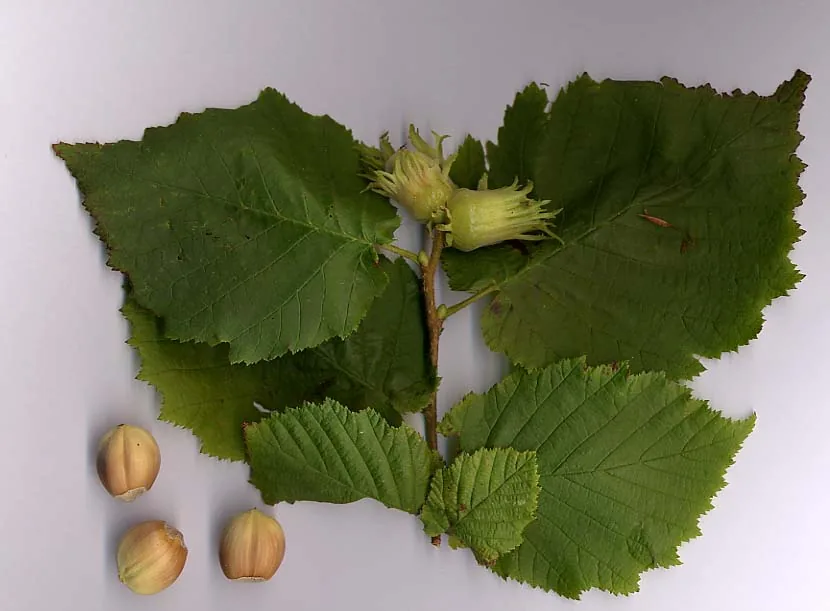
Overview
Corylus avellana is a hardy, multi-stemmed shrub in the birch family, indigenous across Europe and into western Asia. The many common names, cobnut and filbert among them, attach to a plant that earns its place two ways: a dependable autumn crop of edible nuts and a suckering habit well suited to a hedge or orchard margin. Rated for zones 4 to 8, it withstands winter cold that eliminates less hardy trees.
Anthesis precedes leaf-out: pale yellow catkins open on bare branches in late winter and shed pollen to the wind rather than to insects. That anemophily is precisely why an isolated plant seldom fills a crop, since its own pollen will not fertilize its flowers. Most hazels are largely self-incompatible, so a second, cross-compatible cultivar must stand nearby for the female flowers to set nuts.
Managed properly, the shrub is long-lived and undemanding, and two decisions govern the outcome. Selecting blight-resistant cultivars protects the framework wood, while consistent suppression of the suckers that arise from crown and roots holds the intended form. Attend to both and the plant maintains a clean structure for decades.
Care
The short version: site it in full sun and deep, well-drained soil, establish a compatible pollinizer nearby, water through the first few years and dry spells, and prune in late winter while excising suckers and any blight.
Light
Hazelnut fruits most heavily in full sun, because greater light ripens more wood and fills more kernels. It tolerates partial shade and continues to grow there, but reduced light yields a lighter harvest.
Water
Water regularly through the first two or three years while the root system develops, and again during dry spells while the nuts are sizing, since the crop draws on soil moisture then. An established shrub is moderately drought tolerant, yet even moisture consistently improves nut fill. Allow the top half of the soil to dry between waterings.
Soil
Plant in deep, well-drained loam rich in organic matter, although the species tolerates a broad range of soils, including shallow rocky ground. Maintain a pH between 6.0 and 7.5, spanning slightly acidic to slightly alkaline.
Temperature
The species is markedly cold hardy, enduring winter minima near -31°F (-35°C) and summer highs to roughly 95°F (35°C). Its vulnerability is a hard freeze during the late-winter bloom, which can destroy the season's crop before it forms.
Humidity
Ambient outdoor humidity around 40% to 70% is entirely adequate, so no target need be met. Airflow through the canopy matters more, because open growth reduces the leaf wetness that favors fungal disease.
Feeding
Apply fertilizer in early spring before bud break, timing nutrient availability to the coming flush and guiding rates by a soil or leaf test. A nitrogen-rich balanced fertilizer, applied seasonally, sustains vegetative growth and nut fill.
Pruning
Prune in late winter while dormant, removing dead, weak, and crossing wood and thinning to maintain an open center that admits light and air. Excise blight cankers well below the visible stromata, and remove basal suckers routinely to preserve a tree form.
Repotting
As a long-lived landscape and orchard shrub, hazelnut grows in the ground rather than in containers and is seldom repotted. Should a specimen be raised in a pot, pot it on before roots circle, shoot growth stalls, or water drains straight through the medium.
Size & spacing
At maturity the shrub reaches 12 to 20 feet (3.7 to 6 m) in height and 8 to 15 feet (2.4 to 4.5 m) in spread. Allow that clearance from neighboring plants so air circulates freely and the suckers remain accessible for removal.
When to plant
Hazelnut culture follows dormancy. Establish new plants from late fall to early spring while they are dormant, observe the wind-pollinated catkins opening in late winter, and collect the nuts as they ripen and abscise from late summer into early fall.
Northern hemisphere
Southern hemisphere
Typical months for a temperate climate: start earlier in warm zones, later where spring frosts linger.
- Plant: Late fall to early spring while dormant
- Harvest: Wind-pollinated catkins open late winter to early spring; nuts ripen and drop late summer to early fall
Hardiness
USDA hardiness zones: 4–8
Temperature: down to -34°C
Troubleshooting
Most hazelnut disorders present in the wood, the crop, or the flush of shoots at the base. Reading those signs accurately lets you intervene before a minor issue advances. Match the symptom below, then act while intervention remains effective.
Branch dieback with rows of raised black bumps erupting on the bark
Those raised bumps are the stromata of eastern filbert blight, caused by the fungus Anisogramma anomala, which colonizes one to several year old wood and girdles it, killing the branch over a few seasons. Because the pathogen extends beyond the visible canker, cut each infected limb 2 to 3 feet below the lowest one and destroy the wood so it cannot sporulate. Follow that with resistant cultivars and removal of nearby wild hazels, which act as a reservoir of inoculum.
Fix:
- Prune out infected limbs at least 2 to 3 ft below the lowest visible canker and destroy the wood
- Apply protectant fungicides during the spring bud-break infection period
- Replace highly susceptible plantings with resistant cultivars
Abundant catkins yet poor nut set, or shells that prove empty
Since hazelnut is wind-pollinated and largely self-incompatible, a solitary plant will flower heavily and still set almost no nuts, because its own pollen cannot fertilize its female flowers. A hard freeze coinciding with the late-winter bloom compounds the problem by killing catkins or the receptive female flowers. The remedy is a compatible pollinizer whose bloom overlaps the main variety, sited where late frosts are less severe.
Fix:
- Plant at least one cultivar that sheds compatible pollen and overlaps bloom with the main variety
- Site plants where late frosts are less severe
Dense basal and root shoots building into a thicket
Corylus avellana suckers freely from the crown and along its roots, an innate habit that consolidates into a dense thicket where it is left unchecked. Sever the suckers while they are young and soft, repeating the work several times across the growing season before they harden. Mowing or cultivating around the drip line cuts the spreading shoots at the source and keeps the plant to a defined form.
Fix:
- Cut or pull suckers while young, several times per growing season
- Mow or cultivate around the drip line to sever spreading shoots
Toxicity
Reassuring for a household with pets and children: the hazelnut is not poisonous. No part of the plant is listed as toxic, and the ripe kernels are an ordinary food. The only real concerns are the choking hazard posed by whole nuts and the digestive upset their high fat can cause a dog.
Safe for
People · Cats · Dogs · Horses · Rabbits · Livestock · Birds
Cats None
No component of the hazelnut is toxic to cats, so an exploratory bite of leaf or shell carries no poisoning risk.
Dogs None
The tissue of the plant is non-toxic to dogs. The concern lies with the nuts, since a whole nut can obstruct the airway of a small dog and the high fat content can provoke gastrointestinal upset or, in quantity, pancreatitis.
Horses Safe
Neither hazelnut foliage nor its nuts present any poisoning risk to horses.
Rabbits Safe
The foliage and twigs are non-toxic to rabbits, though the high-fat kernels are poorly suited to their diet and are better withheld.
Livestock Safe
Cattle, goats, and sheep can graze in the vicinity of hazelnut with no toxic consequence.
Birds Safe
No part of the plant is harmful to birds, and numerous wild species readily crack and consume the ripe nuts.
People Safe
The ripe kernels are an established food, safe to eat raw or roasted, the exception being anyone with a tree-nut allergy.
Whole nuts are a choking and gastrointestinal obstruction hazard and are high in fat, so large quantities can cause stomach upset and, in dogs, raise the risk of pancreatitis.
Varieties
Named hazels are selected chiefly for blight resistance, kernel quality, or ornamental form. These are the cultivars worth knowing by name.
Jefferson
A blight-resistant OSU release valued in wide plantings for its large, high-quality kernels.
Yamhill
A compact, early-maturing OSU cultivar carrying strong resistance to eastern filbert blight.
Barcelona
A traditional Oregon commercial cultivar that remains highly susceptible to eastern filbert blight.
Contorta
The ornamental Harry Lauder's Walking Stick, selected for its twisted, corkscrew stems and winter interest.
Companions
Plant near
Compatible pollinizer hazelnut cultivar: Supplies overlapping, cross-compatible pollen needed for nut set
Clover or other legume ground cover: Living mulch that fixes nitrogen and suppresses weeds in the orchard floor
Keep apart
Wild or abandoned hazel (Corylus) plants: Act as a reservoir of eastern filbert blight inoculum that infects nearby plantings
How to propagate
Hazelnut responds to several propagation methods, from inducing roots on a low branch to lifting the suckers it produces unprompted. The choice turns on whether an exact clone of a cultivar is required or a seedling will suffice.
LayeringModerate
Late winter to early spring · 1 to 2 years to rooted, separable plants
Mound and simple layering are the standard techniques for cloning a cultivar onto its own roots. Pin or mound soil over the low shoots in late winter to early spring; the covered stems form adventitious roots over the following 1 to 2 years, after which they are severed as independent plants.
DivisionEasy
Dormant season, late fall to early spring · 1 season
The most direct method exploits the suckers the shrub produces regardless. Lift the rooted basal suckers from an established clump during the dormant season, late fall to early spring, and transplant them; they establish within a single season.
GraftingDemanding
Late winter on dormant rootstock · 1 to 2 years
Grafting unites a named cultivar with a selected rootstock and demands practiced technique. Perform the union in late winter on dormant rootstock; the graft then requires 1 to 2 years to develop into a reliable, productive plant.
SeedModerate
Sow outdoors in fall or stratify cold and moist for 2 to 3 months · Several years to bearing
Seed propagation is straightforward but does not reproduce the parent, because seedlings do not come true to cultivar. Sow outdoors in fall, or supply 2 to 3 months of cold, moist stratification beforehand; either way, expect several years of growth before the plant reaches bearing age.
Myths
A single hazelnut bush will reliably crop on its own.
Because Corylus avellana is wind-pollinated and largely self-incompatible, an isolated plant generally sets little or no fruit, as its pollen cannot fertilize its own flowers. A separate compatible pollinizer cultivar nearby is required to obtain a genuine crop of nuts.
Hazelnut plants are poisonous to cats and dogs.
The species is absent from the ASPCA toxic list, and its foliage and nuts do not poison pets. The genuine hazards are airway obstruction from a whole nut and gastrointestinal upset from the high fat, rather than any toxic principle.