Tree · Betulaceae
Paper Birch
Betula papyrifera
Give it a cool, moist root run and paper birch holds its brilliant white bark for decades.
Full sun
Every 3–7 days
USDA 2–7
50–70 ft · 15.2–21.3 m
Overview
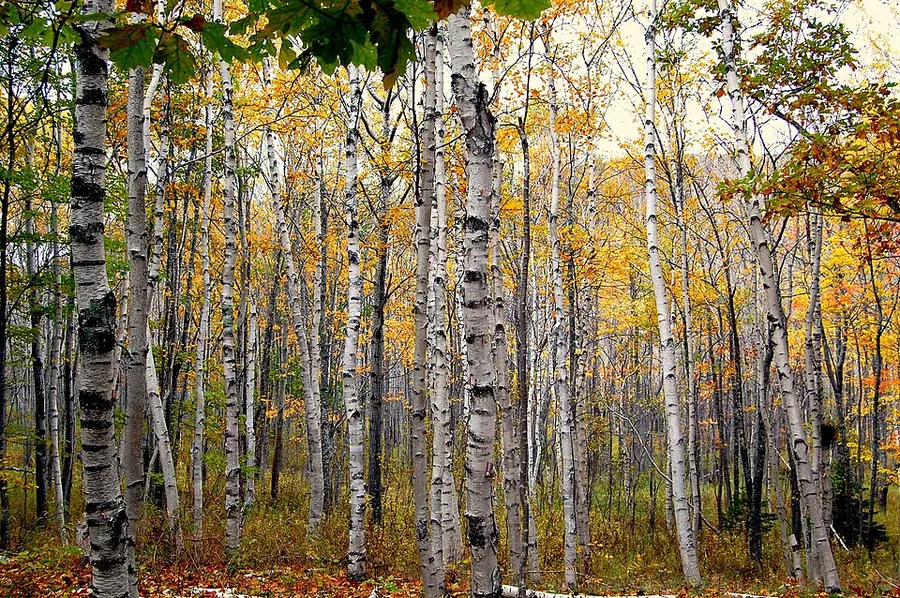
The paper birch reads unmistakably in a winter landscape, its bright white bark separating into thin papery curls as the trunk expands. It is a fast-growing pioneer native to the far north, transcontinental in range through the cold woods of Canada and the northern states. That papery bark is waterproof and structurally sound, the property Indigenous peoples exploited to sheathe canoes, and the source of the common name canoe birch.
Adaptation to cold defines its physiology: it withstands severe winters yet loses vigor where summers turn hot and dry. Growth is rapid, commonly to 50 to 70 feet (15 to 21 meters), but longevity is modest, with height growth ceasing after several decades rather than extending over centuries. On a cool, moist site the tree performs to type; placed in a hot urban lot, it enters premature decline.
One factor governs the outcome more than any other: the bronze birch borer, an insect that selects trees already under stress. Keeping the roots cool, the soil moist, and the canopy vigorous removes the physiological opening the borer depends on, which is the substance of growing the species well.
Care
The short version: full sun, cool and evenly moist slightly acidic soil, a deep mulch layer to insulate the roots, and consistent water through heat and drought, which together maintain the vigor that excludes the borer.
Light
Paper birch requires full sun and does not persist in shade, a consequence of its ecology as a pioneer that colonizes open clearings. It accepts limited partial sun, but light directly governs bark quality and overall vigor, so more is better.
Water
Hold the soil cool and evenly moist, since the species has little tolerance for drying. Water deeply through heat and drought and mulch to insulate the root run, because drought stress is precisely the condition that opens the tree to the bronze birch borer. Dry, compacted ground is incompatible with its physiology.
Soil
Provide moist, well-drained, sandy or silty loam on the acidic side. A pH held between 5.0 and 6.5 supports normal function; above that range iron uptake falls and the foliage yellows with chlorosis.
Temperature
Cold hardiness is a defining trait, and the tree tolerates winter minima to -49°F (-45°C) without injury. The constraint lies at the warm end, where physiological stress sets in once summer temperatures exceed roughly 86°F (30°C).
Humidity
Ambient outdoor humidity is adequate, so no target percentage applies. The operative factor is air movement through the canopy, which shortens leaf wetness periods and suppresses the leaf-spot fungi during wet seasons.
Feeding
A balanced tree fertilizer in spring sustains the vigor that constitutes the tree's primary defense against the borer. Continue seasonally as needed to maintain that condition.
Pruning
Confine pruning to summer through early fall and avoid late winter and early spring, when severed vessels bleed sap heavily under root pressure. Remove dead and borer-infested wood on detection.
Repotting
not applicable - landscape tree
Size & spacing
This is a large tree, attaining 50 to 70 feet (15 to 21 meters) in height with a spread near 30 to 35 feet (9 to 11 meters). Allocate open space and a position where the root zone remains cool and shaded.
When to plant
Paper birch is a cold-climate species that performs best in the northern zones where summers remain mild. Plant during the cool weather of spring or fall to limit transplant stress, and expect the pendulous catkins to open in spring, roughly April to May.
Northern hemisphere
Southern hemisphere
Typical months for a temperate climate: start earlier in warm zones, later where spring frosts linger.
- Plant: Spring or fall
- Harvest: Catkins in spring (April to May)
Hardiness
USDA hardiness zones: 2–7
Temperature: down to -46°C
Troubleshooting
Most disorders of paper birch resolve to underlying stress and the pests that exploit a weakened tree. Inspect the crown and foliage across the season and intervene early, since the most consequential decline begins inconspicuously at the top of the canopy.
Progressive top-down crown decline paired with D-shaped exit holes
Progressive dieback from the crown down, paired with D-shaped exit holes, is the signature of the bronze birch borer, the most serious pest of this species. The larvae mine the cambium and phloem beneath the bark, severing the vascular tissue that carries water upward, which is why the top of the tree fails first. Since the grubs establish only where the tree is already weakened by heat or drought, the durable control is sustained vigor: cool roots, steady moisture, and prompt removal of infested wood.
Fix:
- Prune out and destroy infested and dead branches
- Reduce stress by watering deeply and mulching to cool the roots
- Apply a registered insecticide when adults are active in June
- Maintain tree vigor; larvae do not survive in healthy trees
Brown foliar lesions appearing by midsummer with premature defoliation
Foliar spotting and blotching that emerges by July indicates Marssonina leaf spot and anthracnose, fungal pathogens whose spores germinate and spread under prolonged leaf wetness and can defoliate the tree by late summer. Removing and destroying fallen leaves interrupts the overwintering inoculum, while thinning the canopy shortens the drying time that the spores exploit. Defoliation of this kind is a temporary drain on reserves, so a vigorous tree refoliates normally the following spring.
Fix:
- Rake and destroy fallen infected leaves
- Improve air circulation and avoid overhead wetting
- Keep tree vigorous with proper watering and mulch
Chlorotic leaf patches maturing into brown blotch mines
Pale patches that mature into brown blotch mines are the feeding tracks of the birch leafminer, whose larvae develop between the upper and lower leaf surfaces. Backlighting a leaf about ten days after bud break reveals the larvae inside the kidney-shaped mines, which is the window when treatment still reaches them. Because the tissue lost is a small fraction of a healthy canopy, the damage stays largely cosmetic and a well-hydrated tree absorbs it without decline.
Fix:
- Treat with a registered systemic insecticide when larvae first hatch and begin feeding
- No control is needed once large brown blotches appear, as larvae have already left
Distorted, chlorotic foliage bearing sticky honeydew
Puckering, distortion, and a glaze of honeydew trace to aphids drawing sap from the expanding new growth, which deforms the leaf as it hardens off. Light populations do not measurably affect tree health, and the predatory insects such as lady beetles that follow the colony usually bring it down without intervention. A dense colony is dislodged with a firm jet of water, which is enough to reset the balance.
Fix:
- Tolerate light infestations, as natural predators usually provide control
- Wash off heavy infestations with a strong stream of water
Toxicity
For a household with pets or grazing animals, the record is reassuring: paper birch is not toxic to any of them. No toxic principle is present in the leaves, bark, twigs, or sap, and the spring sap is in fact tapped and reduced into birch syrup. The most a sampled portion produces is a mild, self-limiting gastric upset.
Safe for
People · Cats · Dogs · Horses · Rabbits · Livestock · Birds
Cats None
No compound in paper birch is toxic to cats. A sampled leaf may provoke transient drooling or a mild gastric upset, the nonspecific response to any indigestible plant matter, and that marks the limit of the effect.
Dogs None
Paper birch presents no toxic hazard to dogs. Chewed bark or a dropped branch will not poison one, though a large volume of leafy material can produce a day of loose stool through simple mechanical irritation.
Horses Safe
Paper birch is safe for horses, and the foliage and twigs are browsed at times with no ill effect. The tissue contains no equine toxin, so its presence on pasture or along a paddock fence poses no concern.
Rabbits Safe
Rabbits may gnaw the bark and twigs without risk. Wild rabbits and hares routinely strip young birch through winter, which confirms the absence of any toxic principle for them.
Livestock Safe
Cattle, goats, and sheep browse paper birch without harm. Neither the foliage nor the bark carries a toxin, so an animal reaching the lower branches is at no risk.
Birds Safe
Paper birch is entirely safe for birds. Many species in fact rely on it, consuming the catkin seed and the insects sheltered in the bark, and the tree presents no hazard to them.
People Safe
Paper birch is safe for people, with no poisonous tissue. The spring sap is tapped and reduced by boiling into birch syrup, following the same principle as maple sap.
No special handling required; ingestion of plant material may still cause mild stomach upset in pets.
Varieties
The wild species accounts for most landscape planting, but a small number of named selections are distinguished by bark quality and site tolerance.
Renaissance Reflection
A selection valued for bright white bark and greater vigor, carrying improved resistance to the bronze birch borer relative to the wild type.
Varen (Prairie Dream)
A cold-hardy selection with bold white bark, developed to perform in the harsh, exposed conditions of far northern sites.
How to propagate
Propagation of paper birch is almost entirely by seed, since vegetative cuttings perform poorly.
SeedModerate
Sow in fall or after cold stratification in spring · 1 to 2 growing seasons
Seed is the standard propagation method for paper birch. Sow the fine seed in fall, or cold-stratify it and sow in spring, onto exposed, moist mineral soil in the light the small seed requires to germinate. Allow the seedling one to two growing seasons to establish a working root system.
Stem cuttingsDemanding
Summer (softwood) · Variable; often unreliable
Cuttings are a poor propagation route for paper birch. Softwood material taken in summer roots at low rates and gives unreliable at best results, which is why the trade relies on seed.
Myths
Paper birch proves as undemanding across any planting site as river birch.
These two birches are not horticulturally interchangeable. Paper birch is markedly more susceptible to the bronze birch borer than river birch and is adapted to a cold climate. Sited in a hot, dry, or compacted urban lot, it declines and dies young, whereas river birch tolerates that same heat load.