Tree · Betulaceae
River Birch
Betula nigra
Sited in acidic, consistently moist soil under full sun, river birch grows fast and develops its signature peeling, cinnamon bark.
Full sun
Every 3–7 days
USDA 4–9
40–70 ft · 12.2–21.3 m
Overview
Betula nigra is the birch adapted to conditions that defeat the others. As a native of stream banks and floodplains through the eastern United States, its roots evolved to function in saturated ground, tolerating flooding and periodic inundation that would suffocate most species. That physiology explains why it establishes fast on heavy clay and wet sites where white-barked birches decline.
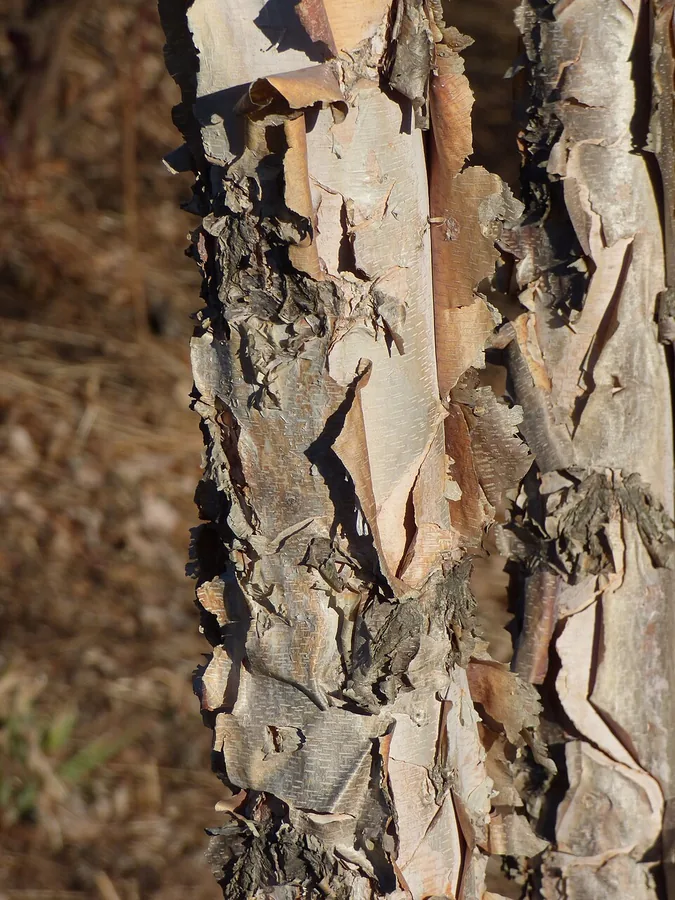
Its defining feature is the exfoliating bark. On young trunks the outer layers peel into papery curls of salmon, cinnamon, and cream, and as the tree ages those plates thicken, darken, and grow ragged. Mature specimens exceed 40 feet and are frequently grown as multi-stemmed clumps, a form that displays the bark from several trunks at once.
Its landscape value rests on more than color. River birch is the most disease-free birch and carries the strongest resistance to the bronze birch borer, the pest that kills stressed white-barked birches, which makes it the reliable choice for fast shade. Given acidic soil and a cool, moist root zone, its maintenance demands drop to almost nothing.
Care
The short version: full sun, acidic soil held moist to wet, and consistent water through establishment. Mulch to insulate the roots, confine pruning to summer or fall, and allow generous spacing for the mature canopy.
Light
River birch performs best in full sun, though it tolerates partial shade. Higher light drives denser crown development and intensifies bark color, so an open exposure produces the strongest specimen.
Water
The species demands moist to wet, acidic soil and withstands outright flooding, but it drops interior leaves under summer drought to reduce water loss. Soaker hoses paired with bark mulch stabilize root-zone moisture and temperature, which is the condition it is adapted to.
Soil
Plant it in moist to wet, acidic soil, loam, sand, or clay, since it tolerates poor drainage that excludes less adapted trees. Maintain a pH of 5.0 to 6.5, because higher pH restricts iron uptake and yellows the foliage.
Temperature
River birch is hardy across a wide thermal range, from -29°F to 100°F (-34°C to 38°C). That tolerance corresponds to zones 4 through 9, covering most of the temperate United States.
Humidity
Atmospheric humidity is not a limiting factor for this species; ambient outdoor air suffices. Its water requirement is at the root zone, not the canopy, so soil moisture governs its condition.
Feeding
Apply a balanced fertilizer or compost in spring, though fertile soils rarely require any input. Limit the nitrogen, because the flush of soft growth it produces is what draws aphids.
Pruning
River birch needs minimal pruning, and timing is the critical variable. Cut only in summer or fall; in late winter and spring rising sap pressure forces the wounds to bleed heavily.
Repotting
This is a landscape tree, not a container subject, so it seldom remains potted. When a nursery specimen shows circling roots or stalled growth, transplant it, because prolonged confinement deforms the root system.
Size & spacing
Growth is rapid, reaching 40 to 70 feet (12 to 21 m) in height with a 40 to 60 feet (12 to 18 m) spread at maturity. Site it clear of foundations and pavement and allow the full canopy width, since the roots run shallow and wide.
When to plant
River birch is hardy through zones 4 to 9 and transplants best in spring or fall, when mild temperatures reduce moisture stress on new roots. The yellow-brown catkins emerge in April and May, before the foliage expands.
Northern hemisphere
Southern hemisphere
Typical months for a temperate climate: start earlier in warm zones, later where spring frosts linger.
- Plant: Spring or fall
- Harvest: April to May (catkins)
Hardiness
USDA hardiness zones: 4–9
Temperature: down to -34°C
Troubleshooting
Most disorders in river birch derive from two variables: soil pH, which governs nutrient uptake, and pruning date, which determines sap pressure at the cut. Reading the early symptoms lets you correct the cause rather than chase the symptom. Identify the sign below, then treat the underlying condition.
Interveinal yellowing with green veins
This pattern is iron chlorosis, caused when soil pH rises high enough to lock iron out of solution and beyond the reach of the roots. Correct the substrate: elemental sulfur lowers the pH, chelated iron restores the deficient element, and mulch sustains the moist, acidic conditions the tree requires. Because Betula nigra retains chlorophyll only on the acid side, alkaline and limed sites should be avoided at planting.
Fix:
- Acidify soil with elemental sulfur to lower pH
- Apply chelated iron to soil or as foliar spray
- Mulch and keep soil moist and acidic
Distorted leaves with honeydew
The cause is aphids colonizing the leaf undersides, and the sticky honeydew they excrete confirms them. A strong water jet dislodges the colony first, and insecticidal soap or horticultural oil treats any that persist. Predators such as lady beetles suppress the remainder, so restrict nitrogen and maintain steady irrigation to limit the soft growth that sustains successive generations.
Fix:
- Spray plants with a strong jet of water
- Apply insecticidal soap or horticultural oil
- Encourage beneficial predators such as lady beetles
Foliar spotting with premature drop
Extended wet weather favors fungal leaf spot, which can force early defoliation but seldom causes lasting injury. Remove and destroy the fallen infected leaves to break the cycle, prune for airflow through the canopy, and keep irrigation off the foliage. As the most disease-free birch, the species usually needs only a resistant cultivar and good sanitation.
Fix:
- Rake and remove fallen infected leaves
- Improve air circulation
- Avoid overhead watering
Continuous sap flow from cuts
Cuts made in late winter or early spring weep persistently because the tree is bleeding sap under the rising pressure of spring flow. The loss is harmless to a healthy tree, and sealants will not stop it. Suspend pruning until the canopy has leafed out and the wounds callus on their own, then confine all future cuts to summer or fall.
Fix:
- Stop pruning until summer or fall
- Allow cuts to seal naturally without sealant
Toxicity
River birch presents no toxicological hazard. No part, whether foliage, bark, twig, or seed, contains a compound poisonous to animals or people, so incidental ingestion carries no risk. It is safe around pets, livestock, and children.
Safe for
People · Cats · Dogs · Horses · Rabbits · Livestock · Birds
Cats None
Betula nigra is non-toxic to cats; a leaf or twig taken in play or curiosity produces no poisoning.
Dogs None
Dogs may chew the bark or fallen twigs without consequence, as the tree contains no compound toxic to them.
Horses Safe
Horses browsing near a river birch face no risk, since neither the foliage nor the bark holds a toxin.
Rabbits Safe
Rabbits gnawing bark or young shoots are unaffected, because the species carries nothing harmful to them.
Livestock Safe
Cattle, goats, and sheep can browse the foliage safely; the tree is not poisonous to grazing stock.
Birds Safe
Birds consume the small seeds from the catkins without hazard, and the tree poses them no problem.
People Safe
The species presents no poisoning risk to people, including children who handle the bark or leaves.
No special handling required for toxicity; this is a large landscape tree, not a houseplant.
Varieties
Breeders have selected named cultivars for improved bark, restrained size, or greater heat tolerance. The following account for most nursery stock and represent the traits worth comparing.
Heritage ('Cully')
A vigorous, borer-resistant selection whose salmon-cream to brown outer bark exfoliates to expose a creamy white inner layer.
Dura-Heat ('BNMTF')
A compact cultivar of 30 to 40 feet bearing creamy white bark, with superior tolerance of summer heat and disease.
Summer Cascade
The pendulous form, its branches arching and cascading toward the ground.
How to propagate
River birch propagates by seed or by softwood cuttings, each on its own timeline. The methods below explain the technique and the establishment period to expect from each.
SeedModerate
Collect and sow seed in late spring after catkins ripen · 1 to 2 growing seasons
Seed is the standard means of raising river birch. Collect it in late spring as the catkins ripen and sow it fresh onto a moist substrate, since viability declines quickly in storage. Expect 1 to 2 growing seasons for the seedling to establish before transplanting.
Stem cuttingsModerate
Early summer using softwood cuttings · Several weeks to root, one season to establish
Softwood cuttings taken in early summer and rooted under mist offer an alternative. The cuttings need several weeks to root and a full season to establish, so the method demands more time than seed.
Myths
The bronze birch borer kills every birch, so river birch is equally vulnerable to it.
River birch in fact holds the highest borer resistance of any birch and withstands the bronze birch borer that kills stressed white-barked species. For a birch that resists the borer, this is the species to select.