Tree · Anacardiaceae
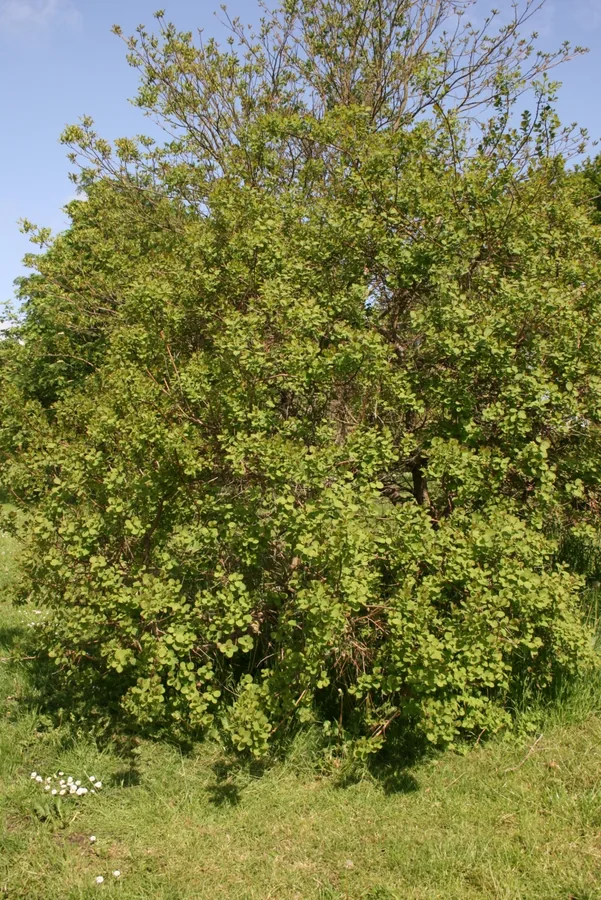
American Smoketree (Tree Form)
Cotinus obovatus
Grown on poor, dry ground in full sun, the American smoketree produces its hazy summer plumes and its strongest fall color.
Full sun
Every 7–21 days
USDA 4–8
20–30 ft · 6.1–9.1 m
Overview
Cotinus obovatus, the American smoketree, takes its common name from the feathery, smoke-like panicles that hover over the canopy in early summer. Trained as a single-trunk specimen it reaches 20 to 30 feet (6 to 9 m), a larger and more upright habit than the familiar European smokebush. As a member of the Anacardiaceae alongside cashews and sumacs, it carries that family's tolerance for sites where more demanding species fail.
Its defining trait is low demand. Once the root system establishes, drought tolerance carries it through dry spells, and it colonizes poor, dry, rocky, and alkaline limestone soils while enduring cold to -29°F (-34°C). Lean ground actually favors the grower, since high fertility reduces both flowering and fall color, so the poorer the soil, the stronger the seasonal display.
Growth is slow, but the tree returns its investment twice each season, first through the early-summer haze of bloom and then through foliage that turns orange, red, and purple before leaf drop. Full sun and sharp drainage are the two conditions that matter most, and where both are met the tree performs reliably for decades.
Care
The short version: full sun and lean, well-drained soil, with regular water only during establishment. After that the tree is self-sufficient in drought, wants minimal or no fertilizer, and needs only light structural pruning.
Light
Site the tree in full sun, the exposure under which it flowers most heavily and develops the strongest fall color. It tolerates partial sun and light shade, but reduced light directly reduces both the smoke display and autumn pigmentation, so shade is a compromise rather than a preference.
Water
During establishment, irrigate young trees on a regular cycle, roughly every 7 to 21 days according to weather, until the root system is self-supporting. Thereafter the tree is drought tolerant and needs supplemental water only in prolonged dry periods. Avoid saturated soil, because excess moisture is the condition that predisposes the tree to disease.
Soil
The tree performs best in lean, well-drained soil and adapts to poor, dry, rocky, clay, and alkaline limestone ground that limits less tolerant species. It accepts a wide pH range of 5.5 to 8.5, which is broad enough that amendment is rarely warranted.
Temperature
Cold hardiness and heat tolerance span -29°F to 100°F (-34°C to 38°C), a range that covers most temperate climates. This breadth of tolerance is a principal reason the species performs dependably across diverse regions.
Humidity
No specific humidity level is required, as ambient outdoor conditions suffice. What governs foliar health instead is air circulation and soil that dries between waterings, because stagnant, humid conditions favor the leaf spot and rust fungi that disfigure foliage.
Feeding
Fertilize minimally or not at all, since the species is adapted to infertile ground. Excess nutrients reduce both flowering and fall color, so any feeding should be light and applied in spring.
Pruning
Prune sparingly, confining work to late winter or early spring for shaping, removal of dead or crossing wood, and training to a single trunk. Keep cuts light, because the inflorescences develop on the previous season's wood, and heavy pruning removes the flowering wood that produces the smoke.
Repotting
Repotting is seldom relevant, as the tree is best sited permanently in the ground. Where a young plant is container-grown, pot up only when roots circle the container edge or emerge from the drainage holes, the standard indicators that root volume has become limiting.
Size & spacing
As a tree it attains 20 to 30 feet (6 to 9 m) in height with a comparable spread. Allow that much clearance from structures and neighboring trees so the crown can develop fully and air can move through the canopy, which also limits foliar disease.
When to plant
Plant during dormancy or its approach, in spring or fall, so roots can extend before summer heat or winter cold imposes stress. Flowering runs May to June, the smoky effect persists through summer, and the foliar color develops as temperatures drop in autumn.
Northern hemisphere
Southern hemisphere
Typical months for a temperate climate: start earlier in warm zones, later where spring frosts linger.
- Plant: spring or fall
- Harvest: May to June, with the smoky display persisting through summer
Hardiness
USDA hardiness zones: 4–8
Temperature: down to -34°C
Troubleshooting
This is a low-maintenance tree whose few problems nearly always originate in excess soil moisture or plant stress. Monitor branches and foliage for the two disorders below and intervene early, since response is most effective before symptoms advance.
Progressive branch wilt and dieback in sections
The likely cause is verticillium wilt, a soilborne fungus that invades and occludes the water-conducting tissue, cutting off water movement to whole branches. Confirmation comes from dark vascular streaking exposed when an affected limb is cut. Because no curative treatment exists, prune well below the visible symptoms, sustain vigor with water during drought, and refrain from replanting a susceptible species in the same infested ground.
Fix:
- Prune out and destroy affected branches well below symptoms
- Keep the tree vigorous with appropriate water during drought
- Do not replant susceptible species in confirmed infested soil
Discrete leaf spots and orange rust pustules
These are leaf spot and rust fungi, which appear predominantly on trees already under stress. The effect is cosmetic and seldom warrants intervention. Remove and dispose of fallen leaves, thin the canopy to improve air movement, and correct the underlying stressor, whether drought or a poorly drained, wet site.
Fix:
- Rake and remove fallen infected leaves
- Improve air circulation and avoid overhead watering
- Reduce plant stress with proper siting and watering
Toxicity
For animal-keeping households the record is reassuring: American smoketree is not toxic to pets or people and does not appear on ASPCA poison lists. The one qualification concerns the sap, which, consistent with its sumac relatives, carries urushiol-type compounds that can irritate sensitive skin, so gloves are advisable when pruning.
Safe for
People · Cats · Dogs · Horses · Rabbits · Livestock · Birds
Cats None
A cat may browse the foliage without toxic effect, as the tree contains no compounds harmful to felines.
Dogs None
Dogs are unaffected by the tree, and ingestion of a leaf or twig produces no poisoning.
Horses Safe
Horses grazing in proximity are at no risk from this species.
Rabbits Safe
The foliage contains nothing injurious to rabbits.
Livestock Safe
Cattle, goats, and sheep may occupy the same pasture without hazard.
Birds Safe
Birds using the branches for perching or foraging encounter no risk.
People Safe
The tree presents no poisoning risk to people; the sap alone may irritate sensitive skin, so pruning is best done with gloves.
The plant is in the Anacardiaceae (cashew/sumac) family, and its sap contains urushiol-type compounds that may cause mild contact dermatitis in sensitive people; wear gloves when pruning. This does not affect pet toxicity rating.
Varieties
The genus divides into the larger American native and the more ornamental European species and their hybrids. The three below are the forms most often available and most readily trained to a single trunk.
Cotinus obovatus (American smoketree, species)
The species itself is the largest and most tree-like of the group, distinguished by pronounced orange-red-purple autumn color and unusual adaptability to dry, rocky, alkaline soils.
Cotinus coggygria 'Royal Purple'
'Royal Purple' is a purple-foliaged European selection whose leaves intensify to a near-black maroon; typically multi-stemmed, it can nonetheless be trained to a single-trunk small tree.
Cotinus x 'Grace'
'Grace' is a vigorous interspecific hybrid of the European and American species, notable for large purple-red leaves and prominent pink inflorescences, and it is amenable to training as a small tree.
How to propagate
Propagation proceeds by seed, by softwood cuttings, or by layering, and the appropriate method follows from the goal: the wild species reproduces from seed, while named cultivars require cuttings to remain true.
SeedModerate
Fall (sow outdoors) or stratify for spring · 1-2 growing seasons
Seed propagation is workable but slow. The seed is dormant and requires cold stratification, achieved either by sowing outdoors in fall or by chilling for a spring start, which raises germination. Seed-grown plants of the species come true to type and take one to two growing seasons to establish.
Stem cuttingsModerate
Early to mid summer (softwood) · Several weeks to root, then 1-2 seasons
Softwood cuttings, taken in early to midsummer and rooted under mist, form roots within several weeks and then require another season or two to establish. This is the necessary method for named cultivars, as only vegetative propagation preserves their identity.
LayeringEasy
Spring · 1 growing season or more
Layering is the least demanding technique. A low branch pinned to the soil in spring will root in place over a growing season or more, after which it is severed and grown on as an independent plant.
Myths
Because it belongs with poison ivy and poison sumac, the smoketree must be dangerously toxic too.
Shared ancestry does not confer shared toxicity. Cotinus is not classified as toxic to pets and is absent from the ASPCA lists. The only genuine hazard is dermal: the sap can irritate sensitive skin, which is why gloves are recommended for pruning.
American smoketree performs best in rich, fertile, consistently moist soil.
The requirement is the reverse. The species is adapted to well-drained, infertile ground, withstands drought, and reaches its best condition on poor, dry, rocky, and alkaline sites. Supplying abundant water and fertilizer suppresses the flowering and fall color it is grown for.