Tree · Anacardiaceae
Cashew
Anacardium occidentale
A tropical tree that pays out twice over, cashew apple and nut, as long as its roots stay warm, sunny, and well drained.
Full sun
Every 7–14 days
USDA 10–13
20–39 ft · 6–12 m
Overview
A fast-growing tropical tree in Anacardiaceae, the same family as poison ivy and mango, native to the warm lowlands of Brazil and now grown across the frost-free tropics. It needs sustained heat and has no tolerance for cold, surviving only in the warmest zones outside the reach of frost. Given room, it builds a broad, spreading canopy and can pass 40 feet (12 m) tall with a width to match.
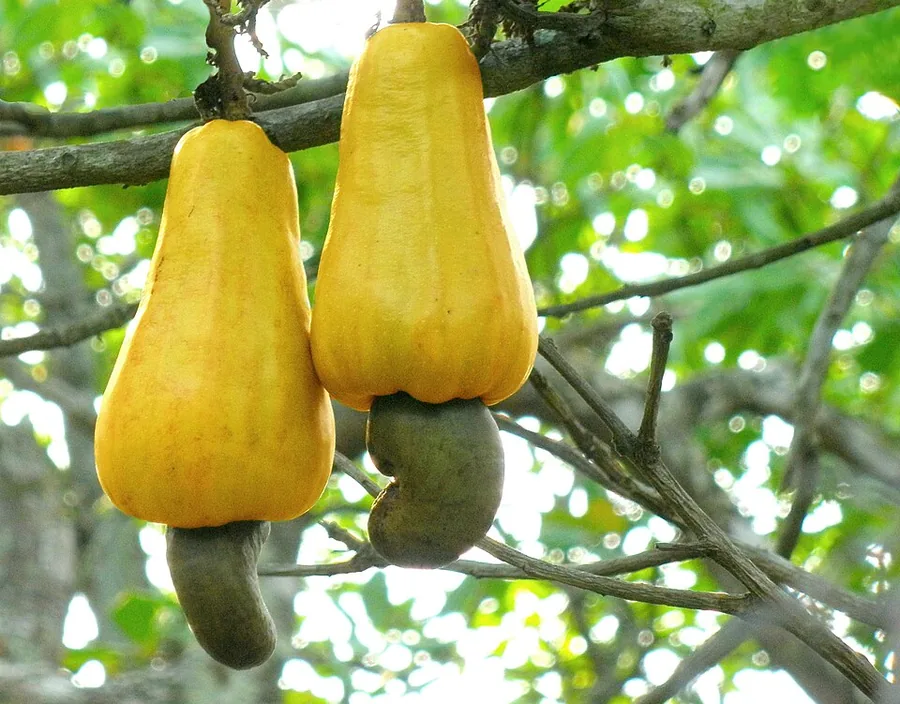
The reproductive parts are widely misread. That fleshy red or yellow body is the cashew apple, a swollen pedicel rather than the true fruit, while the kidney-shaped nut forms on the outside below it. The nut is the crop, but its shell holds a caustic oil that heat must drive off before the kernel is fit to eat.
For all its size, an established cashew asks little. It grows on poor sandy ground that would stall fussier trees and turns notably drought tolerant after the early years. Its one weakness is waterlogging, so drainage matters more than fertility from the day you plant.
Care
The short version: give it full sun and deep sandy soil that drains fast, water steadily only while the tree is young, and keep it warm and frost-free. Once it matures, pull back on water and feeding, and never let the roots sit in saturated ground.
Light
Cashew is a full sun tree and crops poorly in shade, because flowering and nut set both run on high light. Set it in an open spot with nothing overtopping the canopy, so light reaches the wood that carries the crop.
Water
Water young trees often to settle the root system, then cut back hard, because a mature cashew is highly drought tolerant and cannot abide saturated soil. Let the top half of the profile dry between waterings, on the order of every 7 to 14 days, and lean toward too little rather than too much.
Soil
Plant into deep, well-drained sandy or sandy-loam soil, including the poor, low-fertility ground that defeats more demanding trees. Aim for a pH of 5.0 to 6.5; fast drainage is the deciding factor, far ahead of soil richness.
Temperature
As a strictly tropical species it works from 50°F to 104°F (10°C to 40°C) and is killed outright by frost. Keep it to tropical or frost-free subtropical climates where cold never reaches damaging levels.
Humidity
Cashew is at home in humid air, roughly 50% to 80%, in keeping with its tropical roots. Even so, hold the canopy open so leaves dry fast, because lingering leaf wetness invites fungal infection.
Feeding
Apply a balanced NPK carrying nitrogen, phosphorus, and potassium through the warm growing season, and add zinc where soils run short of it. One seasonal application covers the needs of this low-demand tree.
Pruning
Train young trees to a single strong leader, then take out dead, diseased, crossing, and low limbs. Opening the canopy improves air movement and shortens the time leaves stay wet, which is the main cultural control for cashew's fungal diseases.
Repotting
Field trees stay put for good, while container specimens need potting up every 2 to 3 years. Roots circling the pot, water running straight through, and growth that has stalled all tell you the plant has gone rootbound.
Size & spacing
A standard cashew grows into a broad tree of 20 to 40 feet (6 to 12 m) tall and nearly as wide, so it needs generous room. Place it well clear of buildings, paths, and power lines, since the canopy can reach 33 feet (10 m) across.
When to plant
Cashew runs on tropical seasons, not a temperate calendar. Sow nuts in nursery bags roughly two months before you transplant, move young trees out once the soil has warmed and frost risk has passed, and look for flowering in the dry season with nuts and apples filling out several months on.
Northern hemisphere
Southern hemisphere
Typical months for a temperate climate: start earlier in warm zones, later where spring frosts linger.
- Sow: Seeds sown in nursery bags 2 to 3 months before transplanting in warm climates
- Plant: After all frost danger when soil is warm; tropical and frost-free subtropical regions only
- Harvest: Flowers in dry season; nuts and cashew apples harvested several months later, typically late dry season
Hardiness
USDA hardiness zones: 10–13
Temperature: down to -1°C
Troubleshooting
Almost every cashew problem shows up first on the new flushes, the inflorescences, or the roots, and the trigger is usually humidity or surplus moisture. Catch it early with a fungicide or better drainage and most cases reverse. Match the symptom you see below, then act before it spreads through the canopy.
Black sunken lesions on leaves and shoots, with twig dieback
Those merging dark lesions are anthracnose, caused by Colletotrichum gloeosporioides, which takes hold when warm weather lines up with long spells of wetness on young flushes and inflorescences. Cut out and destroy infected shoots, open the canopy to shorten leaf wetness, and run a labeled fungicide through the vulnerable flushing and flowering period. Wide spacing and keeping water off the foliage hold back most of the infection.
Fix:
- Prune and destroy infected shoots
- Improve canopy air circulation
- Apply a labeled fungicide during susceptible flushing and flowering
Wilting and leaf scorch in saturated soil
Wilting with poor fruit set in heavy, waterlogged ground is root rot from waterlogging, not drought, and you will see the roots discolored. The trouble usually follows heavy irrigation or standing water. Improve drainage, ease off on watering, and on heavy soils set the tree on a raised mound. Since mature trees ride out dry spells, it is sustained root saturation that does the damage.
Fix:
- Improve drainage
- Reduce irrigation
- Plant on mounds in heavy soils
Grayish-white powdery coating on flowers and young nuts
A powdery white film on the panicles and small nuts points to powdery mildew, Oidium anacardii, which settles on soft flushes and inflorescences during cool, dry flowering weather. Left alone it drops flowers and small nuts and cuts the yield. Apply sulfur or a labeled fungicide at flowering, strip out the worst-hit panicles, and keep the canopy open.
Fix:
- Apply sulfur or a labeled fungicide at flowering
- Remove badly affected panicles
Toxicity
The roasted, shelled kernel is a safe and familiar food; the raw nut is not. The shell and the lining around the kernel hold a caustic oil, cashew nut shell liquid (CNSL), loaded with the same urushiol found in poison ivy, and it burns skin and mucous membranes on contact. Store raw shells, husks, sap, and prunings out of reach of children and pets, and handle them only with gloves.
Toxic to
Cats · Dogs · Horses · Rabbits · Livestock · Birds
Safe for
People
Cats Caution
The high-fat kernel brings on drooling, vomiting, and loose stools, and contact with a raw shell can cause caustic burns to the mouth from CNSL. Keep both the kernels and the shells out of a cat's reach.
Dogs Caution
Small amounts of nuts usually trigger vomiting and diarrhea, while a larger helping of the fatty kernel can bring on pancreatitis. Chewing a raw shell adds urushiol burns to the mouth and skin.
Horses Caution
Keep horses away from raw shells, sap, and prunings, since the urushiol that injures human skin can blister the equine lips and mouth. Clear fallen shells and trimmings from any paddock.
Rabbits Caution
The caustic shell oil and the dense, fatty kernel are both wrong for a rabbit's gut. Offer neither, and watch for soft stools or a drop in appetite if one gets at dropped shells.
Livestock Caution
Cattle, goats, and sheep can take oral burns from the raw shell liquid and digestive upset from the oily kernels. Fence stock away from the tree and clear shell waste after harvest.
Birds Caution
Hold raw shells and husks back from backyard birds, since the irritant oil burns soft tissue. An odd crumb of plain roasted kernel does no harm, though the fat brings no benefit.
People Roasted nuts safe
Properly roasted and shelled cashews are wholesome and safe to eat. The raw nut and its shell are another matter, carrying the same urushiol as poison ivy and burning skin and mouth, which is why unprocessed material should be neither handled nor eaten.
Wear gloves when handling raw shells, husks or sap; never let people or pets contact or chew unprocessed nuts. Roasting in the open can release irritant fumes.
Helpline numbers

United States
ASPCA Animal Poison Control: (888) 426-4435 (fee applies)

United Kingdom
Animal PoisonLine: 01202 509000 (fee applies)

Australia
Animal Poisons Helpline: 1300 869 738
Varieties
Cashew selections sort mainly by height and time to first crop, and two broad classes cover most of what is grown.
Common (medium/tall) cashew
The common medium to tall cashew is the traditional plantation tree, a broad spreading form that reaches 12 m or more and is comparatively slow to start bearing.
Dwarf precocious cashew (e.g. anao precoce types)
Dwarf precocious cashews, such as anao precoce types, are compact selections that flower and fruit within a few years and stay small enough for close spacing and easy picking.
How to propagate
Cashew is grown from fresh seed or cloned vegetatively, and the method you pick decides how soon it bears and how true it stays to the parent.
SeedEasy
Sow fresh viable nuts in the warm season · Germinates in 2 to 3 weeks; bears in about 3 years
Seed propagation. Sow fresh, viable nuts in the warm season, keeping only those that sink in water, with germination in 2 to 3 weeks. Sow in place or in bags, because the developing taproot resents disturbance once it has formed. Seedlings vary genetically, and a seedling tree takes about 3 years to start bearing.
GraftingModerate
Onto vigorous seedling rootstock in warm conditions · Bears in roughly 2 to 3 years
Grafting. Grafting a chosen clone onto vigorous seedling rootstock under warm conditions gives uniform, earlier-cropping trees. Softwood, cleft, or veneer grafts are standard, and the finished tree bears in roughly 2 to 3 years.
Air layeringModerate
Warm humid growing season · Several weeks to root before severing
Air-layering. Air-layering during the warm, humid growing season produces a clone of the parent. The wrapped stem needs several weeks to root before you sever it, and the method sees far less use than grafting at commercial scale.
Myths
Cashews labeled raw are truly raw, and any nut pulled off the tree is edible.
Cashews sold as raw have in fact been steamed or otherwise heat-treated and shelled before they reach the shelf. A nut taken straight off the tree still carries caustic shell oil with urushiol and anacardic acid that burn skin and mouth. No cashew is safe to handle or eat until it has been roasted and processed.
The fleshy red or yellow cashew apple is the fruit, and the nut grows inside it.
The cashew apple is not the true fruit but a swollen pedicel, an accessory fruit formed below the flower. The true fruit is the kidney-shaped nut carried on the outside below the apple, not enclosed within it.