Shrub · Anacardiaceae
Smoke Bush
Cotinus coggygria
Site it in full sun with sharp drainage, and Cotinus coggygria answers with summer haze and strong fall color.
Full sun
Every 7–14 days
USDA 4–8
10–15 ft · 3–4.6 m
Overview
Smoke bush, Cotinus coggygria, is a fast-growing deciduous member of the Anacardiaceae, the cashew and sumac family. Its vigor reads in the mature dimensions, 10 to 15 feet (3 to 4.5 m) in both height and spread, which is why its final scale should govern placement from the start. Because it is adapted to lean, sharply drained ground, an established plant carries drought well while resenting wet soil.
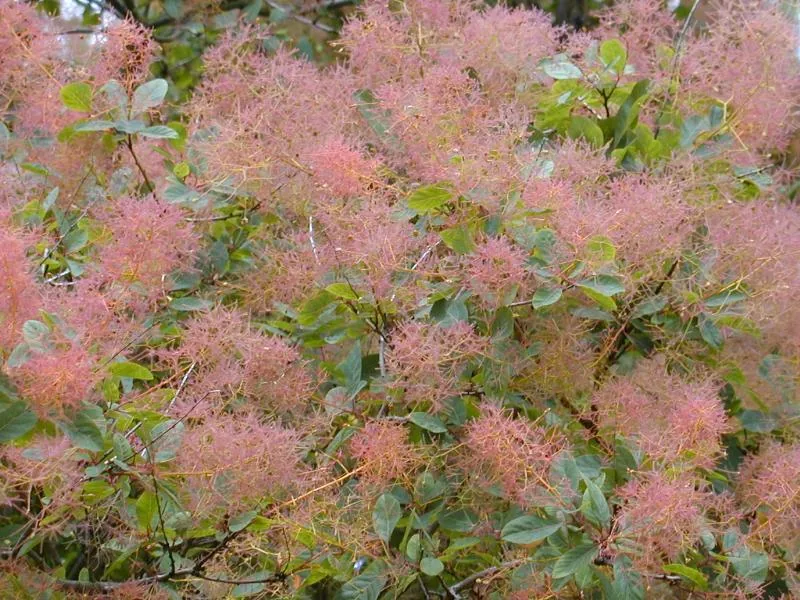
The ornamental appeal is chiefly foliar and inflorescent. Leaf color ranges from green to a near-black purple by cultivar, and most forms develop orange and red pigmentation in autumn as chlorophyll breaks down. The signature haze is not floral tissue but the elongated pedicels of spent flowers, which extend into fine hairs that read as smoke among the branches.
Culturally it asks little. Full sun, infertile soil, and sharp drainage meet its needs, while rich ground works against it by forcing soft, leggy growth. The single hard limit is standing water, which drowns the roots and invites rot, so waterlogged sites stay off the list.
Care
The short version: full sun, average to poor soil, and sharp drainage, with deep watering limited to the establishment phase. After that the plant manages drought unaided, seldom requires fertilizer, and needs only the pruning regime that matches your goal of smoke or foliage color.
Light
Site it in full sun, which drives both the deepest foliar pigment and the fullest smoke. Partial sun is tolerated, but reduced light thins the haze and pushes purple cultivars back toward green, since strong light is what develops that purple pigment.
Water
Maintain even moisture during establishment, when the young root system cannot yet buffer dry spells. Once settled the plant is drought tolerant and performs best on deep, infrequent irrigation every 7 to 14 days. Waterlogged, poorly drained ground is the primary killer, as saturated soil rots the roots.
Soil
This species is adapted to lean substrates. Average, well-drained loam suffices, and it succeeds in poor, rocky soil that would starve more demanding shrubs. It tolerates a broad pH of 5.5 to 8.0, but drainage is the non-negotiable factor, because its roots will not withstand prolonged saturation.
Temperature
Cold hardiness is considerable, with a working range of -29°F to 95°F (-34°C to 35°C) spanning deep winter cold and summer heat. That breadth explains its reliability across the temperate zone, where few seasonal extremes fall outside its limits.
Humidity
Ambient outdoor humidity is adequate, so no target range applies. Air circulation is the more consequential variable, since still, humid air around dense foliage favors the spores of leaf spot and rust.
Feeding
Fertility requirements are minimal. A single light spring application of balanced fertilizer covers the rare case that needs it, and most plants need none, because excess nutrients drive weak, leggy extension growth at the expense of form on a shrub adapted to infertile soil.
Pruning
Pruning strategy follows the flowering wood. Because the inflorescences form on old wood, only light early-spring pruning preserves the smoke. To maximize foliage color on purple cultivars, coppice hard in late winter to 6 to 8 inches, which forfeits that season's bloom but forces vigorous, well-pigmented new shoots.
Repotting
As a landscape shrub it is seldom containerized, so repotting rarely applies. In a pot, up-size only when the roots circle the container or water passes through with little uptake, both indicating the root mass has exhausted the available volume.
Size & spacing
Account for the mature footprint when siting. A grown specimen occupies 10 to 15 feet (3 to 4.5 m) in height and spread, so allow that clearance from paths, structures, and neighboring plants at installation to avoid later crowding or repeated cutting back.
When to plant
Rated for zones 4 to 8, smoke bush is planted in spring or fall once hard frost has cleared, giving roots a moderate window to establish before temperature extremes. The inflorescences open May to July, and the smoke effect develops afterward as the spent pedicels elongate through late spring and summer.
Northern hemisphere
Southern hemisphere
Typical months for a temperate climate: start earlier in warm zones, later where spring frosts linger.
- Plant: Spring or fall, after the last hard frost
- Harvest: Smoke display from late spring through summer (flowers May to July)
Hardiness
USDA hardiness zones: 4–8
Temperature: down to -34°C
Troubleshooting
Vigorous smoke bushes present few disorders, and the ones that appear are diagnosable by pattern. One-sided branch collapse points to a vascular pathogen, while foliar spotting points to a fungal one. Read the branches and leaves, then confirm before you act.
One-sided branch dieback and vascular streaking
This pattern indicates verticillium wilt, a soil-borne fungus that colonizes the xylem and occludes water movement, so foliage yellows and individual limbs collapse, often on one side. A cut through an affected stem reveals dark vascular streaking beneath the bark, which confirms the diagnosis. No fungicide cures the infection, so management is sanitary: excise dead wood, disinfect tools between cuts, and remove a heavily infected plant rather than replant a susceptible species on the same site.
Fix:
- Prune out and destroy affected branches, disinfecting tools between cuts
- Improve drainage and avoid overwatering
- Remove and destroy severely infected plants; do not replant susceptible species in the same spot
Encrusted scale colonies on woody stems
The gray-to-brown crusts on the bark are San Jose scale, armored sap-feeders that shelter beneath a waxy test and draw down stem vigor, sometimes to the point of dieback. A test scrapes free, distinguishing it from bark texture. Prune out heavily colonized wood and apply a dormant horticultural oil in late winter, which smothers the overwintering stages before spring activity resumes.
Fix:
- Prune out and destroy heavily infested branches
- Apply dormant horticultural oil in late winter to smother overwintering scale
Defined leaf spots and rust pustules
Persistent leaf wetness and poor air movement favor fungal leaf spot and rust, which produce discrete lesions and orange-brown pustules on the leaf undersides. The damage is cosmetic and seldom threatens an established shrub. Remove and dispose of fallen leaves to break the infection cycle, improve airflow, and keep the canopy dry.
Fix:
- Rake up and dispose of fallen infected leaves
- Improve air circulation and avoid overhead watering
Toxicity
For households with animals, the profile is favorable: smoke bush carries no recognized toxicity and is absent from the ASPCA's poison lists. The relevant hazard is dermatological, not systemic, because as an Anacardiaceae member its sap can provoke contact dermatitis in people sensitized to poison ivy, which is why gloves are advised at pruning.
Safe for
People · Cats · Dogs · Horses · Rabbits · Livestock · Birds
Cats None
Cotinus coggygria is absent from the ASPCA toxic-plant listing, so ingestion by a cat presents no expected systemic toxicity.
Dogs None
Dogs face no documented toxic principle in this species, whether from browsing the foliage or incidental contact.
Horses Safe
No case of equine poisoning has been attributed to smoke bush, indicating negligible risk from grazing.
Rabbits Safe
Rabbits browsing the lower stems encounter no toxic constituent, so the shrub poses no ingestion hazard to them.
Livestock Safe
Cattle, goats, and sheep may graze in proximity without exposure to any poisoning risk from the plant.
Birds Safe
Birds nesting or foraging on the shrub are unaffected by its foliage, stems, or the plumose seed heads.
People Safe
The plant is systemically non-toxic to people, though sap contact can elicit mild dermatitis in individuals sensitized to poison ivy, hence gloves during pruning.
As a member of the Anacardiaceae (cashew and sumac family), contact with the sap may cause mild contact dermatitis in sensitive people, especially those allergic to poison ivy. Wear gloves when pruning if you are sensitive.
Varieties
The trade sells smoke bush almost entirely as named cultivars, selected for foliage pigment or the density of the inflorescent display. The following are the forms most often encountered.
Royal Purple
A compact purple selection whose foliage emerges maroon-red and matures to a near-black purple that resists fading through the summer.
Golden Spirit ('Ancot')
A golden-yellow cultivar that develops orange and red tones in autumn, distinct from the standard green and purple forms.
Young Lady
A compact green-leaved form valued for prolific smoky panicles borne even on young plants.
Velvet Cloak
A larger dark-purple cultivar carrying sizable pink panicles and capable of reaching the upper end of the size range.
How to propagate
Propagation follows three routes, but only vegetative methods preserve cultivar identity, since named selections do not reproduce true from seed. Layering is the most reliable for a small number of plants because the shoot roots while still attached to the parent.
Stem cuttingsModerate
Early to mid summer · Several weeks to root; a full season to establish
Root softwood or semi-hardwood cuttings taken from current-season growth in early to mid summer, when the wood is at the right stage of maturity. Rooting takes several weeks, and full establishment a complete growing season.
LayeringEasy
Spring to early summer · One growing season or more to root
Layering is the most dependable method, done in spring or early summer. A low, flexible branch is pinned to the soil and roots there over a growing season or more, drawing on the parent until severed, which raises the success rate over detached cuttings.
SeedModerate
Fall sowing or after cold stratification · Slow; seedlings of cultivars will not come true to type
Seed suits the species rather than cultivars, sown in fall or after cold stratification to break dormancy. Germination is slow, and because cultivars do not come true from seed, propagate named selections vegetatively.
Myths
The smoke is composed of the plant's flowers.
The flowers themselves are small and yellowish, of little visual weight. The display comes from the elongated pedicels of spent blooms, which extend into fine plumose hairs that color from smoky pink to purplish pink over the summer.
Annual hard pruning yields the heaviest smoke.
Since the inflorescences arise on old wood, cutting the plant back each year removes the very growth that would flower. Late-winter coppicing therefore trades smoke for foliage color for that season, the standard reason purple cultivars are managed for leaves rather than bloom.