Tree · Anacardiaceae
Mango
Mangifera indica
Supply warmth, direct sun, and sharply drained soil, and a mango rewards a warm-climate garden with months of ripening fruit.
Full sun
Every 7–14 days
USDA 10–11
10–49 ft · 3–15 m
Overview
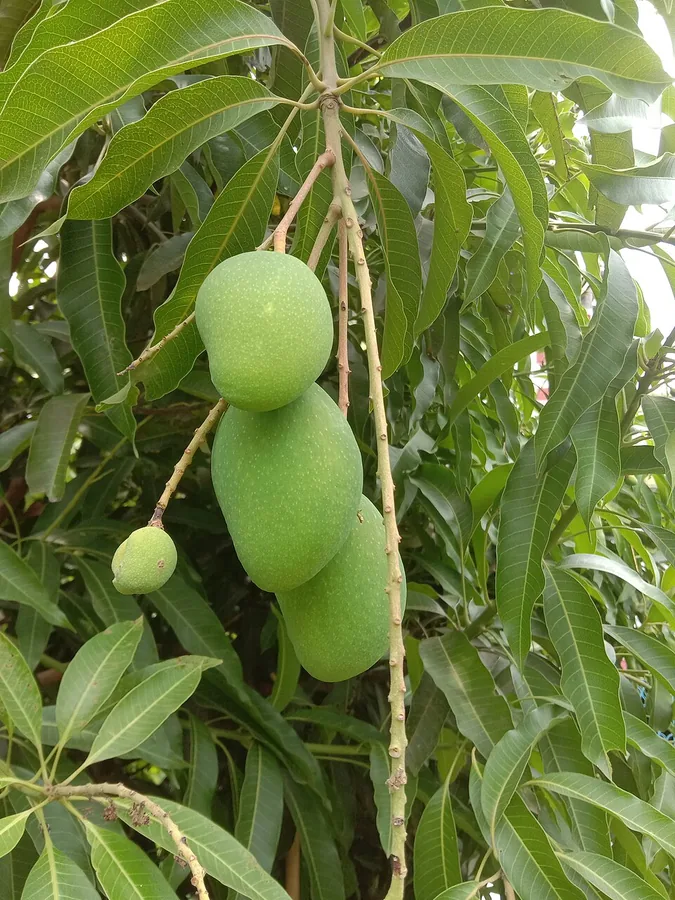
Mango ranks among the great tropical fruit trees, a large, long-lived evergreen that attains 10 to 50 feet (3 to 15 m) with a canopy nearly matching its height. Its leathery, persistent foliage stays on the tree year-round because there is no cold season to trigger leaf drop, and flowering falls in the cool months, with fruit maturing through the warmth of late spring and summer. Given a suitable climate it functions as a permanent framework planting, a single specimen that structures a garden for decades.
The tree's requirements follow directly from its tropical origin. It is rated for USDA zones 10 and 11, demands full sun to fuel the photosynthesis behind vigorous growth and flowering, and needs freely draining soil, since saturated roots exclude oxygen and are among the few conditions that will kill it. A young tree depends on consistent water to establish its root system, whereas a mature tree draws on deep roots to tolerate drought and even reads the cool dry period before flowering as the physiological signal to bloom.
Propagation choice determines both trueness and time to fruit. A grafted named cultivar reproduces the parent exactly and bears within a few years, while a seedling from a saved seed can take the better part of a decade and segregate into something quite different. The flesh is edible and worth growing for, but the tree belongs to the poison-ivy family, so the skin, sap, and leaves carry an allergen that calls for careful handling.
Care
The short version: full sun and genuine warmth, deep well-drained soil, and consistent water for a young tree that you taper as it matures. Feed through the growing season, prune after harvest to keep the canopy open, and never allow the roots to stand in water.
Light
Mango requires full sun, essentially all the light a day provides. It will tolerate some partial sun, but light drives the photosynthesis behind vigorous growth and heavy flowering, so a shaded tree blooms poorly and sets little fruit.
Water
Water a young tree deeply and regularly while it establishes, because a developing root system cannot yet buffer against drought; taper off as the tree matures and its deep roots take over. Withholding water during the cool dry spell before flowering imposes the mild stress that triggers bloom, after which watering resumes as fruit develops. The one intolerable condition is waterlogged soil, which starves the roots of oxygen.
Soil
Provide deep, well-drained loam or sandy loam. Mango accepts a wide range of soils but not constant wetness, and a pH of 5.5 to 7.5 keeps the key nutrients in a plant-available form.
Temperature
As a tropical tree it grows across a broad warm band, roughly 32°F to 104°F (0°C to 40°C), but it has no frost hardiness. A freeze kills young trees and flowers directly, which is why cultivation is confined to zones 10 and 11.
Humidity
Mango prefers the air on the humid side, around 50% to 80%, consistent with its tropical origin. The caveat is that damp, still air at bloom is precisely what favors fungal infection, so airflow matters as much as ambient moisture.
Feeding
Feed through spring and summer while the tree is in active growth and fruiting, using a balanced fertilizer with micronutrients. A mature tree benefits from nitrogen plus periodic iron, zinc, and manganese, particularly on alkaline soils where those micronutrients become less available.
Pruning
Prune after harvest to contain height, remove dead or crossing branches, and open the canopy so light and air penetrate the interior, which also reduces disease pressure. Tip-pruning a young tree establishes a sound branch framework early. Wear gloves, since the sap can irritate skin.
Repotting
A container or dwarf mango needs fresh soil every 2 to 3 years, with light root-pruning to renew the root zone. Roots circling the pot or emerging from the drainage holes, rapid drying after watering, and stalled new growth all indicate the tree has outgrown its container.
Size & spacing
A standard mango is a large tree, reaching 10 to 50 feet (3 to 15 m) tall with a spread of 10 to 40 feet (3 to 12 m). Allow generous room, well clear of buildings, pavement, and overhead lines, or select a dwarf cultivar where space is limited.
When to plant
Mango's schedule reflects a tropical, not a temperate, life cycle. The tree flowers in winter to early spring, sets fruit that ripens from late spring through summer, and is planted in spring once frost has passed and the soil has warmed enough for root activity. Where the climate is mild and frost-free, these windows behave as a physiological rhythm rather than fixed calendar dates.
Northern hemisphere
Southern hemisphere
Typical months for a temperate climate: start earlier in warm zones, later where spring frosts linger.
- Sow: fresh seed started under warmth in spring (seedlings vary; grafted cultivars preferred)
- Plant: spring after all danger of frost has passed and soil is warm
- Harvest: flowers in winter to early spring; fruit ripens late spring through summer
Hardiness
USDA hardiness zones: 10–11
Temperature: down to -1°C
Troubleshooting
Nearly all mango problems concentrate at bloom, because that is when moisture and fungal activity determine how much fruit the tree can retain. Reading the panicles and young fruitlets accurately lets you intervene before a disorder becomes crop loss. Match the symptom below to the cause, then act while intervention still changes the outcome.
Dark necrotic lesions on panicles, fruitlets, and foliage
Blackened panicles and dark, tear-stained streaks on the fruit are the signature of anthracnose, driven by a fungus that sporulates and infects in the warm, wet conditions that coincide with bloom. Because free moisture on the flower is what lets spores germinate, the disease directly suppresses fruit set and rots developing fruit. Pruning to open the canopy speeds drying, keeping water off the flowers denies the fungus that film of moisture, and clearing infected debris removes the inoculum that starts the next cycle.
Fix:
- Improve air circulation by pruning
- Apply protective fungicides during flowering and fruit set per label
- Remove and destroy infected plant debris
White mildew coating over panicles and developing fruit
A white, powdery film on the panicles indicates powdery mildew, a fungus whose spores are favored by cool nights and dry days across the bloom period. It colonizes flower and fruitlet surfaces and interferes with tissue development, so the coated organs blacken and abscise before they can set. Because the pathogen advances during flowering, a protective sulfur or labeled fungicide applied at the earliest sign, before symptoms spread, is the point at which control is still possible.
Fix:
- Apply sulfur or labeled fungicides at early bloom
- Repeat applications during flowering as needed
Abundant flowering followed by minimal fruit retention
A heavy bloom that fails to hold fruit usually traces to cool, wet, or cloudy weather during flowering, which limits pollinator activity and pollen viability while raising disease pressure, so most fruitlets abort. A second driver is alternate bearing, in which a tree that carried a heavy crop depletes its reserves and rests the following year. Managing disease through bloom protects the flowers that do set, balanced fertility without excess nitrogen keeps the tree in reproductive rather than vegetative mode, and accepting the off-year works with the tree's own cycle.
Fix:
- Ensure disease control during bloom
- Maintain balanced fertility and avoid excess nitrogen
- Be patient through off-years of alternate bearing
Toxicity
The ripe flesh is edible and safe for people, but the rest of the plant deserves respect for a specific reason. Mango sits in the same family as poison ivy, so the skin, sap, and leaves contain urushiol, the allergen that provokes an itchy contact rash on sensitized skin. With animals the greater risk is mechanical: the large pit is a genuine choking and obstruction hazard, so stones, peels, and prunings should be kept out of reach.
Toxic to
Cats · Dogs · Horses · Rabbits · Livestock · Birds
Safe for
People
Cats Caution
A small lick of ripe flesh poses no real risk to a cat, since the toxin sits elsewhere. The urushiol in the sap and peel is a contact irritant that can inflame skin and the lining of the mouth. The controlling hazard is mechanical rather than chemical: the pit is too large to pass and can obstruct the gut, so keep stones and trimmings inaccessible.
Dogs Caution
Dogs tolerate small amounts of the sweet flesh without incident, because the edible portion carries no significant toxin. Chewing the peel or sap exposes the mouth to irritating urushiol, producing soreness and itching. The serious risk is the hard pit, which can choke a dog or lodge in the intestine as an obstruction.
Horses Caution
A horse handles a small portion of peeled fruit without harm, as the flesh itself is benign. The peel and leaves hold irritating urushiol compounds that can inflame contact tissue, and the intact pit presents a genuine choking hazard, so restrict offerings to small, pitted, peeled pieces.
Rabbits Caution
A rabbit can process only a thin sliver of ripe flesh occasionally, because the sugar load strains a hindgut fermenter. The peel and leaves carry the family's irritating resins and should be withheld, and the pit must be kept entirely out of reach.
Livestock Caution
Goats, sheep, and cattle typically browse fallen fruit without major effect, though the urushiol in peel and leaves can irritate contact surfaces. Overconsumption of windfalls causes digestive upset, and whole pits represent a choking and obstruction risk that warrants fencing.
Birds Caution
Many birds consume ripe flesh readily, and a small quantity is well tolerated. The peel, sap, and leaves carry irritating compounds and should be excluded, and pits should be removed so a bird cannot become physically trapped by one.
People Flesh safe
The ripe flesh is edible and safe for people. The relevant allergen is urushiol, the same compound as in poison ivy, concentrated in the skin, sap, and resin, which can provoke an itchy contact rash in sensitized individuals. Peel with care, wear gloves if your skin reacts, and keep the sap off bare hands.
Mango is in the Anacardiaceae (cashew and poison-ivy family); the sap, peel, and leaves contain urushiol-related compounds (mangol) that can cause contact dermatitis in sensitive people, much like poison ivy. Wear gloves when pruning or peeling, and avoid skin contact with trimmings. The large hard seed/pit is a choking and intestinal-obstruction hazard if swallowed by pets.
Helpline numbers

United States
ASPCA Animal Poison Control: (888) 426-4435 (fee applies)
Poison Control: (800) 222-1222



Canada
Poison Centres: 1-844-764-7669
Varieties
Hundreds of mango cultivars exist, ranging from commercial workhorses to esteemed dessert selections. The following are the names a grower is most likely to encounter.
Tommy Atkins
The dominant commercial cultivar worldwide, favored for firm flesh, good disease resistance, and the durability to withstand shipping.
Kent
A late-season selection valued for fresh eating on account of its sweet, nearly fiberless flesh.
Haden
A historic Florida cultivar noted for colorful fruit but predisposed to anthracnose and inclined to alternate bearing.
Alphonso
The renowned Indian dessert cultivar, esteemed for rich, aromatic flesh yet notably frost-sensitive.
Keitt
A large, late-ripening cultivar with nearly fiberless flesh that holds on the tree well past most others.
How to propagate
Mango can be started several ways, and the method governs how soon it fruits and how faithfully it reproduces the parent. Grafting and air-layering deliver a known, earlier-bearing clone, whereas seed is the simplest but slowest and least predictable route.
GraftingModerate
Warm season when bark slips and rootstocks are actively growing · Grafted trees commonly begin fruiting in about 3-4 years
Grafting is the standard commercial method, uniting a veneer or cleft scion with seedling rootstock during the warm season, when the bark slips and the actively growing cambium favors a successful union. Because the scion is mature clonal wood, the resulting tree comes true to type and reaches bearing in roughly 3 to 4 years, well ahead of a seedling.
Air layeringModerate
Warm growing season · Roots form over several weeks to a few months before severing
Air-layering induces a chosen branch to root while still attached to the parent, producing a clone on its own roots. Performed in the warm growing season, the wrapped section develops roots over several weeks to a few months before it is severed, though it is used less routinely than grafting.
SeedEasy
Sow fresh seed promptly in spring as viability is short · Seedlings can take 5-8 years or more to fruit and may not be true to type
Seed is the simplest method but the least predictable, and because mango seed is recalcitrant with short viability, it must be sown fresh in spring. Expect 5 to 8 years or more to first fruit, with the outcome depending on embryony: polyembryonic seeds frequently produce nucellar clones of the parent, while monoembryonic seeds yield variable hybrids.
Myths
Because the fruit can be eaten, the plant carries no risk on contact.
Mango is a member of the poison-ivy family, and its sap, peel, and leaves contain urushiol-related compounds capable of inducing an itchy contact rash in sensitized people. The flesh is safe to eat, but the peel and the vegetative parts warrant careful handling.
A seedling raised from saved mango seed reproduces the parent exactly and bears quickly.
A monoembryonic seed produces a genetically variable seedling that may need many years to fruit, so the result can differ markedly from the parent fruit. Grafted named cultivars come true to type and reach bearing far sooner, whereas polyembryonic seeds can yield nucellar seedlings that clone the parent.