Tree · Anacardiaceae
Pistachio
Pistacia vera
Give it hot, dry summers and a male tree nearby, and the pistachio repays the wait with split-shell nuts.
Full sun
Every 10–21 days
USDA 7–11
20–30 ft · 6–9 m
Overview
Pistachio is a long-lived nut tree native to the arid uplands of western Asia and a member of the same family as the cashew and the mango. Its growth is slow, building over many years into a broad, spreading crown that attains 20 to 30 feet (6 to 9 m) in both height and width. The horizon for this tree is measured in decades rather than seasons.
The defining trait is its dioecious habit: male and female flowers are borne on separate trees. A female tree bears the nuts but remains barren unless a male tree blooms nearby and the wind delivers pollen to its flowers. Provision for both from the outset, or the result is a well-formed tree that never yields.
Its climate requirements are equally specific. Pistachio is adapted to hot, dry summers, real winter chill, and low humidity, the regime of California's Central Valley and the Mediterranean. Sited in damp, mild air it exchanges a nut crop for fungal blight.
Care
The short version: full sun, deep but infrequent irrigation, and a dry canopy in alkaline, well-drained soil. Establish a male near the females, fertilize through the growing season, and supply the hot summers and winter chill the species requires.
Light
Pistachio requires full sun and tolerates no shade whatsoever. The tree depends on the full daily light budget and the accompanying heat to ripen a complete crop, so it belongs in the most open, sun-exposed position available.
Water
Irrigate deeply but infrequently, saturating the root zone every 10 to 21 days and allowing the upper half of the profile to dry between events. The tree is drought-tolerant once established, and holding the canopy dry while tapering water toward harvest is what keeps blight in check.
Soil
Plant in deep, well-drained sandy loam to loam, ideally alkaline at a pH of 7.0 to 8.0. Pistachio tolerates calcareous and moderately saline ground without difficulty, but it will not withstand waterlogging, which is lethal to the roots.
Temperature
The tree endures a wide thermal range, from roughly 14°F (-10°C) in winter to 109°F (43°C) in summer. Both extremes are functional requirements: the winter chill breaks dormancy and the summer heat is needed to fill the developing nuts.
Humidity
Pistachio is suited to dry air, around 20% to 50% humidity. Damp, muggy conditions are precisely what Alternaria and Botryosphaeria blights exploit, so adequate spacing and a dry canopy outweigh any other humidity consideration.
Feeding
Fertilize through spring and summer with nitrogen plus potassium, zinc, and boron, applied in split doses rather than a single application. The micronutrients are significant here, because zinc and boron deficiencies are common in orchard soils.
Pruning
Prune in the dormant winter, training young trees to an open vase or modified central leader. Remove rootstock suckers and water sprouts below the graft union, then thin and head shoots to renew fruiting wood and temper the alternating heavy and light bearing.
Repotting
Not container-grown; field/orchard tree planted in the ground
Size & spacing
At maturity pistachio reaches 20 to 30 feet (6 to 9 m) in height and an equal spread. Allocate that full footprint of open ground from planting, since the canopy relies on the resulting airflow to remain dry and disease-free.
When to plant
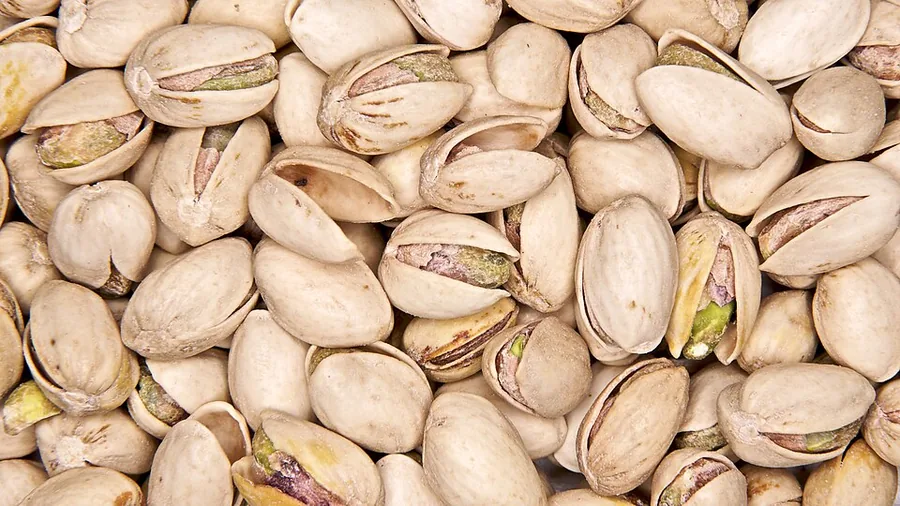
Pistachio follows a slow seasonal cycle. Establish dormant grafted trees in late winter to early spring once hard frost has passed, expect the petalless bloom in spring, and harvest the nuts from late August into October as the hulls loosen and the shells split.
Northern hemisphere
Southern hemisphere
Typical months for a temperate climate: start earlier in warm zones, later where spring frosts linger.
- Plant: Late winter to early spring, as dormant grafted nursery trees, after hard frost danger passes
- Harvest: Blooms early to mid spring (wind-pollinated, no petals); nuts harvested late August through October when the hulls loosen and split and separate from the shell
Hardiness
USDA hardiness zones: 7–11
Temperature: down to -18°C
Troubleshooting
Most pistachio disorders resolve to one of two causes: a soil or canopy fungus, or a failure of pollination. Recognizing the early signatures on wood, foliage, and shells allows intervention before the season is compromised. Match the symptom below, then act on it.
Asymmetric wilt and dieback confined to one flank
The pattern points to Verticillium wilt, caused by the soilborne fungus Verticillium dahliae. It enters through the roots and colonizes the xylem, and because it plugs those water-conducting vessels the canopy above a blocked sector wilts while unaffected sides stay turgid. A cut branch reveals brown vascular streaking, typically one-sided. No fungicide reaches the pathogen inside the wood, so the working defense is a resistant rootstock such as UCB-1 and avoiding ground that previously carried cotton, tomato, or pepper.
Fix:
- Plant on resistant rootstock such as Pistacia integerrima (PGII) or UCB-1
- Remove and destroy severely affected trees
- Avoid replanting into heavily infested soil
Shoot lesions and panicle blight from a rain-borne fungus
These are the signs of Botryosphaeria blight, driven by Botryosphaeria and Neofusicoccum species. The inoculum disperses in rain and overhead irrigation water, which is why infection intensifies in wet years and where sprinklers wet the canopy. Blighted shoots and mummified nut panicles become studded with the fungus's black fruiting bodies. Control follows the epidemiology: remove and burn infected wood to cut inoculum, lower sprinkler heads to keep the canopy dry, and apply a strobilurin fungicide at bloom and ahead of rain.
Fix:
- Prune out and destroy blighted shoots and mummified panicles
- Apply strobilurin fungicides starting at bloom and before rain events
- Lower sprinklers and shorten irrigation duration to keep the canopy dry
Angular foliar lesions and moisture-driven leaf drop
The symptom set indicates Alternaria late blight from Alternaria alternata, a pathogen whose infection is governed by leaf wetness. Prolonged humidity, dew, or a wet canopy give the spores the moisture they need to establish, producing black angular leaf lesions and hull lesions with a reddish halo, followed by premature defoliation. Because moisture on the leaf drives it, the management targets that: open the canopy for airflow, replace overhead irrigation with drip, and rotate fungicide modes of action from late June into early July.
Fix:
- Improve canopy airflow and avoid late-season canopy wetting
- Apply fungicides around late June to early July, rotating modes of action
High blank counts tracing to pollination failure
A crop dominated by blanks is a pollination problem before anything else. Pistachio is dioecious, carrying male and female flowers on separate trees, so a female without a male flowering nearby receives none of the wind-borne pollen required to set a filled kernel. The remedy addresses each limiting factor: position one male within about 20 m of the females with overlapping bloom, sustain irrigation and nutrition through nut fill so developing kernels are not starved, and moderate crop load to blunt alternate bearing.
Fix:
- Plant a male pollenizer within about 20 m of female trees with overlapping bloom
- Maintain adequate irrigation and nutrition during nut development
- Manage crop load to reduce alternate bearing
Toxicity
Pistachio nuts are a safe, nutritious food for people, with no toxin in the kernel itself. For cats and dogs the situation is less severe than commonly claimed but not benign: the high fat can upset the stomach, the shells can choke or block the gut, and moldy nuts can carry aflatoxin. Keep nuts and shells away from pets, and discard anything with a musty odor.
Toxic to
Cats · Dogs · Horses · Rabbits · Livestock · Birds
Safe for
People
Cats Mild
The kernel is not a systemic poison, yet its fat content is enough to provoke drooling, appetite loss, and vomiting or loose stools in a cat. The greater concern is mechanical: a swallowed shell can obstruct the airway or the gut, and a moldy nut introduces mycotoxins capable of causing tremors or liver injury.
Dogs Mild
Dogs most often ingest a quantity, and the high fat load can produce vomiting, diarrhea, and pancreatitis. The hard shells present a choking and intestinal obstruction hazard, and mycotoxins from a moldy nut can drive tremors or seizures.
Horses Caution
Pistachios are not part of an equine diet and warrant no place in it. The rich, fatty nuts can disturb digestion and provoke colic, and moldy nuts carrying mycotoxins raise the risk further.
Rabbits Caution
A rabbit's digestion is adapted to high-fiber hay and greens, not to oily nuts. Even a single pistachio delivers far more fat than the gut can process, so both kernels and shells should be kept out of reach.
Livestock Caution
Cattle, goats, and sheep gain nothing from pistachios, and windfall nuts are best removed from grazing. The fat is poorly suited to a ruminant, and moldy nuts bearing aflatoxin are the principal hazard to guard against.
Birds Caution
Plain, unsalted kernels are occasionally offered to pet birds, but salted nuts supply an excessive sodium load and moldy ones can be toxic. The shells are indigestible for a bird and should be withheld.
People Edible nuts safe
Shelled pistachios are a nutritious, safe food for people. The two practical cautions are discarding any nut with a musty or moldy odor, since spoilage can introduce aflatoxins, and moderating intake in anyone with a tree-nut allergy.
Salted or seasoned pistachios add a sodium risk; keep shells and nuts, especially any moldy ones, out of reach of pets.
Helpline numbers

United States
ASPCA Animal Poison Control: (888) 426-4435 (fee applies)

United Kingdom
Animal PoisonLine: 01202 509000 (fee applies)

Australia
Animal Poisons Helpline: 1300 869 738
Varieties
Pistachio cultivars divide by sexual function, the females that set the nuts and the males that pollinate them. A productive orchard needs both, so the selections below are best understood as complementary pairs.
Kerman
The long-established standard female cultivar of California, a late-blooming type that expresses a pronounced alternate pattern of heavy and light crop years.
Peters
The principal male pollenizer, selected because its bloom period coincides with Kerman's and supplies the wind-carried pollen it requires.
Golden Hills
A University of California release whose earlier bloom and ripening relative to Kerman lengthens the effective harvest window.
Lost Hills
A further UC female cultivar selected for large nut size and generally matched with the Randy male as its pollenizer.
Companions
Pistachio's one essential companion is a male tree of its own kind. Without a bloom-matched male within range, the wind has no pollen to carry and the females set nothing.
Plant near
Male pistachio pollenizer (e.g., 'Peters' or 'Randy'): Pistachio is dioecious and wind-pollinated; a nearby, bloom-synchronized male tree is required for female trees to set nuts.
How to propagate
Pistachio is propagated by grafting rather than direct sowing, because the named cultivars do not breed true. Seed retains a role, but strictly to raise the rootstock onto which a chosen variety is later grafted.
GraftingDemanding
Late summer (budding) or early spring (whip/bench graft) onto seedling rootstock · Grafted trees begin bearing in about 5 to 7 years; full production by 10 to 12 years
Because named cultivars do not come true from seed, they are budded or grafted onto vigorous rootstocks such as UCB-1 or Pistacia integerrima, which also confer resistance to Verticillium. Budding is done in late summer and bench grafting in early spring. The tree then follows a long juvenile phase, beginning to bear in about 5 to 7 years and reaching full production by 10 to 12 years.
SeedModerate
Spring, after stratification · 1 to 2 years to a graftable rootstock
Seed serves to produce rootstock rather than to reproduce a named cultivar, since the varieties do not breed true. After stratification the seed is sown in spring, and within 1 to 2 years it yields a seedling of graftable caliper onto which the chosen cultivar is worked.
Myths
Pistachios are poisonous to dogs.
The kernel is not a genuine toxin, and the ASPCA classifies pistachios among the not-truly-poisonous foods. The real dangers are the fat, the shells, and mold: a high-fat load can cause gastric upset or pancreatitis, a swallowed shell can obstruct the gut, and a moldy nut can deliver aflatoxin.
A single pistachio tree will produce a crop on its own.
The species is dioecious, so each tree is either male or female and never both. A female sets nuts only when a male blooms nearby at the same time and the wind transfers its pollen, which is why an isolated tree yields foliage and no crop.
Pistachios grow well in humid, mild climates.
The species is adapted to hot, dry summers, substantial winter chill, and dry air. Humidity is the enemy here, because moisture around the canopy favors both Alternaria late blight and Botryosphaeria blight, undermining tree health and nut quality.