Tree · Juglandaceae
Pecan
Carya illinoinensis
Give it room, full sun, and a pollination partner, and a pecan shades the yard for generations.
Full sun
Every 7–14 days
USDA 6–9
66–131 ft · 20–40 m
Overview
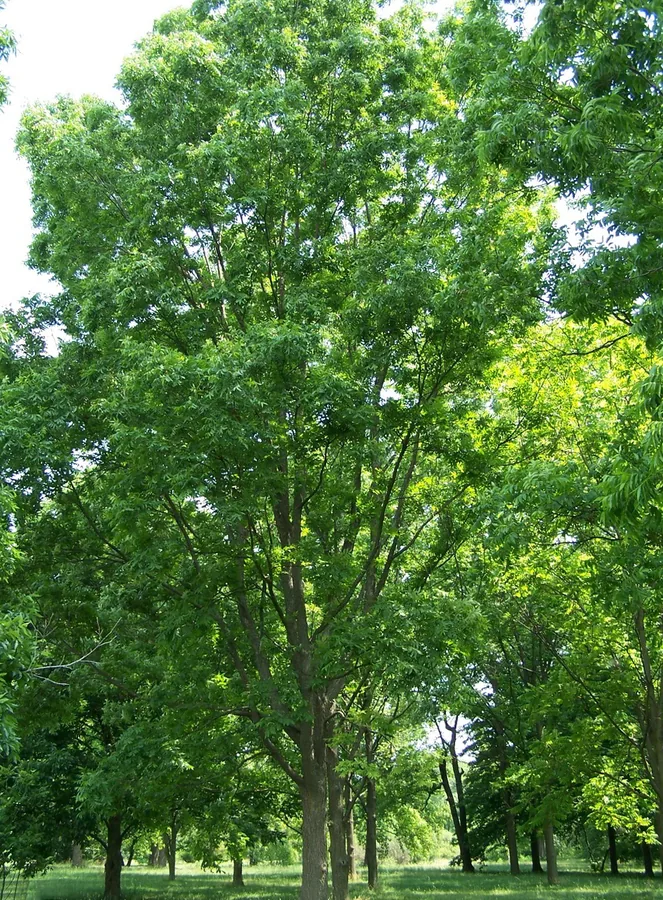
The pecan is a long-lived deciduous shade tree that also yields a nut crop. A member of the walnut family, it evolved in the river-valley bottomlands of the south-central United States, where it develops a broad, towering canopy. Its longevity is central to how it is planted, because a healthy specimen can persist for a hundred years or more.
Mature dimensions govern the planting decision. A pecan reaches 66 to 131 feet (20 to 40 m) in height with a comparable spread, which demands open ground set well back from houses, walks, and power lines. The wood is brittle and prone to limb loss under ice and wind loading, reinforcing the case for generous clearance.
Reproductive biology and nutrition define the timeline to a crop. Pecans are wind-pollinated and dichogamous, so a lone tree overlaps poorly with its own bloom, and two compatible cultivars cross-pollinate for a substantially larger yield. Combined with a marked zinc requirement and a long juvenile phase before first harvest, the species rewards a grower who plans in years rather than seasons.
Care
The short version: full sun and deep, well-drained soil, with ample room for a very large tree. Irrigate deeply but infrequently, supply nitrogen and zinc through the growing season, and site a second compatible cultivar nearby for cross-pollination.
Light
Pecans require full sun, ideally 8 or more hours a day, because heavy nut fill depends on the photosynthetic capacity that full exposure supplies. A young tree tolerates limited partial sun, but sustained shade thins the canopy and suppresses cropping.
Water
Irrigate deeply but infrequently, allowing the top half of the root zone to dry between soakings so the deep root system is drawn downward. Young trees need regular deep watering to establish, and even mature trees demand a thorough soak during nut fill and late-summer drought, when water stress reduces kernel filling. Shallow, frequent application wets only the surface and works against that goal.
Soil
Plant into deep, fertile, well-drained sandy loam to loam, which supports the extensive root system and drains freely. The species tolerates periodic flooding but declines in standing water, and a pH between 6.0 and 7.0 keeps zinc soluble enough for the roots to take up.
Temperature
Pecans withstand a broad range, roughly -4°F to 104°F (-20°C to 40°C), and the high end matches the long, hot summers required to mature the nuts. The deep cold tolerance applies once the tree is fully dormant and hardened off for winter.
Humidity
The trees perform across 40% to 70% ambient humidity, so no target is worth pursuing in the open. What matters is that warm, humid air accelerates scab infection, which places the emphasis on airflow and resistant cultivars rather than the humidity reading.
Feeding
Apply a balanced nitrogen fertilizer from early spring through early summer to drive shoot and canopy growth, then supplement zinc by soil or foliar route. Zinc deficiency is common in the species and manifests as rosetted, crinkled new leaves, so it belongs in the standard fertility program.
Pruning
Prune in late winter during dormancy, when the absence of foliage exposes structure and wounds seal cleanly before spring. Train a young tree to a single central leader and remove crossing, dead, or weak limbs, while a mature tree needs little beyond deadwood removal.
Repotting
Field-grown pecans are not repotted, and the deep taproot makes transplanting difficult once established. Move young nursery stock only once while dormant, and read circling roots, stalled top growth, or rapidly drying soil in container stock as signs the roots have outgrown the pot.
Size & spacing
Site for full mature scale from the start. A pecan attains 66 to 131 feet (20 to 40 m) in height with a spread of 39 to 75 feet (12 to 23 m), so place it well clear of buildings and lines and at ample distance from neighboring trees.
When to plant
Pecans are established during dormancy. Set young dormant trees in late winter to early spring after the hardest freezes have passed, so the root system reactivates before bud break, and the catkins follow in spring. Nut maturity comes late, with harvest running from October into November.
Northern hemisphere
Southern hemisphere
Typical months for a temperate climate: start earlier in warm zones, later where spring frosts linger.
- Plant: late winter to early spring while dormant, after the worst freezes
- Harvest: wind-pollinated catkins and flowers in spring; nuts ripen and are harvested October through November
Hardiness
USDA hardiness zones: 6–9
Temperature: down to -23°C
Troubleshooting
The great majority of pecan problems reduce to a moisture-driven disease, a nutrient shortage, or sap-feeding insects. Because each announces itself on the foliage or the developing nuts, early recognition lets you intervene before a season's crop is lost. Match the observed symptom below, then act while the intervention still changes the outcome.
Black sunken lesions on foliage and shucks, with early nut drop
These lesions mark pecan scab, a fungal disease driven by warm, humid conditions that favor spore germination and infection, which is why it accounts for most crop failure across the wet Southeast. A protective fungicide program held through the season shields the tissue before infection sets in. Wider spacing and pruning dry the canopy faster, and scab-resistant cultivars carry the load where humidity stays high.
Fix:
- Apply recommended fungicides on a protective schedule during the growing season
- Improve air movement by proper spacing and pruning
- Plant scab-resistant cultivars in humid regions
Puckered, yellow-mottled leaves with rosetted, short internodes
Rosetting of this kind signals a zinc shortage, which appears readily on sandy or high-pH soils where the element binds tight and stays out of reach of the roots. Because zinc drives normal internode elongation and leaf expansion, the deficiency crowds and crinkles the new growth at the tips. A foliar spray delivers zinc straight to that expanding tissue in spring, while a soil correction guided by a test and a pH held near 6 to 6.5 restores root uptake for the long term.
Fix:
- Apply foliar zinc sprays to new growth in spring
- Correct soil zinc per soil test recommendations
Honeydew, sooty mold, and premature leaf drop from aphid feeding
The sticky film and blackened surfaces trace to pecan aphids, which feed on phloem sap along the leaf undersides and excrete the excess sugar as honeydew that sooty mold then colonizes. Predators such as lady beetles and lacewings usually hold the population below damaging levels, so a targeted insecticide is warranted only when numbers rise enough to defoliate. Restraint with nitrogen limits the flush of soft, sap-rich growth that lets aphid numbers build.
Fix:
- Encourage natural predators such as lady beetles and lacewings
- Use targeted insecticides only when populations are damaging
Toxicity
Pecan kernels are a safe, established food for people, and the tree presents a relatively low hazard overall. The exceptions are moldy fallen nuts, which can carry tremorgenic mycotoxins, and the heavy fat load of whole nuts that upsets a pet's digestion. Clearing the drops and denying pets access to them removes most of the concern.
Toxic to
Cats · Dogs · Horses · Rabbits · Livestock · Birds
Safe for
People
Cats Mild
In a cat, the fat load of a nibbled fallen nut is enough to disturb digestion and produce mild upset. The graver concern is a moldy nut, whose tremorgenic mycotoxins can provoke tremors or more severe signs.
Dogs Mild
Dogs scavenge windfall nuts more readily than any other pet, and the high fat load commonly triggers vomiting or diarrhea. Trembling or an unsteady gait signals mycotoxin exposure from a moldy nut and warrants veterinary attention.
Horses Mild
Fresh nuts and leaves seldom affect horses to any degree, yet moldy fallen nuts carried into feed or pasture deliver the same tremorgenic mycotoxins. Clearing the drop zone under grazed trees removes that exposure.
Rabbits Mild
A rabbit's digestive tract is adapted to fibrous greens rather than concentrated fat, so even a fresh kernel can disrupt it. Pecans are unsuitable as a treat, and moldy fallen nuts should stay out of reach.
Livestock Mild
Cattle, goats, and sheep grazing beneath the canopy may ingest moldy windfall nuts, where the mold toxins rather than the tree itself pose the hazard. Removing drops from grazed ground breaks that pathway.
Birds Mild
Backyard hens can take split nuts from the ground without harm, but moldy ones carry the same mycotoxin load. Regular removal of drops keeps rotten material out of the diet.
People Safe
Ripe pecan kernels are a well-established food and safe for human consumption. The only cautions are to discard nuts that have molded on the ground and to keep them away from pets.
Keep fallen nuts raked up so pets cannot scavenge moldy ones; the fresh kernels are not considered highly toxic but the high fat content and obstruction risk make them unsuitable as pet treats.
Helpline numbers

United States
ASPCA Animal Poison Control: (888) 426-4435 (fee applies)

United Kingdom
Animal PoisonLine: 01202 509000 (fee applies)

Australia
Animal Poisons Helpline: 1300 869 738
Varieties
Pecan cultivars are classified by pollen-shed timing and by their resistance to scab, the two traits that govern siting and pairing. The selections below are among the most widely grown, and combining two of them is what secures a crop.
Pawnee
A protandrous Type I cultivar whose early ripening suits the shorter season at the northern limit of pecan culture.
Desirable
A Type II cultivar valued for large, high-grade nuts, though its susceptibility to scab limits it in humid regions.
Elliott
A Type II cultivar planted throughout the humid Southeast on the strength of its scab resistance.
Stuart
An old, widely established Type II cultivar valued for consistent cropping and fair tolerance of scab.
Companions
Plant near
Crimson clover or other legume cover crops: Cover crops between rows add nitrogen, reduce erosion, and support beneficial insects in orchards.
Keep apart
Tomato: Pecan produces juglone (milder than black walnut), which can stress juglone-sensitive plants like tomato grown directly beneath the canopy.
How to propagate
A named pecan cannot be reproduced from a planted nut. Cultivars are grafted onto seedling rootstock to preserve the clone, while seed is grown chiefly to produce that rootstock.
GraftingDemanding
Late winter to spring for whip and tongue or patch budding in summer · Named cultivars graft onto seedling rootstock and begin bearing in roughly 4 to 8 years
Because named pecans do not reproduce true to type from seed, they are propagated vegetatively onto vigorous seedling rootstock to preserve the clone. Whip and tongue grafting is timed from late winter into spring and patch budding to summer, after which a grafted tree comes into bearing in roughly 4 to 8 years.
SeedModerate
Stratify nuts over winter and sow in spring · Seedlings used mainly as rootstock; seedling-grown trees are variable and bear after many years
Seed propagation serves mainly to raise rootstock, since sexual reproduction reshuffles the genetics and will not reproduce a named cultivar. Winter stratification breaks dormancy for a spring sowing, but the resulting seedlings are genetically variable and delay bearing by many years.
Myths
A single pecan tree will reliably crop on its own.
Pecans exhibit dichogamy: a Type I tree sheds pollen before its own stigmas are receptive, and a Type II tree reverses that order, so a solitary tree overlaps poorly with itself. Pairing the two types nearby aligns pollen shed with stigma receptivity and lifts yield well beyond what one tree achieves alone.
All pecans are dangerously poisonous to dogs.
Fresh kernels are not highly toxic, although whole nuts can cause gastrointestinal upset or obstruction and carry a heavy fat load. The genuine hazard is moldy nuts, which may hold tremorgenic mycotoxins, so removing the drops addresses the actual risk rather than the tree.