Shrub · Ericaceae
Blueberry
Vaccinium corymbosum
Hold the soil acidic and a compatible cultivar nearby, and the blueberry returns fruit each summer.
Full sun
Every 3–7 days
USDA 4–7
5–12 ft · 1.5–3.7 m
Overview
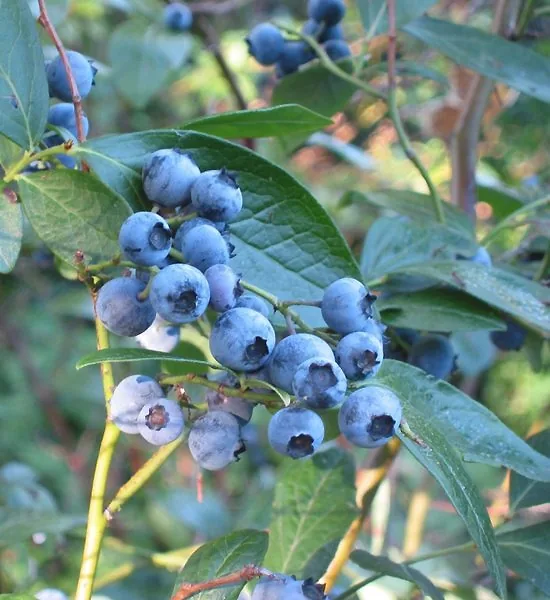
Vaccinium corymbosum is a long-lived ericaceous shrub, sharing the heath family with rhododendrons and azaleas, and its native range in the moist, acidic soils of eastern North America dictates almost every cultural demand it makes. That ancestry is why it depends so heavily on acidic, peaty soil. Supplied with the medium it evolved in, a single bush remains productive for decades.
What separates blueberries from most fruit crops is the narrow soil chemistry they require. The roots take up nutrients only in a low pH window between 4.5 and 5.5, and the shallow, fibrous root system tolerates neither drought nor waterlogging. Meet both conditions and the established plant proves remarkably hardy, enduring winter lows of -22°F (-30°C).
Yield also rises sharply with cross-pollination. Most cultivars are partly self-fertile, but interplanting two or more varieties with overlapping bloom produces larger, earlier, and heavier crops because pollen transfer between genotypes improves fruit set. A young bush invests in framework first, so full cropping typically arrives around the third growing season.
Care
The short version: full sun drives fruiting, soil must sit at pH 4.5 to 5.5, the shallow roots need steady moisture, and a second cultivar nearby supplies the cross-pollination that sets a full crop.
Light
Fruiting depends on full sun, ideally six or more hours daily, because carbohydrate production drives flower bud and berry development. Partial shade is tolerated, but reduced light lowers yield and slows the ripening and sugar accumulation in the fruit.
Water
The shallow, fibrous root system holds little reserve, so keep the soil evenly moist and apply roughly 1 to 2 inches of water a week. These roots dry out quickly and recover poorly from drought stress, an effect most damaging during fruit set when demand peaks.
Soil
Soil chemistry governs success here. The plant requires acidic soil at pH 4.5 to 5.5, moist yet well drained and high in organic matter, because nutrient availability collapses outside that range. Incorporate peat moss or pine bark before planting, since unamended garden soil rarely meets the requirement.
Temperature
Northern highbush is genuinely cold hardy, surviving winter lows near -22°F (-30°C) and summer highs to 95°F (35°C). The cold period is functional rather than merely tolerated, as the plant needs accumulated winter chilling to break dormancy and flower properly.
Humidity
Ambient outdoor humidity in the 40% to 70% range is entirely adequate, so atmospheric moisture warrants no intervention. Root-zone moisture and air movement through the canopy influence plant health far more than humidity does.
Feeding
Apply an acid-forming fertilizer based on ammonium nitrogen, such as an azalea or rhododendron formulation, from spring through early summer once growth resumes. Avoid nitrate sources and lime, both of which raise pH and impair the very nutrient uptake the plant depends on.
Pruning
Prune in late winter during dormancy, when the framework is visible and energy is stored in the crown. On mature bushes remove the oldest canes past six years and thin weak, crossing, or dead wood, retaining 6 to 10 vigorous canes to support productive fruiting laterals.
Repotting
A container plant exhausts and alkalizes its medium over time, so renew the acidic mix every 2 to 3 years by repotting or top-dressing. Roots circling the pot, water channeling straight through, and stalled growth with reduced fruiting all indicate the medium is spent.
Size & spacing
Mature highbush reaches 5 to 12 feet (1.5 to 3.7 m) tall with a spread of 4 to 6 feet (120 to 180 cm). Space each bush for its full dimensions so light penetrates the canopy and air moves freely through the canes.
When to plant
Blueberry phenology follows the temperate northern hemisphere. Establish new bushes in early spring once the soil is workable, or in fall in mild zones where root growth continues. Bloom occurs mid to late spring and fruit matures through summer, with harvest running from June into August.
Northern hemisphere
Southern hemisphere
Typical months for a temperate climate: start earlier in warm zones, later where spring frosts linger.
- Plant: early spring once soil is workable (or fall in mild zones)
- Harvest: blooms mid to late spring; harvest summer (June to August), with full crops by the third growing season
Hardiness
USDA hardiness zones: 4–7
Temperature: down to -34°C
Troubleshooting
Most blueberry disorders resolve to one of two causes: soil pH that has risen out of the uptake range, or a single cultivar with no pollination partner. Foliar color and fruit set are the two diagnostic signals worth reading first. Match the signs below, identify the underlying cause, and correct that rather than the symptom.
Interveinal yellowing with veins remaining green
Pale tissue between green veins indicates iron chlorosis, an induced deficiency that follows when soil pH rises above the uptake range and locks up iron and manganese. The newest leaves show it first because immobile iron cannot move from older tissue. Confirm with a pH test, acidify with elemental sulfur to the recommended rate, and shift to an ammonium nitrogen feed.
Fix:
- Acidify soil with elemental sulfur per soil-test recommendations
- Mulch with acidic pine bark or peat
- Switch to an acid-forming ammonium nitrogen fertilizer
Strong flowering followed by negligible fruit set
Abundant bloom with little fruit usually reflects poor cross-pollination, the predictable result of a single cultivar with no genetically distinct pollen source. Fruit set improves markedly with a compatible partner. Interplant a second highbush variety of overlapping bloom and protect pollinating bees by suspending sprays during flowering.
Fix:
- Plant two or more different highbush cultivars that bloom together
- Encourage bees and avoid spraying insecticides during bloom
Toxicity
For households with pets or children, the species presents no toxic risk in any part. The ripe fruit is a nutritious treat, and the foliage and stems contain nothing harmful. The only practical limit is quantity, since a large volume of any fruit can cause mild digestive upset in a small animal.
Safe for
People · Cats · Dogs · Horses · Rabbits · Livestock · Birds
Cats None
Blueberries pose no risk to cats, and a ripe berry or two serves as a sound treat. Most cats show little interest in fruit regardless, so no concern arises.
Dogs None
Dogs digest ripe blueberries without difficulty, and many take to them readily. Keep portions small, as a large quantity of any fruit can loosen the stool.
Horses Safe
Horses can take the berries and leaves safely as an occasional offering. They are best treated as a supplement rather than a feed component.
Rabbits Safe
Rabbits tolerate a berry or two as a treat. Because the fruit is high in sugar, restrict the amount and base the diet on hay and greens.
Livestock Safe
Cattle, goats, and sheep may browse the bushes without harm, as the plant contains nothing toxic. A heavy load of ripe fruit is nonetheless best kept moderate.
Birds Safe
Birds consume ripe blueberries readily and will clear a bush if unprotected. The fruit is entirely harmless to them, which is precisely why growers net their plants.
People Safe
Blueberries are a nutritious food eaten fresh, baked, or frozen. Every edible part is safe for children and adults.
No special handling precautions are required around pets.
Varieties
Hundreds of cultivars exist, classified chiefly by ripening date. Combining early, mid, and late selections both extends the harvest window and ensures the overlapping bloom that cross-pollination requires.
Bluecrop
Bluecrop is a widely planted midseason northern highbush valued for heavy, reliable crops and strong cold tolerance.
Duke
Duke ripens early with firm, uniform berries while blooming late enough to escape most spring frost damage.
Elliott
Elliott is a late selection that extends the harvest into the end of summer, bearing firm, tart fruit.
Companions
Blueberries pair well with other acid-loving shrubs that share their soil, and badly with anything that wants the dry, limey ground they can't tolerate.
Plant near
Rhododendron: Shares the same acidic, moist, well-drained soil requirements so culture is identical.
Azalea: Acid-loving ericaceous shrub with matching pH and moisture needs.
Keep apart
Lavender: Prefers alkaline, dry soil that is incompatible with the low pH and steady moisture blueberries need.
How to propagate
Both clonal methods reproduce the parent exactly from existing wood. You can root detached cuttings under controlled humidity, or layer a still-attached cane until it forms roots in place.
Stem cuttingsModerate
Softwood cuttings in late spring to early summer; hardwood cuttings taken from dormant wood in late winter · 6 to 12 weeks to root, with transplanting the following season
Stem cuttings are the standard means of multiplying blueberries true to type. Collect softwood in late spring to early summer or hardwood from dormant canes in late winter, then root them in a moist, acidic peat and perlite medium under high humidity. Rooting takes 6 to 12 weeks, after which the cuttings are grown on and transplanted the following season.
LayeringEasy
Spring · One growing season to root before separating
Layering is the simpler clonal route. In spring, bend a low, flexible cane to the ground and bury a section while it remains attached to the parent, which supplies it during rooting. Roots form over one growing season, and the layer is then severed and lifted as an independent plant.
Myths
A single blueberry bush will fruit just as well on its own.
Because highbush types are partly self-fertile, an isolated bush sets some fruit, but it never reaches the output of a multi-cultivar planting. Cross-pollination between distinct cultivars raises yield, increases berry size, and advances ripening.
Burying coffee grounds will quickly acidify soil for blueberries.
Coffee grounds shift pH only marginally, and any effect develops slowly. Predictable acidification comes from elemental sulfur applied according to a soil test, not from organic kitchen waste.