Shrub · Ericaceae
Lingonberry
Vaccinium vitis-idaea
Match its need for acidic soil, full sun, and steady moisture, and this low evergreen carpet returns two crops of tart red berries a year.
Full sun
Every 3–5 days
USDA 2–7
4–16 in · 10–40 cm
Overview
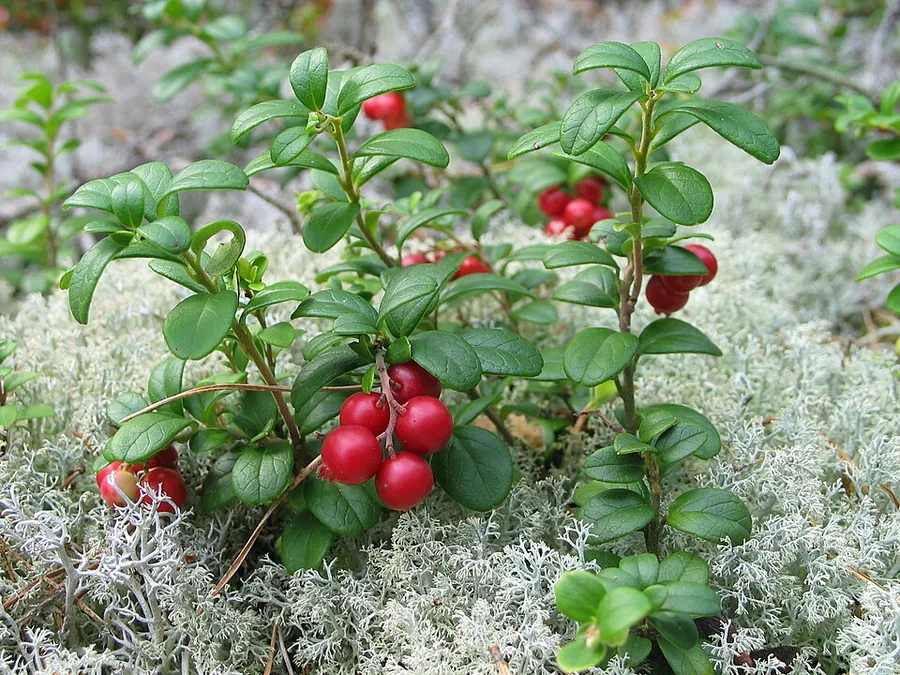
Lingonberry is a low, spreading evergreen in the Ericaceae, the heath family that also holds the blueberries and rhododendrons. Native to the cold northern latitudes, it holds to the ground at 4 to 16 inches (10 to 40 cm) while its rhizomes extend laterally to form a dense, glossy-leaved sward. Small campanulate flowers develop into bright red berries whose sharp acidity softens with cooking.
Its defining requirement is edaphic. The species performs only in acidic, well-drained ground of the peaty, sandy character found in its native heaths, a condition its fine root system and fungal partners depend on to feed. Met that requirement, it becomes a durable groundcover, cold-hardy to -40°F (-40°C) and evergreen through winter.
Growth is deliberate rather than rapid. The rhizomes advance season by season until the bed is occupied, and on European types the reward for that patience is two crops in a single year, one taken in late summer and a second in fall.
Care
The short version: provide full sun, an acidic and well-drained soil held in the 4.0 to 5.5 range, and steady moisture that neither dries out nor becomes waterlogged, with only occasional light feeding.
Light
Fruiting is maximized in full sun, although the plant tolerates partial sun and light shade. In deep shade photosynthesis and flower initiation both fall away, so a heavy crop is exchanged for a scattered few berries and slow, weak spread.
Water
The root system is shallow and fibrous, which is why it needs steady moisture every 3 to 5 days and tolerates neither drought nor waterlogging. Where feasible, irrigate with rainwater or another low-mineral source, since the dissolved salts in hard water gradually raise pH away from the acidity the roots require.
Soil
Soil is the decisive factor. The species demands acidic, well-drained soil within the 4.0 to 5.5 range, sandy or peaty and high in organic matter such as peat moss and pine bark. That open, acidic medium is what permits the fine roots to take up nutrients.
Temperature
Cold tolerance here is exceptional among fruiting plants. Lingonberries withstand -40°F (-40°C) and grow well to about 77°F (25°C), a range consistent with the cool northern climates of their origin.
Humidity
Ambient humidity of 40% to 60% is entirely adequate, so atmospheric moisture needs no management. Consistency of soil moisture is far more consequential than the humidity of the air.
Feeding
Restraint is essential, since the species has low nutrient demand and is readily over-fertilized. A single low-rate spring application of an acidic, ammonium-based fertilizer formulated for rhododendrons or azaleas meets its needs. Excess feeding is more damaging than a deficit.
Pruning
Pruning requirements are minimal. Remove dead or weak wood as it appears, and every few years shear or mow an old planting in early spring to clear woody stems and stimulate fresh rhizome shoots and new fruiting wood.
Repotting
A container specimen should be moved into fresh acidic mix and a larger pot every 2 to 3 years. Roots circling the pot, stalled growth, or a medium that dries almost immediately after watering indicate it has become rootbound.
Size & spacing
The plant stays low at 4 to 16 inches (10 to 40 cm) tall but spreads by rhizome to 12 to 24 inches (30 to 60 cm) across. Allow each specimen room to run, as it will progressively close the gaps into a dense mat.
When to plant
The species is hardy and unhurried in its schedule. Set young plants out in spring as soon as the soil is workable, expect bloom in spring with a second flush in midsummer on European types, and harvest in late summer and again in fall.
Northern hemisphere
Southern hemisphere
Typical months for a temperate climate: start earlier in warm zones, later where spring frosts linger.
- Plant: Spring as soon as soil can be worked (about April to May); early fall in mild regions
- Harvest: Blooms in spring, and again in midsummer on European types; harvest late summer and again in fall (two crops per year on European types)
Hardiness
USDA hardiness zones: 2–7
Temperature: down to -46°C
Troubleshooting
Most disorders in lingonberry originate from soil that is insufficiently acidic, excessively wet, or from inadequate light. Because the earliest signs appear on the foliage and roots, an accurate reading lets you correct the cause before decline sets in. Identify the pattern below, then intervene while intervention still helps.
Failure to establish, with wilt and dieback in wet soil
The shallow, fibrous root system carries little reserve and depends on air in the soil, so soggy, heavy soil excludes oxygen and invites root rot before the plant can anchor. Persistently wet ground and dark, softened roots confirm the diagnosis. The remedy is structural: build a raised bed amended with peat and sand, correct the drainage before planting, and withhold excess water.
Fix:
- Plant in raised beds amended with peat and sand
- Improve drainage before planting
- Avoid overwatering
Interveinal yellowing with veins still green
This pattern is chlorosis, the classic signature of soil that has risen above the acidic band this species requires. Above pH 5.5 iron shifts into forms the fine roots cannot take up, and because chlorophyll depends on iron the blade pales while the veins, drawing on reserves, stay green. Correct it by lowering pH with elemental sulfur or acidic peat, mulching with pine bark, and feeding an ammonium-based acidic fertilizer.
Fix:
- Lower pH with elemental sulfur or acidic peat
- Mulch with acidic peat moss or pine bark
- Switch to an ammonium-based acidic fertilizer
Poor flowering and fruit set with limited spread
A shy crop almost always traces to insufficient light, since this species flowers and fruits best in full sun. In deep shade the plant sets few flowers, carries little fruit, and is slow to colonize its bed. Relocate it to full sun or only light shade, and thin any canopy growing over the top so light reaches the foliage.
Fix:
- Site in full sun to only light shade
- Thin overhanging vegetation
Toxicity
The verdict here is straightforward: the entire plant is safe. The tart red berries are a long-standing culinary fruit, and neither the leaves nor the stems contain any principle toxic to people, pets, or livestock. A pet that samples it warrants no concern.
Safe for
People · Cats · Dogs · Horses · Rabbits · Livestock · Birds
Cats None
No toxic principle in the plant affects cats. A sampling taste is harmless, and even a large volume of leaves produces at most transient gastric upset that resolves on its own.
Dogs None
The species poses no toxic risk to dogs. A dog that takes a few berries comes to no harm, and the foliage contains no compound of concern.
Horses Safe
Grazing horses face no hazard. Neither the low evergreen foliage nor the fruit carries a constituent that would affect them.
Rabbits Safe
Rabbits may browse the plant without consequence. Leaves and berries alike are non-toxic, so a browsed stem needs no response.
Livestock Safe
Cattle, goats, and sheep can graze it without restriction. The species contains no toxin that affects ruminants.
Birds Safe
In the wild birds consume the red berries and disperse the seed, so both poultry and wild species are entirely safe in its presence.
People Safe
The tart red berries are a long-established culinary fruit, taken raw, cooked into sauce, or baked. Every part is safe to handle and the fruit is fit to eat.
No special handling needed; ripe berries are edible and safe.
Varieties
Most named lingonberries are European selections developed for larger fruit and consistent two-crop yields. The following are the cultivars most often offered to growers.
Koralle
The most widely cultivated European type and a dependable heavy cropper, it yields two flushes of bright red berries per season.
Red Pearl
A vigorous Dutch selection valued for its large fruit and strong, healthy constitution.
Sussi
A Swedish cultivar notable for carrying unusually large berries on neat, compact plants.
Regal
A University of Wisconsin selection distinguished by a more upright habit and reliably good yields.
Companions
Lingonberries do best beside other acid-loving plants that share their soil, and worst beside anything that competes for nutrients or wants sweeter ground.
Plant near
Blueberry (Vaccinium): Shares the same acidic, well-drained soil and moisture requirements
Rhododendron and azalea: Acid-loving ericaceous plants with similar culture
Keep apart
Lawn grasses: Compete for nutrients and prefer higher pH that harms lingonberry
How to propagate
Because lingonberry spreads naturally by underground rhizomes, its vegetative methods are notably straightforward. You may divide an established clump, allow a stem to layer, root cuttings, or, with considerably more patience, raise it from seed.
DivisionEasy
Early spring before new growth · One season to establish
The most reliable increase comes from lifting a clump in early spring, before new growth breaks, and separating rooted rhizome sections. Each division is genetically identical to the parent and establishes in a single season. The caveat is sanitary: division can transmit disease with the roots, so take material only from healthy stock.
LayeringEasy
Spring to summer · One season
The species layers naturally. Through spring and summer its creeping rhizomes and prostrate stems strike roots wherever they contact moist ground, so pinning a stem to damp soil yields a rooted, liftable plant within about a season.
Stem cuttingsModerate
Softwood in spring or semi-hardwood in late summer to fall · About 8-12 weeks to root; 2-3 years to fruit
Softwood cuttings taken in spring or semi-hardwood cuttings from late summer into fall root over roughly 8 to 12 weeks. Expect a slower return, however, since a cutting requires 2 to 3 years to reach fruiting, spreads by rhizome more slowly than a division, and yields lightly in its early years.
SeedDemanding
After cold stratification · Several years to fruit
Seed propagation is slow and seldom justified. The seed requires a cold period to break dormancy, the seedlings advance only gradually over several years before fruiting, and, being sexually produced, they do not come true to type.
Myths
Lingonberry and cranberry are the same plant.
Though close relatives, they are distinct species. Lingonberry is Vaccinium vitis-idaea, a low evergreen subshrub, whereas the American cranberry is Vaccinium macrocarpon, a sprawling bog plant. In habit and form the two are readily separated once compared directly.
Lingonberries want acidic soil just because they like acid.
Acidity is a means, not a preference. The roots and their symbiotic fungi mobilize nutrients efficiently only across the 4.0 to 5.5 range, so as pH climbs the uptake pathway breaks down and the plant becomes nutrient-starved and chlorotic even where fertilizer is present. The pH governs nutrient availability, not the plant's taste for acid.