Herb · Asteraceae
Wormwood
Artemisia absinthium
Site it in lean, dry soil under full sun, and this silver Artemisia performs almost unaided.
Full sun
Every 10–21 days
90–120 days
USDA 4–9
Overview
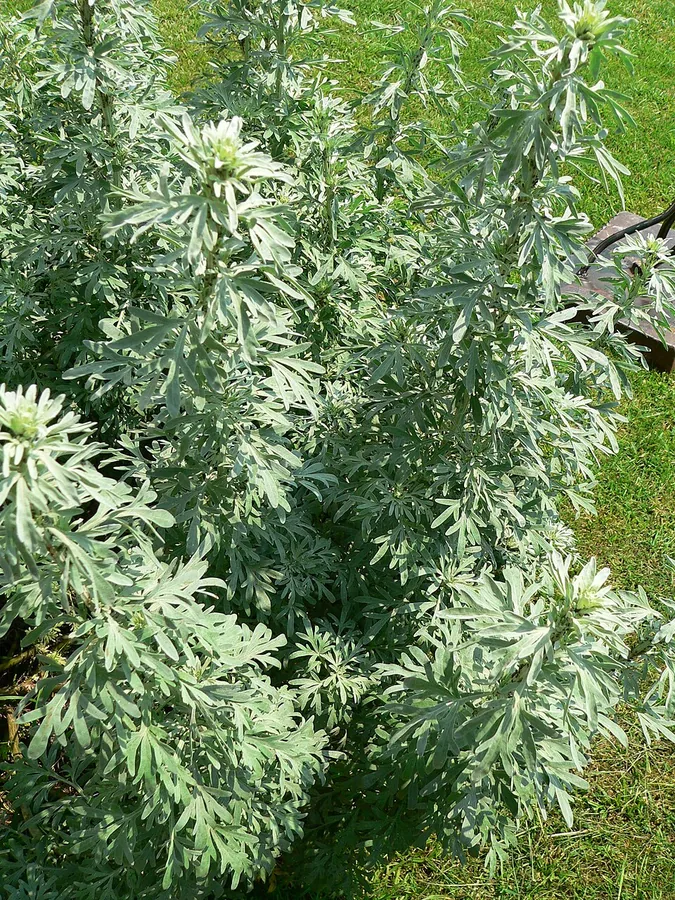
Wormwood, Artemisia absinthium, is a hardy silver-leaved perennial in the daisy family, distinguished by its finely dissected foliage and a pronounced bitterness. A native of Europe and Asia, it was introduced to North America and has since naturalized widely. It is grown chiefly for the aromatic gray foliage; the small, dull yellow flowers it carries in late summer are of little ornamental value.
Its cultural needs are minimal, and understanding why clarifies the care. Adapted to lean, dry, sharply drained ground in full sun, it resents both fertile soil and standing moisture, since each promotes soft growth or root disease. That same adaptation to marginal habitats explains its tolerance of drought and poor soil, and a wide hardiness range lets it withstand severe winter cold and considerable summer heat.
The chemistry that defines wormwood also governs how it should be handled. Every part contains thujone, a neurotoxic monoterpene, alongside the bitter sesquiterpene lactone absinthin that lends absinthe its name. That bitterness deters most herbivores, but the plant is not one to ingest, and its allelopathy, mediated by absinthin from the roots and rain-washed foliage, suppresses neighboring plants.
Care
The short version: full sun and lean, dry, sharply drained soil match this plant's native adaptation. Water sparingly and only after the profile has dried, withhold fertilizer, and shear hard after flowering to counter the flopping that rich or wet conditions encourage.
Light
Wormwood is a full sun species, adapted to open, high-light sites. It endures light partial shade, but reduced irradiance yields weak, etiolated stems that splay open by midsummer, so maximum exposure sustains a compact habit.
Water
Restraint is essential. Allow the medium to dry out completely between irrigations, applying water only every 10 to 21 days once established, and never sustain saturation. Persistent moisture is the principal cause of mortality, acting through root rot.
Soil
Provide poor to moderately fertile, dry, sharply drained substrate, sandy or loamy in texture. It accommodates a broad pH range of 5.5 to 8.0, and because it performs better under low fertility than high, amendment of the bed is counterproductive.
Temperature
The species is genuinely cold hardy, functioning across roughly -22°F to 95°F (-30°C to 35°C). That low-temperature tolerance permits survival through severe winters, while its heat tolerance sustains it through pronounced summer warmth.
Humidity
Low atmospheric moisture suits it, on the order of 30% to 50%, consistent with its drought adaptation. Humid, stagnant air is unfavorable, since retained moisture predisposes the foliage to decline.
Feeding
Fertilization is largely unnecessary. Because wormwood thrives in poor soil, at most a light topdressing of compost in spring is warranted. Rich nutrition drives soft, unstable growth prone to flopping.
Pruning
Pinch the stems in late spring to preempt legginess. Following flowering, shear by up to half to stimulate fresh, compact regrowth, and deadhead promptly, since unchecked seed set leads to prolific self-sowing.
Repotting
Container culture is uncommon, but where practiced, repot every 2 to 3 years in spring. Roots circling the pot, water passing straight through, and sparse new growth indicate the plant has become rootbound.
Size & spacing
At maturity the plant attains 2 to 4 feet (60 to 120 cm) in height with a spread of 18 to 35 inches (45 to 90 cm). Spacing to that dimension promotes free air movement through the canopy and helps the stems remain upright.
When to plant
Wormwood follows the phenology of a cold-hardy perennial. Sow seed indoors in early spring, transplant after the last frost once soil temperatures rise, and expect anthesis with small yellow flowers from August into September, harvesting the aromatic foliage through summer at or just before bloom.
Northern hemisphere
Southern hemisphere
Typical months for a temperate climate: start earlier in warm zones, later where spring frosts linger.
- Sow: Early spring, 6-8 weeks before last frost; surface sow as seed needs light
- Plant: After the last spring frost, once soil has warmed
- Harvest: Yellowish flowers August to September; harvest aromatic foliage in summer at or just before bloom
Hardiness
USDA hardiness zones: 4–9
Temperature: down to -34°C
Troubleshooting
A resilient species, wormwood is compromised more often by excess than by deprivation. Waterlogged soil, high fertility, and shade account for most decline, whereas drought rarely does. Diagnose against the cases below and intervene early, before flopping or rot becomes irreversible.
Wilting plant with black, mushy roots
Waterlogging is the most lethal condition for wormwood, and this is root rot, precipitated by soil that remains saturated and drains slowly. Once the root tissue has turned dark and soft the plant is beyond recovery, so remove and discard it, correct the drainage, and cease irrigation of the site.
Fix:
- Improve drainage and stop watering
- Remove and discard affected plants
Stems splaying open from the center in summer
This disorder is summer flop, attributable to excess water, overly fertile soil, or insufficient light. Abundant moisture and nutrition drive soft, top-heavy growth that lacks the structural rigidity to remain erect. Shear back by up to half after flowering to induce compact regrowth, and pinch the stems in late spring before splaying begins.
Fix:
- Shear plants back by up to half after bloom to force fresh compact growth
- Pinch stems in late spring before flopping starts
Curled shoot tips crawling with tiny insects
Despite its bitterness and aromatic oils, wormwood can host aphids on its tender new growth. The diagnostic signs are clustered soft-bodied insects and the sticky honeydew they excrete. Dislodge them with a forceful jet of water, reserving insecticidal soap for persistent infestations.
Fix:
- Dislodge with a strong spray of water
- Treat with insecticidal soap if persistent
Toxicity
Regard this as a plant to keep from pets, grazing stock, and casual ingestion. All parts contain thujone, a neurotoxin capable of inducing vomiting, tremors, and seizures at sufficient dose. Intense bitterness limits voluntary intake in most animals, but that deterrent is not reliable, and the foliage should never be treated as edible.
Toxic to
Cats · Dogs · Horses · Rabbits · Livestock · Birds · People
Cats Toxic
Ingestion of the foliage typically produces salivation and vomiting in cats, frequently followed by diarrhea. The greater hazard is the thujone, which can precipitate tremors and seizures when consumption is substantial.
Dogs Toxic
Dogs that bite the bitter foliage usually develop gastrointestinal upset, vomiting, or loose stools. At higher intake the thujone becomes the serious concern, causing muscle tremors and seizures.
Horses Toxic
Grazing horses may exhibit colic and dullness, and a large intake carries the risk of the tremors and convulsions characteristic of thujone poisoning.
Rabbits Toxic
Rabbits should be excluded from the plant. The same thujone that affects other species disturbs their digestion and, in quantity, acts on the nervous system.
Livestock Toxic
Cattle, sheep, and goats generally reject the bitter herbage, but a hungry animal on impoverished pasture can consume enough thujone to cause abdominal pain and nervous twitching.
Birds Toxic
Birds should be kept from wormwood, as the volatile oils and thujone are too concentrated for their small physiology to tolerate.
People Caution
Wormwood flavors absinthe and bitter tonics but is not a culinary green. Its thujone can induce vomiting, tremors, and seizures if the plant is eaten freely, so it warrants use only as a sparing flavoring, never as food.
Foliage is strongly aromatic and bitter; volatile oils can irritate the skin of sensitive people, so wear gloves when pruning or harvesting in quantity.
Helpline numbers

United States
ASPCA Animal Poison Control: (888) 426-4435 (fee applies)
Poison Control: (800) 222-1222



Canada
Poison Centres: 1-844-764-7669
Varieties
The straight species predominates in cultivation, though two selections merit attention for superior foliage and a more restrained habit.
'Lambrook Silver'
A more compact selection valued for its finely divided, silvery-gray foliage.
Artemisia 'Powis Castle'
A vigorous silver-leaved hybrid of A. absinthium and A. arborescens that seldom flowers and is cultivated solely for its mounded foliage.
Companions
Plant near
carrots: Used traditionally as a strongly scented distant border to help mask the scent of carrots from pests; keep well away from the roots to avoid allelopathic suppression.
Keep apart
fennel: Volatiles and root-exuded absinthin from wormwood inhibit fennel germination and growth.
sage: Absinthin washed from wormwood foliage by rain stunts nearby herbs such as sage.
anise: Aromatic seed herbs near wormwood suffer reduced germination and stunting from absinthin.
How to propagate
Wormwood propagates readily by several routes. Seed offers a slower start, while division of established clumps or softwood cuttings provides a faster increase of true-to-type plants.
SeedModerate
Early spring, 6-8 weeks before last frost · Germinates in 2-3 weeks; reaches usable size in the first to second year
Sow seed indoors roughly 6 to 8 weeks before the last frost. Because the seed is minute and requires light for germination, surface sow and leave it uncovered; emergence follows in 2 to 3 weeks. Growth is unhurried, reaching usable size over the first or second year, after which established plants self-sow freely outdoors.
DivisionEasy
Spring or early fall · Roots in a few weeks and re-establishes the same season
Division is the most efficient means of rejuvenating an aging clump. Lift and divide in spring or early fall every 2 to 3 years; the resulting divisions root within a few weeks and re-establish the same season.
Stem cuttingsEasy
Late spring to summer from softwood or semi-ripe shoots · Roots in about 3-4 weeks
From late spring through summer, take 8 to 10 cm tip cuttings of softwood or semi-ripe shoots. Inserted into a gritty, sharply drained medium they root readily, in about 3 to 4 weeks.
Myths
Thujone in wormwood renders absinthe a hallucinogen.
The hallucinogenic attribution is not supported. Both pre-ban and modern absinthe contain thujone at concentrations far too low to affect cognition, and a drinker would reach alcohol poisoning well before thujone accumulated to a neuroactive dose. The effects of absinthe derive from the alcohol, not the herb.
Because wormwood is a natural herb, it can be taken freely.
Natural origin does not confer safety here. Every part contains thujone, a neurotoxin, and large or repeated doses of wormwood preparations can injure the nervous system. US law limits permissible thujone in food and drink for sound reason.
Growing wormwood improves the vigor of nearby vegetables.
The effect is generally the reverse. Wormwood is allelopathic, exuding the water-soluble compound absinthin from its roots and from rain-washed foliage. That absinthin stunts adjacent plants, so wormwood suppresses rather than benefits its neighbors.