Herb · Asteraceae
French Tarragon
Artemisia dracunculus
Site it in full sun with sharp drainage, the two conditions that concentrate French tarragon's warm anise flavor through summer.
Full sun
Every 5–10 days
USDA 4–8
24–35 in · 60–90 cm
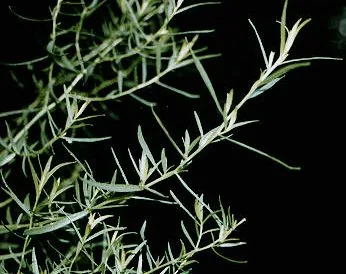
Overview
French tarragon holds its place in the herb garden because of a single trait: a clean, warm anise flavor unmatched by other culinary herbs. A member of the Asteraceae, the family of daisies and sagebrush, it grows as a hardy perennial, retreating to its crown each winter and regenerating fresh shoots from that crown in spring. Because the rootstock persists, one established plant yields harvests for many years.
The practical complication is genetic: the true French herb is a sterile clone that produces no viable seed. Propagation therefore depends on vegetative material, a purchased plant or a division taken from one, rather than sowing. Seed sold as tarragon is invariably the Russian species, which germinates readily and grows vigorously but carries little of the aromatic oil that gives flavor. Acquire the genuine clone once, and every later plant comes free by division.
Above all, tarragon is intolerant of waterlogging at the root. It performs in full sun, lean soil, and very sharp drainage, and it stalls or rots in heavy, saturated ground because its roots cannot respire in airless mud. Once drainage is correct, its demands fall away, calling for only light watering, minimal feeding, and a cutback before dormancy.
Care
The short version: full sun and lean, fast-draining soil, watering only after the top half of the profile has dried. Feed sparingly if at all, harvest the shoot tips through summer, and divide the clump every few years to sustain vigor and flavor.
Light
Site tarragon in full sun, where high light drives the synthesis of the aromatic oils behind its flavor, though it accepts brief afternoon shade. Under deeper shade growth thins and oil production falls, diluting the very taste the herb is grown for.
Water
Allow the top half of the soil to dry between waterings rather than holding it moist, because the roots need air. Tarragon resents saturation, and winter overwatering is the common killer, since cold, wet soil starves and rots the roots.
Soil
Grow it in light, sandy, well-drained loam, where sharp drainage matters far more than fertility. A pH of 6.0 to 7.5 suits it, and only heavy, saturated ground reliably defeats it.
Temperature
Tarragon is markedly cold-hardy, surviving to about -20°F (-29°C) and tolerating heat to roughly 84°F (29°C). It requires the winter chill to break dormancy properly, so that cold rest is a physiological need rather than a fault to correct.
Humidity
Hold humidity low, around 30% to 50%, with open spacing for air movement. Damp, stagnant air raises leaf-surface moisture and invites the mildew and rust that blemish the foliage.
Feeding
Treat it as a light feeder. A single spring application of balanced fertilizer or compost meets its needs, and surplus nitrogen forces soft, watery growth at the expense of aromatic concentration.
Pruning
Pinch and harvest the shoot tips through the season, which removes apical dominance and encourages bushy lateral growth over leggy stems. Cut the stems back in late summer and clear dead top growth before the plant enters winter dormancy.
Repotting
Refresh a container specimen every 2 to 3 years, before the crown becomes woody and congested. Declining flavor, fewer new shoots, and a hardened center signal a spent rootstock in need of fresh medium or division.
Size & spacing
A mature plant attains 24 to 35 inches (60 to 90 cm) in height and 12 to 18 inches (30 to 45 cm) in spread. Allot that footprint so air circulates freely and the foliage dries quickly after wetting.
When to plant
Hardy through zones 4 through 8, tarragon is governed by the seasonal cycle. Establish divisions or rooted cuttings in spring once frost has passed, harvest foliage through summer, and allow the plant to enter dormancy over winter, because that period of chilling resets the crown and drives strong regrowth the following season.
Northern hemisphere
Southern hemisphere
Typical months for a temperate climate: start earlier in warm zones, later where spring frosts linger.
- Plant: Spring, after the last frost, from divisions or rooted stem cuttings
- Harvest: Rarely flowers and sets no viable seed; harvest leaves through summer. Benefits from a period of winter dormancy and chilling to perform well the following season.
Hardiness
USDA hardiness zones: 4–8
Temperature: down to -34°C
Troubleshooting
Nearly all tarragon disorders originate in one of two places: excess moisture at the root or insufficient air movement through crowded foliage. Monitor both and most problems never develop. Identify the symptom below, then intervene early, before it advances.
Collapse with black, mushy roots and a decayed crown
The diagnosis is root and crown rot, a consequence of soil that remains too wet for the roots to respire. Tarragon is especially vulnerable over winter, so lift a failing plant and inspect for brown, foul-smelling roots. Where decay is established, discard the affected tissue and replant sound divisions in raised, sandy ground engineered for sharp drainage.
Fix:
- Improve drainage and reduce watering
- Remove and discard severely rotted plants
- Replant healthy divisions in raised or sandy, well-drained beds
Yellow or stippled leaves bearing powdery patches or insects
Crowding and humidity favor downy mildew or rust, fungal infections that leave pale or rust-colored patches, whereas aphids colonize soft new growth and distort it as they feed. Examine the undersides to distinguish the two. Correct the conditions by opening the canopy for airflow, removing the most affected foliage, and rinsing or treating the aphid colonies.
Fix:
- Improve air circulation and spacing
- Remove and destroy infected foliage
- Rinse off or treat aphids as needed
A mature clump gone woody, sparse, and weak in flavor
After three or four years the clump exhausts itself, forming a hollow, woody center that generates little new growth and loses aromatic strength. The cause is age, not pathology. Lift the clump in early spring, replant the vigorous outer growth, and discard the depleted center.
Fix:
- Divide the clump in early spring
- Replant vigorous outer divisions
- Discard the spent woody center
Toxicity
As a culinary herb, tarragon is safe to eat and unproblematic in a household. People may use it freely in cooking, and it presents no poisoning risk to pets. The single caveat is quantity: a large intake of the strongly aromatic leaves can provoke a transient bout of gastrointestinal upset in a cat, dog, or other animal, which places it as a mild caution for pets rather than a true toxin.
Toxic to
Cats · Dogs · Horses · Rabbits · Livestock · Birds
Safe for
People
Cats Mild
A nibble is harmless, but ingestion of a substantial quantity of the aromatic leaves may cause a cat to salivate briefly or experience a short episode of gastric upset.
Dogs Mild
There is no poisoning risk, though a dog that consumes a large volume of the strongly scented foliage may develop loose stools or transient nausea that resolves on its own.
Horses Mild
Small amounts are inconsequential. A large intake of the leaves can produce mild, short-lived digestive upset in a horse.
Rabbits Mild
Limit intake to an occasional sprig, as the concentrated oils can disturb a rabbit's sensitive digestive tract once consumption exceeds a small taste.
Livestock Mild
Grazing stock generally avoid the pungent plant, and an incidental mouthful causes nothing beyond passing gastric upset.
Birds Mild
A few leaves are tolerated by a backyard bird, but the concentrated aromatic oils warrant offering it only occasionally rather than as routine feed.
People Safe
For people, tarragon is a safe culinary staple at ordinary cooking quantities. Its estragole content is relevant only at very large medicinal doses, well outside normal use.
No special handling precautions are needed for the intact plant; use the leaves as a culinary herb.
Helpline numbers

United States
ASPCA Animal Poison Control: (888) 426-4435 (fee applies)

United Kingdom
Animal PoisonLine: 01202 509000 (fee applies)

Australia
Animal Poisons Helpline: 1300 869 738
Varieties
Only two plants travel under the tarragon name, and telling them apart determines whether the crop carries flavor at all. Confirm which species you are buying before planting.
French tarragon ('Sativa' clone)
The authentic culinary tarragon is this sterile clone, prized for its strong anise flavor and necessarily propagated from divisions or cuttings because it forms no viable seed.
Russian tarragon (Artemisia dracunculoides)
Readily raised from seed, this species is coarser, larger, and nearly devoid of aroma, which explains its frequent appearance in seed packets and its consistent failure in the kitchen.
How to propagate
Because the true French clone sets no seed, propagation is entirely vegetative, matching commercial practice: divide an existing plant or root a cutting. Both methods transmit the clone intact and preserve its flavor.
DivisionEasy
Early spring as growth resumes, or early fall · 4 to 8 weeks
Division is the most dependable means of increasing the true French clone. Lift an established plant in early spring as growth resumes, or in early fall, separate the vigorous outer sections, and replant them, repeating the operation every 3 to 4 years to rejuvenate the clump. The divisions root and establish within 4 to 8 weeks.
Stem cuttingsModerate
Late spring to early summer from softwood growth · 4 to 6 weeks
Take cuttings from non-flowering softwood shoots in late spring or early summer and root them in a sharp, well-drained medium, where they establish in roughly 4 to 6 weeks. Vegetative propagation preserves the prized French flavor, since only the inferior Russian tarragon reproduces from seed.
Myths
True French tarragon can be grown from seed.
The genetics rule it out: true French tarragon is a sterile clone that yields no viable seed, so its flavor can be maintained only by division or rooted cuttings. Anything marketed as tarragon seed is the inferior, nearly flavorless Russian type, a different species rather than the culinary herb.