Herb · Asteraceae
Common Tansy
Tanacetum vulgare
A hardy Asteraceae perennial that runs on almost nothing and colonizes ground given the chance.
Full sun
Every 7–14 days
50–86°F · 10–30°C
USDA 3–8
Overview
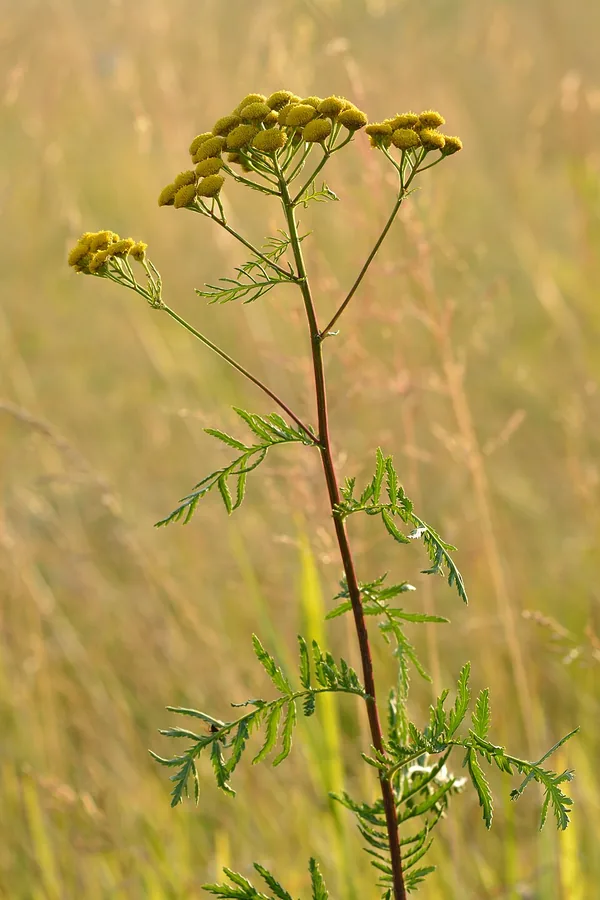
Common tansy (Tanacetum vulgare) is a rhizomatous perennial in the Asteraceae, recognized by the flat corymbs of button-shaped golden-yellow flower heads and finely divided, aromatic foliage. Introduced from Europe for garden and medicinal use, it has naturalized widely across North America. The bitter, camphor-like scent released when the leaves are bruised comes from the volatile oils held in the tissue.
Its resilience follows from that same biology. Tansy tolerates poor soil, drought, and cold to zone 3, and its fast growth lets it establish quickly. The trade-off is invasiveness, since creeping rhizomes extend the clump laterally while abundant seed recruits new plants, which is why several states classify it as a noxious weed. Site it only where the spread can be contained, and confirm it is legal to grow in your area.
One point governs how it should be used. The whole plant contains thujone and sesquiterpene lactones, compounds toxic to pets, livestock, and people, so tansy belongs in the garden as an ornamental and pest-repellent herb rather than in the kitchen.
Care
The short version: full sun and free-draining soil, irrigation limited to the establishment phase and true drought, and disciplined deadheading and division to check its rhizomatous, self-seeding spread.
Light
Tansy performs best in full sun, where high light supports sturdy, self-supporting stems and the fullest flowering. Under partial shade it survives but stretches, producing taller, floppier growth and fewer of the golden button heads.
Water
Once the root system is established the plant is drought tolerant and needs irrigation only during extended dry periods. Water young plants until they root, then withhold, because the roots resent saturated soil far more than they resent drying, and standing moisture invites rot.
Soil
The species tolerates dry and poor soils, a trait tied to its opportunistic nature, though it reaches its fullest growth in moist, humus-rich ground. It is indifferent across a pH of 6.0 to 8.0, provided drainage is sharp enough to prevent waterlogging.
Temperature
Growth proceeds through a broad range of roughly 50°F to 86°F (10°C to 30°C), and the perennial rootstock is cold-hardy to zone 3, which is why established plants overwinter without protection. Neither heat nor cold checks it once it is settled.
Humidity
Adapted to open, exposed sites, tansy prefers the drier end of the scale, near 30% to 60% relative humidity. Damp, stagnant air is the one condition it tolerates poorly, since still humidity favors foliar disease.
Feeding
Feeding is largely unnecessary because the plant is adapted to lean ground and finds its vigor there. A light dressing of compost or balanced fertilizer in spring suffices, and richer feeding only accelerates the already aggressive spread.
Pruning
Deadheading spent heads before they set seed is the single most effective check on self-seeding, removing the seed source before it disperses. Cutting the stems to near ground level in late fall or early spring clears the previous season's growth and lets the crown reflush cleanly.
Repotting
In containers the plant should be divided every 1 to 2 years, before the roots circle and the crown becomes congested and loses vigor. In the ground, lifting and splitting the clump every few years rejuvenates it and simultaneously restrains the lateral rhizome spread.
Size & spacing
Mature height ranges from 1 to 5 feet (30 to 150 cm) according to site and moisture, with each clump reaching a spread of 9 to 18 inches (23 to 46 cm) before the rhizomes extend it further. Space accordingly to allow for that lateral creep.
When to plant
Its schedule is that of a cold-hardy perennial. Sow indoors in late winter to gain a head start, transplant after the last frost once soil temperatures rise, and expect the corymbs to open from July through September.
Northern hemisphere
Southern hemisphere
Typical months for a temperate climate: start earlier in warm zones, later where spring frosts linger.
- Sow: 6 to 8 weeks before the last spring frost
- Plant: After the last spring frost once soil has warmed
- Harvest: Blooms July through September
Hardiness
USDA hardiness zones: 3–8
Temperature: down to -40°C
Troubleshooting
Most problems trace to excess moisture or to the plant's own spreading habit rather than to any weakness. The signs below appear early, so read them and intervene before a waterlogged crown or an expanding colony becomes entrenched.
Tansy colonizing the bed and emerging beyond its planted position
The cause is aggressive spread, driven by two mechanisms operating together. Creeping rhizomes extend shoots laterally beyond the parent clump while shed seed recruits fresh plants in the gaps. Deadhead ahead of seed set to cut off recruitment, excavate the rhizomes to the last fragment because any remnant regenerates, and mow or cut the stand repeatedly through the season to exhaust its reserves.
Fix:
- Deadhead before seed set
- Dig out rhizomes including root fragments
- Mow or cut repeatedly through the season
Lower foliage yellowing on plants standing in wet soil
The disorder is poor drainage or overwatering. Saturated soil excludes oxygen from the root zone, the roots turn dark and soft as they decline, and the lowest leaves yellow as the first visible symptom. Improve drainage and reduce watering frequency, and a species this drought-adapted recovers quickly once the roots dry.
Fix:
- Improve drainage
- Reduce watering frequency
Soft-bodied insects colonizing the tender shoot tips
These are aphids, which congregate on succulent new growth to feed and excrete the sticky honeydew that betrays them. A firm jet of water dislodges the colony, and insecticidal soap follows if they return. Because tansy attracts predatory insects, tolerating a small population often lets those beneficials suppress the aphids without intervention.
Fix:
- Spray with a strong jet of water
- Apply insecticidal soap
Toxicity
Tansy is toxic to people and animals, a direct consequence of its chemistry. The entire plant carries thujone and sesquiterpene lactones that provoke vomiting, drooling, and tremors, and at higher doses damage internal organs and, in people, act as an abortifacient. Handle it in gloves and keep it away from pets, grazing stock, and children.
Toxic to
Cats · Dogs · Horses · Rabbits · Livestock · Birds · People
Cats Toxic
A cat ingesting tansy typically presents with salivation and vomiting, followed closely by diarrhea and oral irritation. Larger quantities warrant real concern, as the thujone content can progress to tremors and more severe effects.
Dogs Toxic
In dogs the signs are vomiting, diarrhea, and contact dermatitis where the foliage was chewed. A large or repeated dose escalates beyond gastrointestinal upset to tremors, seizures, and hepatic and renal damage.
Horses Toxic
Horses generally reject tansy on account of its bitter aroma, but an animal that consumes it develops gastrointestinal upset and lethargy. The thujone accumulates with intake, so sustained grazing risks tremors and organ damage.
Rabbits Toxic
The volatile oils that affect other mammals make tansy unsuitable for rabbits, inducing salivation and digestive upset. It should be excluded from their diet entirely rather than offered in trial amounts.
Livestock Toxic
Cattle, sheep, and goats normally avoid the bitter forage, yet stock on overgrazed pasture will take it when little else remains. In quantity the thujone and sesquiterpene lactones produce vomiting, incoordination, and convulsions.
Birds Toxic
The aromatic oils that deter insects render the foliage and seed unsafe for birds as well. The entire plant should be regarded as unsuitable for both backyard poultry and companion birds.
People Caution
No part of tansy is safe for consumption, notwithstanding its long culinary and medicinal history. The thujone can induce vomiting, salivation, and tremors, it acts as an abortifacient, and a substantial dose causes organ damage, so gloves are advisable and the plant should be kept well away from children.
Wear gloves when handling; the aromatic foliage can cause contact dermatitis in sensitive people.
Helpline numbers

United States
ASPCA Animal Poison Control: (888) 426-4435 (fee applies)
Poison Control: (800) 222-1222



Canada
Poison Centres: 1-844-764-7669
Varieties
The wild species accounts for most plants in cultivation, though a few selections are grown where a more restrained or more colorful form is wanted.
Tanacetum vulgare var. crispum (Fern-leaf or Curly Tansy)
Its foliage is more finely divided, crisped, and curled than that of the wild type, yielding a more compact ornamental that self-seeds and spreads less freely.
'Isla Gold'
The selection is distinguished by bright golden-yellow ferny foliage, and it is grown chiefly for that leaf color rather than its flowers.
Companions
Tansy earns its keep next to roses and fruit trees, where its scent helps turn away some pests and draw in beneficial insects, but it's a poor neighbor for small vegetables it can quickly crowd out.
Plant near
Roses: Traditionally interplanted to help deter some insect pests and to attract beneficial predatory insects.
Fruit trees: Used as an aromatic companion thought to repel some pests while drawing in pollinators and predators.
Keep apart
Low-growing vegetable beds: Aggressive rhizomatous spread and heavy self-seeding can crowd out less competitive crops.
How to propagate
Propagation is trivial by seed or division, a reflection of the same vigor that makes tansy invasive, so the practical challenge is restraint rather than increase.
SeedEasy
Spring · Germinates in 1 to 2 weeks; typically blooms by the second year
Seed sown in spring germinates in 1 to 2 weeks, though the plant typically withholds flowering until its second year. Because it self-seeds prolifically, removing spent heads before dispersal is essential to keep it from colonizing unplanted ground.
DivisionEasy
Spring or fall · Establishes within one growing season
An established clump lifted in spring or fall divides readily, since each rhizome section carries its own buds and roots within a single growing season. Division is the fastest means of increase and doubles as an opportunity to reduce a clump that has exceeded its allotted space.
Myths
Tansy is a safe culinary and medicinal herb because historical recipes relied on it.
Historical use is real, but it predates modern knowledge of the plant's chemistry. Tansy contains thujone, which renders it unsafe to eat even in small amounts. Its place is the ornamental garden, not the kitchen or the medicine chest.
Tansy planted nearby repels all garden pests.
The plant does have a genuine repellent effect on certain insects, but that effect is selective rather than universal. It also attracts some pests along with the beneficial insects it draws, so it functions as one component of pest management rather than a complete solution.