Herb · Asteraceae
Curry Plant
Helichrysum italicum
A sun-loving Mediterranean subshrub whose silver foliage carries a curry-like scent, not a single grain of curry powder.
Full sun
Every 7–14 days
USDA 8–11
16–24 in · 40–60 cm
Overview
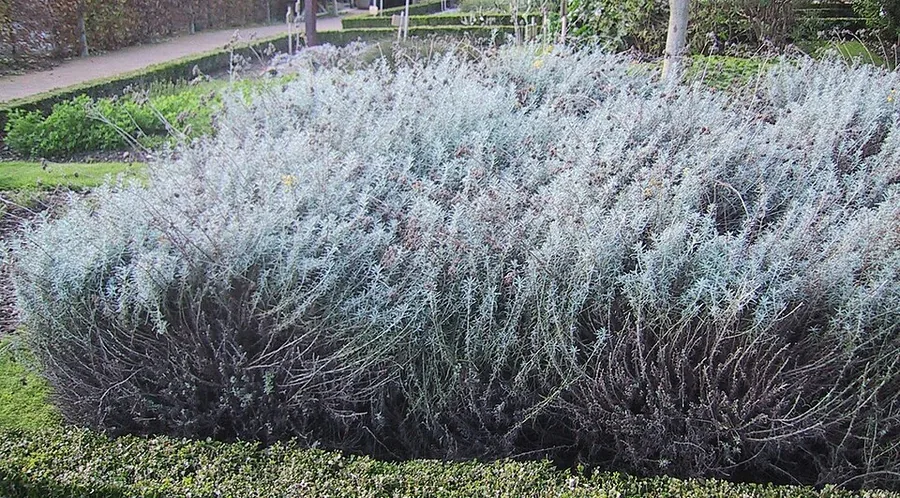
Curry Plant (Helichrysum italicum) belongs to the daisy family, Asteraceae, and grows as a low woody mound of narrow silver leaves topped by clusters of small yellow everlasting flowers in summer. The name points only to its curry-like scent, because the aroma is the whole of the connection. This is neither the source of curry powder, which is a blend of ground spices, nor the curry leaf, which comes from the unrelated tree Murraya koenigii.
Read where it comes from and its care follows logically. The plant evolved on dry, sunny Mediterranean hillsides, so it is built for lean ground and strong light rather than rich beds and steady moisture. That heritage is why sharp drainage and full sun are not optional refinements but the conditions that keep the silver color, the scent, and the compact shape intact.
Treated as an easy, drought-tolerant ornamental, it asks little once it has settled in. The recurring failures all trace back to the same mismatch: too much water, too little light, or too little air, each of which works against a plant adapted to dry, open hillsides. Get those three right and the rest of the care is light-handed.
Care
The short version: give it full sun and sharp, gritty drainage, water only after the top half of the soil dries, and shear it lightly each spring. It tolerates poor soil and drought, so the surest way to lose it is to keep its roots wet.
Light
Full sun is ideal, and partial sun is tolerated rather than preferred. In shade the plant stretches toward the light, which leaves it floppy and weak, while the silver color and the scent both fade because both depend on strong, direct light.
Water
Let the top half of the soil dry before watering again, which usually works out to once every 7 to 14 days. Once established it is drought-tolerant, and the single greatest threat to it is soggy soil, because standing moisture rots the crown.
Soil
It wants a sharp, gritty, well-drained sandy loam in the pH 6.0 to 7.5 range and will get by on poor ground. Heavy clay is the danger: it holds water around the roots, and roots that stay wet rot.
Temperature
The workable band runs 23°F to 86°F (-5°C to 30°C), which places it in hardiness zones 8 to 11. Hard frost is the limit, so in colder areas shelter it or keep it in a pot you can move under cover.
Humidity
Low humidity of 30% to 50% suits it best. Muggy, still air around the foliage invites gray mold, so airflow does more good than misting ever could, and misting only adds the moisture you are trying to avoid.
Feeding
Feed lightly in spring or skip it entirely, since the plant thrives in poor soil. Too much fertilizer backfires, pushing soft, leggy growth and dulling the scent that makes the plant worth growing.
Pruning
Shear lightly each spring to hold a compact mound and head off the woody, leggy, bare-middle growth a subshrub falls into. Do not cut hard into old bare wood, because it is slow to break from old wood and may not refill where you have cut.
Repotting
Pot-grown plants want fresh soil and a roomier pot every 2 to 3 years. The signs that it is ready are roots circling the pot, roots pushing out the drainage holes, and soil that dries out almost as fast as you can water it.
Size & spacing
Expect a low mound of 16 to 24 inches (40 to 60 cm) tall that spreads wider than it stands, reaching 2 to 3 feet (60 to 100 cm) across. Allow it that full width, both to suit its habit and to keep air moving through the foliage.
When to plant
This is a tender, sun-loving plant that resents frost while young, which sets the calendar. Start seed indoors 6 to 8 weeks before the last frost, then set plants out after the last spring frost once the soil has warmed, and look for small yellow everlasting flowers through summer.
Northern hemisphere
Southern hemisphere
Typical months for a temperate climate: start earlier in warm zones, later where spring frosts linger.
- Sow: 6-8 weeks before last frost
- Plant: after the last spring frost when soil has warmed
- Harvest: clusters of small yellow everlasting flowers in summer
Hardiness
USDA hardiness zones: 8–11
Temperature: down to -12°C
Troubleshooting
Most trouble with this plant comes down to conditions rather than pests, and the cause is usually written into the symptom. The three problems below run from a fatal one at the roots to a cosmetic one on the leaves, each explained by what the plant is and where it evolved.
Wilting with a dark, mushy base
When the crown sits in moisture it cannot shed, root rot sets in from below: saturated soil starves the roots of oxygen, the tissue breaks down, and the plant wilts, blackens at the base, and finally collapses. Overwatering or heavy clay that holds water is what feeds the problem.
Fix:
- Stop watering and allow soil to dry
- Improve drainage with grit or sand
- Move container plants to a sunnier, airier spot
- Take healthy stem cuttings to salvage the plant if the crown is failing
Open woody center and flopping stems
Left unsheared, this subshrub naturally goes leggy: it pushes all its energy to the tips, so the lower stems turn bare and woody while the middle thins out. Too little light makes it worse, because a plant in shade stretches toward the light and weakens further.
Fix:
- Shear lightly in spring to encourage compact growth
- Provide full sun
- Replace very old woody plants with fresh cuttings
Fuzzy gray patches on crowded foliage
Damp, still air around tightly packed plants gives gray mold the conditions it needs to take hold, and overhead watering that leaves the foliage wet only encourages it. The result is a fuzzy gray coating or browning leaves where moisture lingers without moving.
Fix:
- Improve spacing and airflow
- Water at the base rather than overhead
- Remove affected foliage
Toxicity
Across cats, dogs, horses, rabbits, livestock, birds, and people, this is a non-toxic ornamental that is not prominently listed as a pet toxin. The strong scent does most of the work of keeping curious mouths away, and the leaves enter cooking only in tiny amounts for aroma, never as a real culinary herb.
Safe for
People · Cats · Dogs · Horses · Rabbits · Livestock · Birds
Cats None
Safe to keep around cats. The pungent silvery foliage tends to put a cat off, and even a curious nibble carries no toxin to worry about.
Dogs None
Safe for dogs. The strong aroma usually discourages a second bite, and a chewed sprig does no real harm.
Horses Safe
Safe for horses; the leaves are not recorded as a toxin, so a mouthful taken in passing causes no trouble.
Rabbits Safe
Safe for rabbits, which seldom show interest anyway because the sharp scent of the leaves rarely tempts them.
Livestock Safe
Safe near cattle, goats, and sheep. They can graze around it without harm, though the heavy scent generally sends them browsing elsewhere.
Birds Safe
Safe for backyard birds and poultry, since neither the leaves nor the flowers carry any toxin.
People Safe
Safe to handle and to grow around children. The leaves go into cooking only in tiny amounts for their scent and are never treated as a true culinary herb.
The aromatic foliage is used only very sparingly for scent; the plant is not a culinary herb in the way kitchen curry is.
Varieties
The forms in cultivation are grown for the same silver foliage and curry-like scent, differing mainly in size and density. The two below are the ones most often offered.
Helichrysum italicum subsp. serotinum
This is a compact, strongly curry-scented form grown chiefly for ornament and sometimes offered in the trade as the dwarf curry plant.
'Nana'
A low, dense dwarf selection whose tight habit suits it to rock gardens and to the edges of paths.
How to propagate
Two routes are available, and one is plainly easier than the other. Cuttings give an exact copy of the parent in a few weeks, while seed is slower and less predictable, which explains why cuttings are the usual choice.
Stem cuttingsEasy
Late spring to summer · 4-8 weeks to root
The reliable route is semi-ripe cuttings taken from late spring through summer. Set them in a gritty, well-drained mix and they root over the next 4 to 8 weeks into plants identical to the parent.
SeedModerate
Spring · Several weeks to germinate and establish
Seed sown in spring works but is slower, with germination and early growth taking several weeks. Because the seedlings come up less uniform than cuttings, most gardeners skip this method.
Myths
The curry plant is where curry powder and the curry leaf used in Indian cooking come from.
It is the source of neither. Curry powder is a blend of ground spices, and the true curry leaf grows on an unrelated tree, Murraya koenigii. With this plant the scent is the only connection, since it merely smells curry-like.
Its leaves can be used freely as a cooking herb, much like rosemary.
The flavor is far too strong for that. A single sprig goes in during cooking and is lifted back out, so it is grown as an ornamental rather than a kitchen herb used by the handful.