Herb · Asteraceae
Feverfew
Tanacetum parthenium
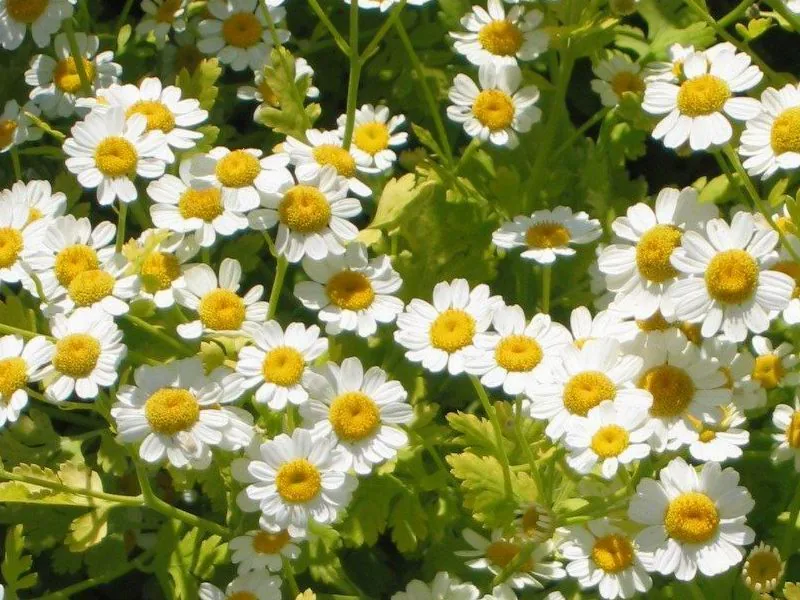
Sited in full sun and lean, dry soil, feverfew flowers in white daisies across the whole summer.
Full sun
Every 7–14 days
90–120 days
USDA 5–9
Overview
Feverfew is a hardy herbaceous perennial in the Asteraceae, carrying small white ray flowers around bright yellow disc centers throughout the warm season. Its fast growth and modest cultural requirements explain its movement from old cottage gardens into general beds, borders, and herb plantings across cooler climates. The aromatic, pinnately divided foliage places it firmly in the genus Tanacetum, closely allied to tansy and to the chrysanthemums.
Its garden value rests on two attributes. The long flowering season supplies cut material and supports pollinators, while a documented history in folk medicine persists in the common name itself. Left unmanaged, the species sets and disperses seed heavily, so an initial clump can develop into a loose colony within a season or two.
These traits do not make it demanding. Provided with sun, free-draining soil, and a hard cut after flowering, feverfew returns each year and recruits seedlings into open ground besides. The single point requiring attention is the self-seeding, which routine deadheading keeps within bounds.
Care
The short version: full sun, lean and free-draining soil, and a deep watering only once the upper half of the profile has dried. Deadhead through the season and cut it back hard after flowering, and it is largely self-maintaining.
Light
Flowering is maximized in full sun, though the plant tolerates light partial shade. In deeper shade reduced irradiance limits flower production and elongates the stems into floppy, leggy growth, so allocate the brightest available position.
Water
Once established the plant is drought-tolerant and intolerant of saturated soil. Water deeply but only after the upper half of the profile has dried, an interval that falls near every 7 to 14 days, allowing the soil to dry between applications.
Soil
Ordinary well-drained garden soil is sufficient, and the plant performs even on poor, dry ground. Maintain a pH between 6.0 and 7.5 and ensure free drainage, since waterlogging is the single condition it will not tolerate.
Temperature
Feverfew is markedly cold-hardy, withstanding temperatures to about -20°F (-29°C) and tolerating summer heat to 90°F (32°C). This breadth allows it to overwinter as a perennial across a wide range of temperate gardens.
Humidity
Ambient outdoor air meets its requirements, so no target value applies. It sits comfortably within the 40% to 60% range characteristic of most gardens, where adequate air movement matters more than the absolute reading.
Feeding
As a light feeder the plant is better suited to lean soil. A single modest application of balanced fertilizer or a little compost in spring suffices, since excess nutrition produces soft growth that lodges and attracts aphids.
Pruning
Deadhead spent flowers through the season to extend bloom and to suppress the heavy self-seeding. After flowering concludes, shear the plant back hard to stimulate compact regrowth, then cut it down in late fall or early spring.
Repotting
Container specimens require repotting annually or as the plant outgrows the pot. Roots circling the rootball, declining vigor, and a substrate that dries almost immediately after watering all indicate the need for more root volume.
Size & spacing
Mature plants attain 18 to 35 inches (45 to 90 cm) in height and form clumps 12 to 24 inches (30 to 60 cm) wide. Allow each plant that spacing so air circulates around the canopy and the roots avoid retained moisture.
When to plant
Feverfew is governed by the seasonal cycle. Sow under cover 6 to 8 weeks before your last frost or sow directly once spring arrives, transplant after the cold has passed, and the white daisies open from early summer through to fall.
Northern hemisphere
Southern hemisphere
Typical months for a temperate climate: start earlier in warm zones, later where spring frosts linger.
- Sow: 6-8 weeks before last frost
- Plant: Spring after danger of frost has passed
- Harvest: White daisy-like flowers with yellow centers from early-mid summer through fall; long bloom period
Hardiness
USDA hardiness zones: 5–9
Temperature: down to -29°C
Troubleshooting
Feverfew is seldom troubled, and most disorders reduce to excess moisture, inadequate light, or its own heavy seeding. Identify the symptom below, then intervene early while correction remains straightforward.
Wilt and chlorosis persisting in waterlogged soil
Wilt that holds on while the soil stays saturated indicates root rot, because waterlogged ground excludes the oxygen roots need and the tissue dies. Examination at the crown reveals brown, soft, foul-smelling roots that can no longer take up water or nutrients, which is why the canopy collapses. Reduce irrigation, correct the drainage, discard plants too far gone, and reset healthy divisions where water cannot accumulate.
Fix:
- Improve drainage and reduce watering
- Remove and discard severely affected plants
- Replant healthy divisions in well-drained soil
Dense volunteer seedlings colonizing the bed
Feverfew is a prolific self-seeder, and a single mature plant can release enough viable seed to colonize the surrounding ground the following season. Deadheading before the capitula set seed interrupts the cycle at its source and is the most reliable control. Any volunteers that establish lift cleanly by hand while the root system is still shallow.
Fix:
- Deadhead before seed set
- Remove unwanted seedlings by hand while young
Distorted, tacky foliage carrying clustered insects
Clustered soft-bodied insects on new shoots and leaf undersides point to aphids, which feed on phloem sap and excrete the sticky honeydew that deforms the surrounding tissue. A firm jet of water dislodges most of the colony by mechanical force alone. Reserve insecticidal soap for heavy populations, and conserve the ladybirds and other predators that regulate aphid numbers naturally.
Fix:
- Spray with a strong jet of water to dislodge aphids
- Apply insecticidal soap if infestation is heavy
- Encourage beneficial predators such as ladybugs
Reduced flowering and a short-lived display
Sparse bloom most often reflects insufficient sunlight or neglected deadheading. A shaded plant allocates less energy to flower initiation and so forms fewer buds, while a plant left to set seed redirects resources from flowering into seed production. Relocate it to full sun and remove spent capitula as they fade, and flowering continues from early summer into fall.
Fix:
- Relocate to a full-sun position
- Deadhead spent flowers regularly to encourage continued bloom
Toxicity
Feverfew has clear garden merit but no place as food or forage. Its foliage contains sesquiterpene lactones that irritate the oral cavity and gut of cats, dogs, and horses, and the same constituents cause contact dermatitis and mouth ulcers in sensitive people. Handle it with gloves and prevent pets and children from chewing the foliage.
Toxic to
Cats · Dogs · Horses · Rabbits · Livestock · Birds · People
Cats Mild
In cats, ingestion of the foliage commonly produces drooling and vomiting, and the gastrointestinal upset can progress to diarrhea. The sap is locally irritant as well, so it may inflame the mouth or raise a rash on contact with skin.
Dogs Mild
Dogs that browse the leaves typically present with drooling and gastrointestinal upset, at times accompanied by loose stools. Direct contact with the sap can redden the oral lining or irritate the skin.
Horses Mild
Grazing horses respond to the bitter foliage with oral irritation, drooling, and a mild episode of colic or loose manure. The bitterness functions as a deterrent, so most animals decline it where alternative forage exists.
Rabbits Caution
The sesquiterpene lactones responsible for toxicity in other animals make feverfew an unsuitable plant for rabbits, so exclude it from the hutch and from any list of acceptable forage.
Livestock Caution
Cattle, sheep, and goats generally reject the bitter leaves, but the plant's compounds can irritate the digestive tract if consumption is forced, so it should not be treated as fodder.
Birds Caution
Evidence that feverfew is safe for pet or backyard birds is lacking, and its irritant oils weigh against exposure, so the plant is best kept clear of cages and aviaries.
People Caution
In sensitive individuals, handling the foliage can provoke contact dermatitis, and chewing fresh leaves frequently produces mouth ulcers and irritation. Use gloves when cutting it back and wash the hands afterward to limit exposure.
Wear gloves when handling foliage; sesquiterpene lactones can cause contact dermatitis in sensitive people, and chewing fresh leaves can cause mouth irritation and ulcers.
Helpline numbers

United States
ASPCA Animal Poison Control: (888) 426-4435 (fee applies)
Poison Control: (800) 222-1222



Canada
Poison Centres: 1-844-764-7669
Varieties
Beyond the species with its plain white daisy, several selections merit attention, distinguished either by double flowers or by colored foliage.
'Aureum' (Golden Feather)
Selected for its bright chartreuse-gold foliage rather than its flowers, it functions in the garden as a foliage plant.
'Flore Pleno'
It replaces the single daisy with fully double, button-like white inflorescences densely packed with petals.
'Snowball'
Its rounded white pompon blooms form a tidy double type that resembles a small chrysanthemum.
How to propagate
Feverfew propagates readily by seed or by division of an established clump, and it supplements both with prolific self-sowing.
SeedEasy
Sow indoors 6-8 weeks before last frost or direct sow in spring; surface sow as seeds need light to germinate · Germination in 1-2 weeks; flowering plants within the first season
Propagation from seed is reliable, whether sown under cover 6 to 8 weeks before your last frost or direct sown in spring. Because the seed is light-dependent for germination, sow it on the surface without covering, after which germination follows in 1 to 2 weeks. Seed-raised plants reach flowering within the first season, and the species self-sows so freely that volunteers can simply be transplanted while young.
DivisionEasy
Spring or early fall · Several weeks to re-establish in the season of division
Division of a mature clump in spring or early fall rejuvenates an aging plant and, being vegetative, produces offspring identical to the parent. Lift the clump, separate it into rooted sections, and replant each division. Re-establishment takes a few weeks, with the divisions resuming growth within the same season.
Myths
Feverfew gets its name because it reliably cures fevers.
The epithet derives from the Latin febrifugia, meaning fever reducer, which records an early intended use. Both traditional practice and the modern studied applications, however, center on headache and migraine rather than fever. It was never a dependable fever remedy, and the name survives only as a relic of historical folk medicine.