Shrub · Rutaceae
Japanese Skimmia
Skimmia japonica
Site it in shade and acidic soil, and this evergreen sets fragrant spring flowers and persistent winter berries.
Partial shade
Every 5–10 days
USDA 6–8
2–7 ft · 0.6–2.1 m
Overview
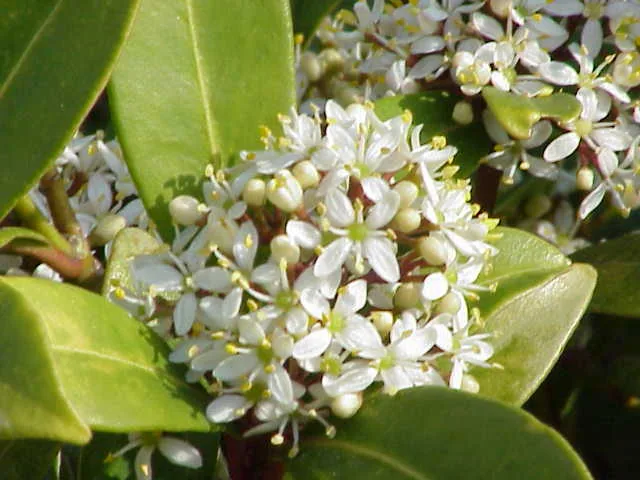
Skimmia japonica is a slow-growing evergreen shrub adapted to the low light of the woodland floor, which is why it performs in shade where sun-demanding plants fail. Native to the woodlands of Japan and China, it sits in the citrus family, Rutaceae, and that lineage accounts for the aromatic oils behind its spicy spring flowers. Its glossy dark foliage persists year round, and clusters of colored buds hold form through the cold months.
The genus is largely dioecious, so individual plants are either male or female, and that reproductive biology governs how it is used. Males produce the more conspicuous flower display, while only pollinated females develop the red drupes that persist into winter. Fruit set therefore depends on a male growing within pollinating distance of the females, which is why the two sexes are planted as a group.
Its value rests on evergreen structure and low maintenance once the site suits it. The controlling factors are narrow: acidic, moisture-retentive soil and consistent shade. Fail on either and the foliage chloroses or scorches, because both are direct responses to soil chemistry and light load, and meeting them holds the shrub in condition across the seasons.
Care
The short version: part to full shade, an acidic and humus-rich soil kept evenly moist, and a male plant within range so the females can fruit.
Light
Skimmia requires part to full shade and reacts poorly to direct sun, which scorches the foliage through excess radiation load. Dappled light, or morning sun paired with afternoon shade, meets its requirement. It tolerates deep shade as well, though flowering diminishes as light falls, since bud formation depends on available energy.
Water
Hold the soil evenly moist but well drained, which in practice means watering every 5 to 10 days and more frequently under heat, when transpiration rises. Its water demand is moderate, so waterlogging is as damaging as drought. The critical point is to prevent the root zone drying out fully in hot weather.
Soil
Grow skimmia in moist, humus-rich, acidic soil that drains freely. Target a pH of 5.0 to 6.5 and incorporate generous organic matter to hold moisture and structure. Above that range iron becomes chemically unavailable to the roots, and the foliage yellows as a direct result.
Temperature
This is a cold-hardy shrub, rated from -9°F (-23°C) at the low limit to roughly 86°F (30°C) at the upper. Heat combined with dry air stresses it more than frost, because the shallow root system cannot keep pace with water loss. That physiological limit is another reason for a shaded position.
Humidity
Ambient outdoor humidity satisfies skimmia, so no target level applies. The operative risk is dry heat, which stresses the plant and favors spider mite outbreaks by accelerating their reproduction. Consistent soil moisture, rather than atmospheric humidity, is the controlling variable.
Feeding
Feed in spring with a balanced or acid-forming ericaceous fertilizer formulated for acid-loving shrubs. One application per season suffices, given the slow growth rate and correspondingly low nutrient demand. The acidifying feed also helps maintain the soil pH that keeps iron available.
Pruning
Skimmia needs minimal pruning because of its slow, self-limiting growth. Shape lightly after flowering to remove damaged or misplaced wood, working after bloom so next season's buds are not sacrificed. Beyond that, allow the naturally mounded habit to develop.
Repotting
Repot a container specimen every 2 to 3 years into a marginally larger pot of fresh acidic medium, refreshing the substrate as much as increasing volume. Roots circling the pot or emerging from the drainage holes signal the need, as does soil that dries faster than before because roots have displaced the medium.
Size & spacing
A mature plant reaches 2 to 7 feet (61 to 213 cm) in height and spreads wider than tall, at 3 to 5 feet (91 to 152 cm). Allow that spacing so the rounded canopy can develop fully and air moves freely between plants, which reduces pest pressure.
When to plant
Skimmia is fully hardy and slow to establish, so timing follows the soil rather than the calendar. Plant in spring or fall while the ground is workable and root disturbance is low. Expect fragrant flowers from late winter into spring, and red berries that ripen on female plants in fall and persist through winter.
Northern hemisphere
Southern hemisphere
Typical months for a temperate climate: start earlier in warm zones, later where spring frosts linger.
- Plant: Spring or fall
- Harvest: Fragrant flowers late winter to spring (around April); red berries on female plants ripen in fall and persist through winter
Hardiness
USDA hardiness zones: 6–8
Temperature: down to -23°C
Troubleshooting
Skimmia holds condition when its roots occupy acidic, shaded soil, so most disorders trace to one of two causes: an unsuitable site or a sap-feeding pest. The foliage records the problem, so read it first. Identify the symptom below, then correct the underlying cause rather than the visible sign.
Yellow leaf tissue framed by green veins
Yellow laminae against green veins is interveinal chlorosis, and the mechanism is soil too alkaline for the roots to take up iron, aggravated by poor drainage. Correct the chemistry: lower the pH with elemental sulfur, supply chelated iron in a form that stays available, and mulch with acidic organic matter to sustain the effect.
Fix:
- Lower soil pH with elemental sulfur or acidifying amendments
- Apply chelated iron and mulch with acidic organic matter
- Improve drainage
Bronze stippling and delicate webbing under the foliage
Bronzed, stippled foliage with fine webbing on the undersides indicates spider mites, whose populations build fastest in hot, dry conditions. Dislodge them with a forceful water spray, then treat with insecticidal soap or horticultural oil to break the cycle. Maintaining soil moisture and shade removes the drought stress that triggered the outbreak.
Fix:
- Spray foliage with water to dislodge mites
- Apply insecticidal soap or horticultural oil
- Improve air humidity and avoid drought stress
Honeydew-slicked leaves, waxy stem bumps, and sooty mold
Honeydew and black sooty mold are secondary signs of a sap-feeding insect, typically scale as raised waxy bumps or aphids on soft new growth, with the mold colonizing their sugary excretion. Remove heavily infested stems to reduce the population, then smother scale with horticultural oil and treat aphids with insecticidal soap.
Fix:
- Prune out heavily infested stems
- Apply horticultural oil to smother scale
- Use insecticidal soap for aphids
Bleaching and browning on sun-exposed foliage
As a shade species, skimmia scorches under direct sun, so browning or bleaching confined to the exposed side while shaded foliage stays green confirms excess light. Relocate it to deeper shade, or supply morning sun with afternoon shade to cap the midday load. Mulch and irrigation reduce the accompanying water stress.
Fix:
- Provide part to full shade or morning sun with afternoon shade
- Transplant to a shadier site if needed
- Mulch and water to reduce stress
Toxicity
Regard the whole plant as poisonous. Foliage and the red berries contain the alkaloid skimmianine together with glycosides, and the fruit poses the greatest risk because its color invites handling and ingestion. Ingestion provokes vomiting and salivation, and a large dose can extend to cardiac and neurological effects, so keep the berries away from children, pets, and grazing stock.
Toxic to
Cats · Dogs · Horses · Rabbits · Livestock · Birds · People
Cats Toxic
Skimmianine in the leaves and berries makes a browsing cat salivate and vomit. A sufficient dose can progress to cardiac disturbance, showing as a rapid or irregular heartbeat.
Dogs Toxic
A dog that ingests the foliage or red berries develops drooling and vomiting soon after. With a larger dose the alkaloids act on cardiac and nervous function.
Horses Toxic
Grazed foliage or fruit leaves a horse hypersalivating, inappetent, and nauseous, with cardiac and neurological effects following a substantial intake.
Rabbits Toxic
The alkaloids are unsafe for a small grazer, and even a modest amount of leaf or berry provokes drooling and gastrointestinal upset, so exclude rabbits from the plant.
Livestock Toxic
Cattle, sheep, and goats respond to the foliage and berries with salivation and digestive upset, escalating to cardiac and nervous involvement after a heavy intake.
Birds Toxic
The berries read as forage, but their skimmianine is toxic, and a bird that ingests the fruit can be poisoned, so treat it as unavailable.
People Caution
No part is edible, and the conspicuous red berries are the principal hazard to a curious child. Ingestion causes nausea and gastrointestinal upset, with possible cardiac effects at a high dose.
Keep berries away from children and pets; wash hands after handling.
Helpline numbers

United States
ASPCA Animal Poison Control: (888) 426-4435 (fee applies)
Poison Control: (800) 222-1222



Canada
Poison Centres: 1-844-764-7669
Varieties
The named skimmias in cultivation differ mainly by sex and by what they contribute, whether flower display, fruit, or scent. The following selections are the ones most often grown.
Rubella
A male clone valued for dark red flower buds that persist through winter and open to fragrant white flowers, contributing display rather than fruit since it sets no berries.
Nymans
A female cultivar that carries heavy crops of large, bright red berries wherever a compatible male grows near enough to pollinate it.
Fragrans
A male cultivar selected for the strong fragrance of its white flower panicles in spring.
Companions
Skimmia thrives next to other shade-loving, acid-soil plants that ask for the same conditions, which makes it an easy fit in a woodland border.
Plant near
Rhododendron: Shares the same acidic soil and part-shade conditions.
Camellia: Both are shade-tolerant broadleaf evergreens that thrive in acidic, moist, well-drained soil.
Hosta: Pairs well as a shade-garden understory companion with similar moisture needs.
How to propagate
Skimmia propagates from cuttings or seed, but vegetative cuttings are preferred because they reproduce the parent exactly, including its sex, which matters for planning fruit set.
Stem cuttingsModerate
Late summer to fall · Several weeks to a few months to root
Cuttings are the reliable method. Take semi-hardwood cuttings in late summer or fall and root them under humidity, allowing several weeks to a few months for a functional root system to form. Because a cutting is a clone, it carries the parent's sex, so both a male and a female are still required nearby for fruit.
SeedModerate
Fall, from ripe berries · Germination can be slow and seedlings take years to mature
Seed cleaned from ripe berries can be sown in fall, but the method demands patience. Germination is slow, seedlings need years to reach flowering size, and the resulting plants are genetically variable, so the sex of any seedling remains unknown until it first flowers.
Myths
Any skimmia, grown by itself, will set a full crop of red berries.
Because skimmia is largely dioecious, plants are separate males and females and only the females bear fruit. Fruit set requires a male within pollinating range, at a working ratio of about one male to six females, so a solitary plant or a lone male produces no berries at all. Plan the planting around that biology, not around a single specimen.