Tree · Rutaceae
Lime
Citrus × latifolia
Supplied with abundant sunlight, sharp drainage, and consistent warmth, a lime tree stays productive for years.
Full sun
Every 5–10 days
USDA 9–11
8–20 ft · 2.4–6.1 m
Overview
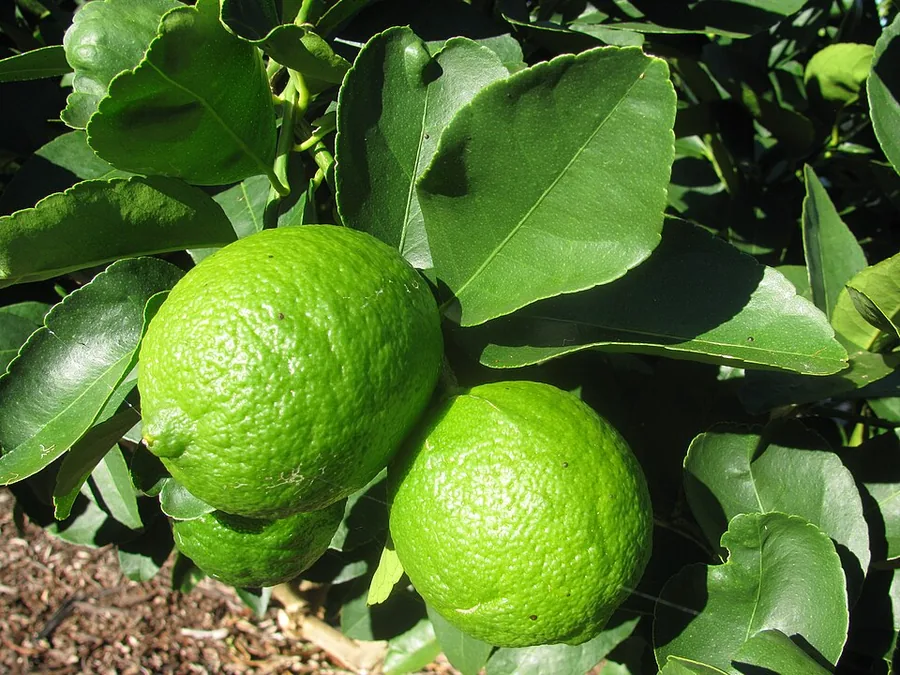
Persian lime is the seedless, smooth-skinned lime that dominates the market, a hybrid citrus cultivated for its sharp, aromatic juice. It develops into a well-formed small tree of 8 to 20 feet (2.5 to 6 m) with a rounded canopy and sets fruit intermittently through much of the year in warm climates. The acid content peaks before color break, which is why the fruit is harvested green.
Physiologically this is a warm-climate species, productive in the ground across USDA zones 9 to 11 and container-grown in colder regions so it can be moved out of frost. Its cold tolerance exceeds that of the Mexican (Key) lime, yet a hard freeze still inflicts real tissue damage. Its cultural requirements reduce to full sun, free-draining soil, and shelter from desiccating wind.
Day to day the tree is undemanding, but a few limiting factors decide the outcome. Saturated soil induces root and foot rot, an out-of-range pH renders nutrients unavailable, and a handful of citrus diseases can end a tree if the early symptoms go unread. Manage drainage and feeding correctly and the reward is a long-lived, productive tree.
Care
The short version: full sun, free-draining sandy loam, and a deep but infrequent irrigation once the top few centimeters dry, supported through the growing season by a citrus fertilizer carrying the trace nutrients limes require.
Light
The tree requires full sun, ideally 8 hours or more a day, to fruit well, since photosynthetic capacity drives cropping. It tolerates a measure of partial sun, but shade thins the canopy and depresses yield.
Water
Irrigate deeply once the top few centimeters of soil dry, then allow full drainage. Established in-ground trees draw on subsoil moisture and need less, whereas containers dry quickly and may require water every few days in heat. The critical fault to avoid is waterlogging, which asphyxiates roots and invites foot and root rot.
Soil
Grow it in well-drained sandy loam, because saturated ground is the commonest cause of citrus loss. A pH of 6.0 to 7.5 keeps nutrients in available form, and a pH that climbs above range is the mechanism behind the interveinal chlorosis of micronutrient deficiency.
Temperature
Limes are adapted to warmth, roughly 32°F to 95°F (0°C to 35°C), and grow continuously where the climate stays mild. Being frost-tender, they call for covering or a move indoors, for potted specimens, whenever temperatures drop.
Humidity
Average humidity of 40% to 60% meets the tree's needs, so no particular target is required. Canopy airflow matters more, because warm, still, saturated air favors the greasy spot fungus and other foliar pathogens.
Feeding
Fertilize through active growth, spring into late summer, with a balanced citrus fertilizer supplying magnesium, manganese, zinc, and iron. Those micronutrients are the very elements limes deplete, and a complete citrus feed forestalls the chlorosis before it appears.
Pruning
Pruning demand is low. Cut out dead, damaged, or crossing branches and any suckers below the graft union, and thin lightly after harvest to open the canopy. Wear gloves, because peel and juice oils combined with sunlight can blister exposed skin.
Repotting
Pot a container tree on every 2 to 3 years in spring. Roots circling the pot or emerging from the drainage holes, water passing straight through, and slowed growth with yellowing leaves are the reliable indicators.
Size & spacing
A mature lime attains 8 to 20 feet (2.5 to 6 m) in height and comparable spread, so allocate genuine room. Confined to a pot it stays smaller, but still requires free air movement around the whole canopy.
When to plant
Because the tree demands warmth and cannot take frost, establish it in spring once soil and air temperatures are reliably high. In warm climates flowering recurs through the year, and the principal crop extends from summer into winter, harvested green when acidity is highest.
Northern hemisphere
Southern hemisphere
Typical months for a temperate climate: start earlier in warm zones, later where spring frosts linger.
- Plant: Plant in spring after all danger of frost, once soil and air are reliably warm.
- Harvest: Blooms on and off year-round in warm climates; main harvest summer into winter, with fruit picked while green for highest acidity.
Hardiness
USDA hardiness zones: 9–11
Temperature: down to -7°C
Troubleshooting
Diagnosis in lime begins at the leaf, where most disorders first express themselves, so inspect the foliage regularly. Some conditions resolve with sanitation or corrected feeding, whereas two of the diseases below are serious enough to warrant reporting. Read the symptom accurately, then intervene before it moves through the tree.
Corky tan lesions haloed in yellow on foliage, twigs, and rind
Corky lesions with a yellow halo indicate citrus canker, a bacterial disease dispersed by wind-driven rain and moved between trees on contaminated pruning tools. It differs from greasy spot because it lesions the fruit rind as well as the foliage, and because leafminer tunnels open the wounds the bacterium enters through. Excise and bag infected growth, disinfect tools between cuts to stop mechanical spread, and report the disease to agricultural authorities wherever it falls under quarantine.
Fix:
- Remove and bag infected leaves and twigs
- Disinfect pruning tools between cuts
- Apply preventive copper sprays
- Report to local agricultural authorities in regulated/quarantine areas
Uneven yellow mottle, twig dieback, and stunted bitter fruit
This is citrus greening, or huanglongbing, a systemic bacterial disease that has devastated citrus across whole regions. The Asian citrus psyllid transmits the pathogen as it feeds, and the diagnostic sign is a blotchy mottle that crosses the leaf midrib asymmetrically rather than mirroring side to side, alongside lopsided fruit with aborted seeds. No cure exists, so removing and destroying an infected tree, controlling the psyllid vector, and reporting the find to agricultural authorities are the only responsible steps.
Fix:
- There is no cure; remove and destroy infected trees to protect others
- Control Asian citrus psyllid with approved insecticides or oils
- Report finds to agricultural authorities
Yellow blotches above and greasy brown blisters beneath the leaves
The pattern points to greasy spot, a fungal disease that colonizes the leaf after spores develop on fallen litter and infect during warm, humid weather. Defoliation peaks in late summer and fall as the lesions mature. Because the pathogen cycles through the leaves decaying beneath the canopy, sanitation to remove that litter, pruning to open airflow, and a copper or oil spray timed for early summer break the cycle.
Fix:
- Rake up and destroy fallen leaves to cut inoculum
- Apply a copper fungicide or horticultural oil in early to mid summer per label
- Prune to improve air circulation
Interveinal yellowing, veins staying green on new flushes
Chlorosis between green veins on the youngest leaves signals a micronutrient shortage of iron, manganese, or zinc, because these elements move poorly within the plant and the newest tissue starves first. Elevated soil pH or waterlogging is usually the driver, since both lock the nutrients out of solution or damage the roots that take them up. Distinguish it from nitrogen deficiency, which yellows older leaves uniformly, then correct with a chelated micronutrient spray, a citrus fertilizer carrying those trace elements, and improved drainage.
Fix:
- Apply a chelated micronutrient foliar spray
- Switch to a citrus fertilizer that includes micronutrients
- Correct drainage and avoid overwatering
Toxicity
The juice and flesh are edible and safe, but the remainder of the tree behaves differently. Its peel, leaves, and seeds concentrate essential oils and psoralens that irritate a pet's gut and can blister human skin under sunlight. Keep prunings, peels, and seeds away from animals, and glove up when working on the tree.
Toxic to
Cats · Dogs · Horses · Rabbits · Livestock · Birds
Safe for
People
Cats Mild
The essential oils concentrated in peel, leaves, and seeds irritate a cat that chews them, producing vomiting, loose stools, and a dull, low mood, with possible irritation of the mouth or skin.
Dogs Mild
A dog that ingests peel, leaves, or seeds reacts to the same oils with gastrointestinal upset and diarrhea, and often appears flat or depressed while the signs run their course.
Horses Mild
Horses respond to the peel and leaf oils much as pets do, going off feed and turning queasy, which is reason enough to keep prunings and dropped fruit clear of the paddock.
Rabbits Caution
A rabbit's sensitive digestive tract does not tolerate the aromatic oils in peel and foliage, and with no benefit to offset the risk, lime is best withheld entirely.
Livestock Caution
Goats and similar stock may take fallen fruit without incident, but a quantity of bitter peel and leaves can disorder the rumen, so exclude them from prunings and windfalls as a precaution.
Birds Caution
A small bird generally tolerates a little of the flesh, yet the concentrated oils in peel and leaves can irritate it, so restrict offerings to a small piece of clean fruit and withhold the rind.
People Fruit safe
The juice and flesh are edible and safe, a culinary staple. The hazard lies in the skin, where peel oils and juice activated by sunlight produce a blistering phytophotodermatitis known as 'margarita burn,' so rinse the hands after handling.
Wear gloves when pruning or zesting; lime juice or peel oils on skin exposed to sunlight can trigger phytophotodermatitis ('margarita burn'), a painful blistering rash.
Helpline numbers

United States
ASPCA Animal Poison Control: (888) 426-4435 (fee applies)
Poison Control: (800) 222-1222



Canada
Poison Centres: 1-844-764-7669
Varieties
Persian lime circulates under several names, and a couple of forms appear at nurseries. The labels resolve to the following.
Bearss
Bearss is the standard Persian lime of US cultivation, most heavily in Florida, a nearly thornless and seedless tree whose smooth-skinned fruit ripens from green to yellow.
Tahiti
Tahiti denotes the same triploid seedless lime as Bearss, a vigorous selection with better cold tolerance than the Mexican (Key) lime.
Companions
A lime grows best beside flowers that pull in the predators of its pests, and worst with grass crowding the trunk where rot likes to start.
Plant near
Sweet alyssum: Its tiny flowers attract hoverflies and parasitic wasps that help control aphids and psyllids.
Marigold: Draws beneficial insects and may deter some pests around young trees.
Keep apart
Turf grass grown up to the trunk: Lawn competes for water and nutrients and holds moisture against the trunk, raising foot-rot risk; keep a mulched, grass-free zone.
How to propagate
Limes are increased by the nursery method of grafting or by slower home techniques, though only grafting confers the full advantages of a rootstock.
GraftingDemanding
Spring to early summer when the bark slips · 1 to 3 years to bearing
Grafting is the standard nursery method for sound horticultural reasons. Budding or grafting the lime onto a disease-resistant, often dwarfing rootstock in spring or early summer, while the bark still slips, confers vigor, cold tolerance, and disease resistance from the rootstock before the tree comes into bearing in 1 to 3 years.
Air layeringModerate
Warm growing season · Several months to root, then 1 to 2 years to establish
Air-layering succeeds in the home garden during the warm growing season, requiring several months to root and a further 1 to 2 years to establish. The horticultural trade-off is that the resulting own-rooted tree forgoes the rootstock, leaving it more cold-tender and more disease-prone.
Stem cuttingsModerate
Semi-hardwood cuttings in late spring or summer · 1 to 2 years
Semi-hardwood cuttings struck in late spring or summer root and reach usable size in roughly 1 to 2 years. As with air-layered material, these own-root plants lack the cold hardiness and disease protection a rootstock would supply.
Myths
Limes are just unripe lemons.
Limes and lemons are distinct citrus species, and Persian lime is a hybrid in its own right, Citrus x latifolia. Growers pick limes green for their sharp acidity, but the fruit turns yellow when fully ripe, a maturation that has nothing to do with an unripe lemon.
A pip extracted from the fruit will yield a true-to-type Persian lime tree.
As a seedless triploid, Persian lime almost never sets a viable seed, which is precisely why nurseries propagate it by grafting. Any stray seedling you did manage to sprout would not come true to the parent tree.
All tissues of the citrus plant are severely toxic to canines and felines.
The fruit flesh provokes no more than a mild gastrointestinal upset. It is the essential oils and psoralens packed into the peel, leaves, and seeds that the ASPCA flags as toxic, not the juicy part people eat.