Tree · Rutaceae
Lemon
Citrus limon
Supply full sun, deep but infrequent water, and frost protection, and a lemon tree crops for decades.
Full sun
Every 7–14 days
USDA 9–11
6–20 ft · 1.8–6 m
Overview
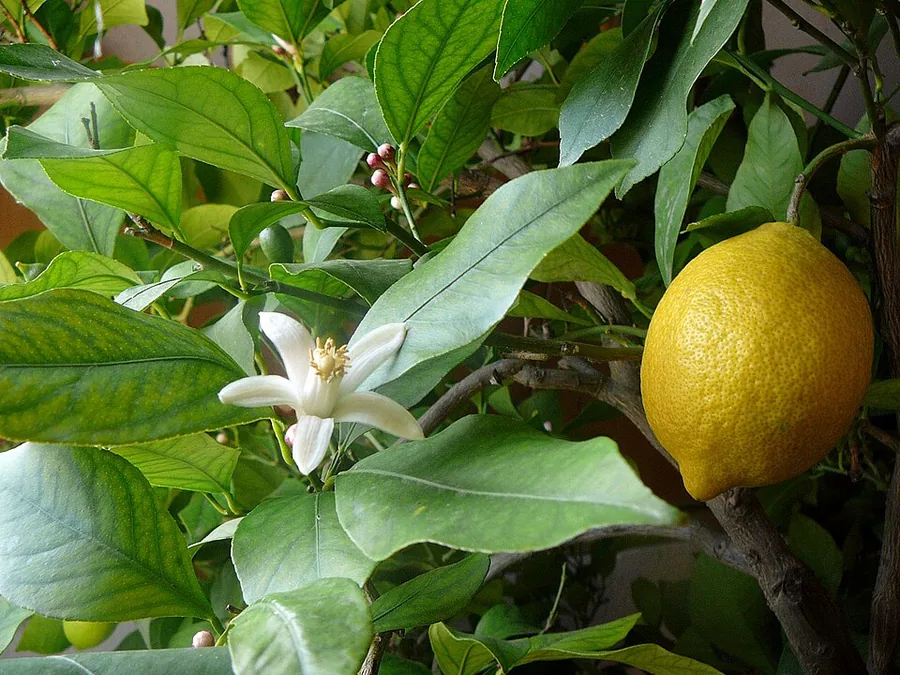
Citrus limon is a small evergreen tree in the family Rutaceae, grown for its glossy foliage, fragrant white blossom, and acidic yellow fruit. The species reached cultivation in the West from Asia by way of the Mediterranean and succeeds where winters remain mild, across zones 9 to 11. In a warm, sunny position it behaves as an everbearing tree, carrying flowers and maturing fruit on the same plant, sometimes throughout the year.
Lemons perform well planted in the ground in frost-free regions and equally well in a large container that can be moved under cover before hard cold. A mature specimen attains 6 to 20 feet (1.8 to 6 m) in height, while dwarfing rootstocks restrict growth to a scale suited to a patio or sunroom. Because nearly all nursery trees are grafted onto a selected rootstock, a plant raised from seed rarely reproduces the character of its parent.
Given its cultural preferences, the lemon is undemanding. The principal risks are frost injury, root anoxia from waterlogging, and a defined set of citrus pests and pathogens. Establish sound drainage and a disciplined watering interval, monitor the tender new flush where most problems begin, and the tree will crop for many years.
Care
The short version: full sun with frost protection, deep irrigation applied only once the top few centimetres of soil have dried, a well-drained soil rich in organic matter, and a monthly citrus feed through the growing season.
Light
The lemon requires full sun, ideally 8 hours or more each day, because photosynthetic supply at that level drives flowering and fruit set. It persists under partial sun or bright indirect light indoors, but reduced irradiance produces etiolated growth and a lighter crop.
Water
Irrigate deeply, then allow the top few centimetres of soil to dry before the next application, typically every 7 to 14 days. Citrus tolerate neither drought stress nor waterlogging, so the interval matters more than the quantity. A containerized tree dries faster and requires closer monitoring in heat.
Soil
Grow the lemon in well-drained sandy loam enriched with organic matter, and never allow the roots to remain saturated. A mildly acidic pH of 5.5 to 6.5 keeps micronutrients available for uptake. Drainage is the single non-negotiable requirement.
Temperature
The lemon favours warmth and functions across roughly 28°F to 100°F (-2°C to 38°C), though temperatures near the lower bound injure tender tissue through frost. Holding a containerized tree above freezing over winter avoids that damage.
Humidity
Average humidity of 30% to 60% meets the species' needs, so supplemental humidity is unnecessary outdoors. Indoors, the dry air adjacent to heating is the chief concern, and an occasional misting or a pebble tray offsets it.
Feeding
Apply a citrus-specific fertilizer higher in nitrogen monthly through the growing season, spring into late summer. Its supplemental iron, zinc, and manganese prevent the interveinal chlorosis to which citrus are predisposed.
Pruning
The lemon needs little structural pruning. Cut lightly in late winter or early spring to remove dead, crossing, or weak wood and any suckers below the graft union, and thin the canopy to admit light and improve airflow.
Repotting
Repot a container tree into a vessel one size larger every 2 to 3 years. Roots circling or emerging from drainage holes, water passing straight through, or growth that stalls despite feeding all indicate the plant is rootbound.
Size & spacing
A mature lemon reaches 6 to 20 feet (1.8 to 6 m) in height with a spread of 5 to 15 feet (1.5 to 4.5 m), so allocate open ground or select a dwarf on reducing rootstock for confined sites or containers.
When to plant
Growth in the lemon is governed by temperature and ceases at frost. Establish young trees in spring once cold has passed and the soil has warmed, since root activity depends on soil temperature. Flowering concentrates in spring, and fruit development is slow, requiring roughly 6 to 9 months to ripen, with the heaviest yields often falling in winter.
Northern hemisphere
Southern hemisphere
Typical months for a temperate climate: start earlier in warm zones, later where spring frosts linger.
- Plant: spring, after all danger of frost has passed and soil has warmed
- Harvest: Blooms mainly in spring but is everbearing in mild climates; fruit ripens roughly 6 to 9 months after bloom, with peaks often in winter. Trees are typically grafted onto rootstock rather than grown from seed.
Hardiness
USDA hardiness zones: 9–11
Temperature: down to -7°C
Troubleshooting
In the lemon, disorders declare themselves on the foliage first, whether from a pest mining the new flush or a fungus colonizing older leaves. Reading these early diagnostic signs allows intervention before decline sets in. Match the symptoms below to the correct cause, then treat while treatment remains effective.
Asymmetric mottling, shoot dieback, and bitter lopsided fruit
This decline is Huanglongbing, or citrus greening, a systemic bacterial disease vectored by the Asian citrus psyllid that starves the phloem and progressively kills the tree. No cure exists, so removing a confirmed tree eliminates the reservoir the psyllid feeds on and protects neighboring trees. The diagnostic clue is that the mottling crosses the leaf veins asymmetrically, which distinguishes it from the symmetrical pattern of a nutrient deficiency, and laboratory confirmation through your agricultural agency is warranted before removal.
Fix:
- There is no cure; remove and dispose of confirmed infected trees to protect the area
- Report suspected cases to your state department of agriculture or extension office
- Manage the Asian citrus psyllid vector
Honeydew, sooty mold, and sessile bumps fixed to the stems
The fixed bumps are scale insects, sap feeders that excrete surplus sugar as honeydew, which in turn feeds the black sooty mold you see on the foliage. A narrow-range horticultural oil works by smothering the sessile bodies, so thorough coverage of stems and leaf undersides is what clears the population after you wipe or prune a light run. Suppressing ants is part of the fix, since they tend the scale for honeydew and drive off the parasitoids and predators that would otherwise regulate it.
Fix:
- Wipe or prune off light infestations
- Apply horticultural or narrow-range oil for thorough coverage
- Control ants to allow natural predators and parasitoids to work
Blistered undersides on mature leaves followed by early leaf fall
The blistering is greasy spot, caused by the fungus Zasmidium citri-griseum, which infects the lower leaf surface during warm humid weather and eventually triggers premature defoliation. Sanitation is central, because the pathogen overwinters in fallen leaves, so raking and removing them cuts next season's inoculum, while pruning to open the canopy shortens the leaf wetness the fungus needs to infect. A copper or oil spray timed to the summer leaf flush protects the vulnerable new foliage where local guidance calls for it.
Fix:
- Rake and remove fallen leaves that harbor spores
- Improve airflow through pruning
- Apply a copper or horticultural oil spray timed to summer leaf flush where recommended
Serpentine mines and distorted young flush
The serpentine mines are cut by the citrus leafminer, whose larvae feed within the epidermis of the soft new flush, which is why the damage stays on tender growth and never touches hardened leaves. Removing the worst-mined flush and restraining nitrogen and light pruning both matter, because each forces the succulent new shoots the larvae must have to develop. On an established tree the loss of leaf area is minor relative to the canopy, so yield holds and a heavy spray does more harm than the pest.
Fix:
- Prune off and dispose of heavily mined new flush
- Avoid excess nitrogen and frequent light pruning that forces vulnerable new flush
- Use horticultural oil on new growth; protect natural parasitoid wasps by avoiding broad-spectrum insecticides
Toxicity
The flesh and juice are safe for people, but the remainder of the plant is not suited to pets. The peel, leaves, and seeds concentrate essential oils and psoralens that the ASPCA classifies as toxic to cats and dogs, and the same compounds can disturb other animals. Keep rinds, prunings, and any concentrated citrus oils out of reach of animals.
Toxic to
Cats · Dogs · Horses · Rabbits · Livestock · Birds
Safe for
People
Cats Mild
When a cat ingests peel or leaf tissue, the limonene and psoralens irritate the gut and produce vomiting, loose stools, drooling, and lethargy. Concentrated citrus oil deposited on the skin can also sensitize it to ultraviolet light.
Dogs Mild
In dogs, chewing bark, leaves, or peel delivers the same oils and psoralens, giving gastrointestinal upset, diarrhea, and low energy. Concentrated citrus oils on the coat can provoke a photosensitive skin reaction, so those products belong nowhere near the animal.
Horses Mild
The peel and leaf oils and psoralens can disturb a horse's digestion and dull its demeanor if consumed. In practice horses reject the bitter foliage, so clinical cases are infrequent.
Rabbits Caution
A rabbit's fermentation-based digestion tolerates the aromatic peel and leaf oils poorly, so both are best excluded. Even the juicy flesh warrants no more than an occasional token amount.
Livestock Caution
Cattle, goats, and sheep seldom browse citrus, yet the oily peel and foliage can irritate the digestive tract when they do. Excluding prunings and windfall fruit from pasture removes the exposure.
Birds Caution
The concentrated rind and leaf oils are poorly metabolized by pet birds and should be withheld. At most a small portion of the plain flesh is defensible.
People Flesh safe
The flesh and juice are standard culinary ingredients and safe to consume. The psoralens in peel and oil are phototoxic, so extended skin contact followed by sun exposure can cause a photosensitive reaction unless the hands are rinsed first.
Keep peels, leaves, seeds, and any concentrated lemon essential oils away from pets, and avoid applying citrus oil products to animals.
Helpline numbers

United States
ASPCA Animal Poison Control: (888) 426-4435 (fee applies)
Poison Control: (800) 222-1222



Canada
Poison Centres: 1-844-764-7669
Varieties
The species includes hundreds of selections, but only a few dominate cultivation and the produce trade. The cultivars below are the ones worth knowing.
Eureka
Eureka is the standard commercial and grocery lemon, effectively thornless and everbearing through the year in mild climates.
Lisbon
Lisbon is a vigorous, thorny selection that bears heavily in defined seasonal flushes and withstands both cold and heat more reliably than Eureka.
Meyer
Meyer is a lemon-mandarin hybrid bearing sweeter, less acidic fruit within a thin orange-tinged rind, which makes it the preferred dwarf container subject.
How to propagate
Lemons are propagated almost exclusively by grafting, though rooting a cutting or sowing seed is possible provided the trade-offs each method carries are accepted.
GraftingDemanding
Active growing season, late spring to summer · A season or more for the graft to take and push growth
Grafting is the standard commercial method because it combines a known lemon scion with a vigorous, disease-resistant rootstock, budded during active growth from late spring into summer when the bark lifts cleanly. The technique demands skill, and the union needs a season or more to callus and begin extending shoots. The reward is a tree that fruits true to the scion while carrying the resistance and vigor of the rootstock.
Stem cuttingsModerate
Spring to early summer from semi-hardwood growth · Several weeks to a few months to root
Semi-hardwood cuttings taken in spring or early summer will root over several weeks to a few months, yielding a tree on its own roots. This is technically simpler than grafting, but the resulting plant forgoes the disease resistance and vigor that a selected rootstock would otherwise confer.
SeedModerate
Sow fresh seed from ripe fruit · Many years to reach fruiting size, if ever true to type
Fresh seed from ripe fruit germinates readily, but the seedlings are genetically variable, frequently thorny, and require many years to reach bearing size, if they ever fruit true to the parent. Consequently seed is reserved largely for breeding programs and rootstock production rather than for raising a tree intended for harvest.
Myths
A supermarket lemon pip will yield a tree matching its parent.
Commercial lemons are propagated by grafting a scion onto a separate rootstock chosen for disease resistance and dependable cropping, so a seedling inherits neither trait faithfully. The seedling that results is typically slow, genetically variable, often thorny, and may never fruit as expected.
Citrus limon and its essential oils pose no hazard to household pets.
The ASPCA classifies Citrus limon as toxic to cats and dogs on the basis of the limonene, linalool, and psoralens concentrated in the peel, leaves, and seeds. Exclude the rind, foliage, and any concentrated citrus oils from any area a pet can reach.