Tree · Rutaceae
Meyer Lemon
Citrus × meyeri
Supply it strong light, even moisture, and shelter from frost, and this dwarf citrus returns fragrant blooms and sweet fruit.
Full sun
Every 5–10 days
USDA 9–11
6–10 ft · 1.8–3 m
Overview
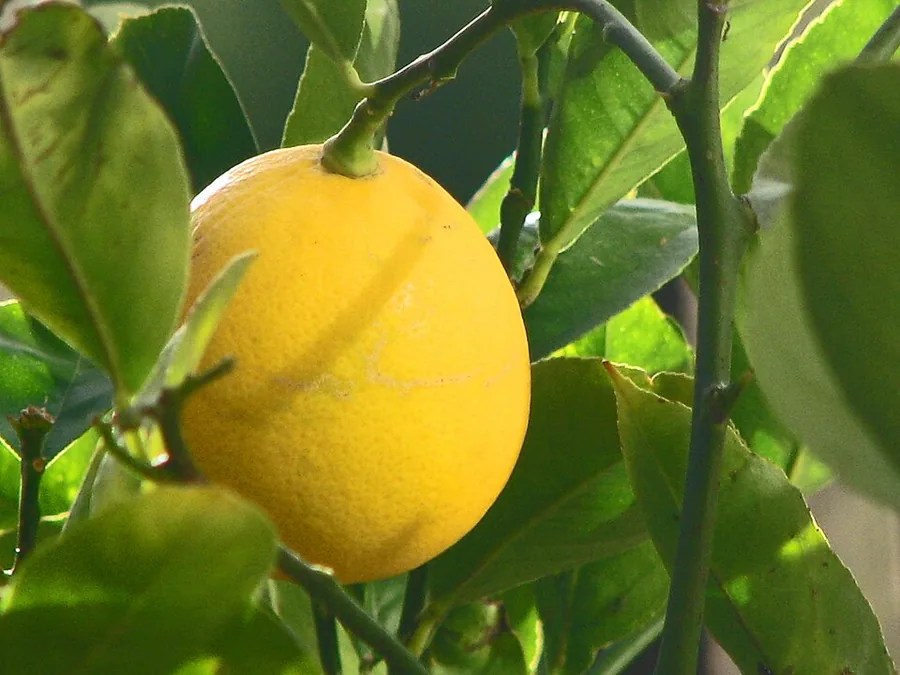
Citrus × meyeri is a hybrid, most probably a lemon crossed with a mandarin or sweet orange, and that genetic background governs its horticultural behavior. The cross yields fruit that is rounder, sweeter, and thinner-skinned than a commercial lemon, carrying enough acid to remain culinary. Its naturally compact stature suits container culture, which is precisely why growers well outside its hardy range keep it as a movable tree.
Grown in open ground the plant develops into a compact evergreen reaching 6 to 10 feet (1.8 to 3 m) tall, with container specimens held well below that ceiling. Flowering is recurrent through the season and concentrated in spring, while fruit matures slowly and ripens chiefly from fall into winter, so a mature tree commonly bears open flowers and developing fruit concurrently.
The species tolerates a range of conditions but responds sharply to a few. Provide strong light, consistent moisture, and protection from hard frost, and the canopy stays dense and productive. Deviate on temperature or irrigation and the tree registers it quickly, shedding leaves or expressing interveinal chlorosis between the veins.
Care
The short version: site it in full sun with a well-draining, slightly acidic mix, irrigate once the top inch dries, feed monthly through the growing season with a citrus fertilizer, and hold the tree above 50°F by moving containers indoors before frost.
Light
Site the tree in full sun, ideally eight or more hours daily, to sustain flowering and fruit set. It tolerates partial sun or light shade, but reduced irradiance thins the canopy and lowers yield. Under indoor culture, place it at the brightest available window or supplement with a grow light.
Water
Allow the top inch (about 3 cm) of mix to dry, then irrigate thoroughly until water exits the drainage holes. Avoid both complete desiccation of the rootball and standing water, and increase frequency for container trees during summer heat. Consistent soil moisture is what retains foliage and holds developing fruit on the tree.
Soil
Grow it in a well-draining, slightly acidic sandy loam or a quality citrus or potting medium. A pH of 6.0 to 7.0 keeps iron, zinc, and manganese soluble and available, which is precisely what prevents the interveinal chlorosis citrus is prone to. Free drainage is the single most decisive factor here.
Temperature
The tree operates across roughly 23°F to 95°F (-5°C to 35°C), but the lower limit governs its survival. With protection it endures near 20°F (-7°C), yet hard frost scorches foliage and can kill an unprotected specimen, so bring containers above 50°F (10°C) before winter sets in.
Humidity
Average interior humidity near 40% to 60% is adequate. Dry winter room air stresses an indoor tree and favors spider mite infestation, so a humidity tray or occasional misting mitigates both. Outdoors the ambient regime requires no intervention.
Feeding
Fertilize monthly from spring through late summer during active growth with a balanced citrus formulation supplying nitrogen alongside iron, zinc, and manganese. Those micronutrients forestall the interveinal chlorosis that develops under deficiency. Withhold feeding through the dormant winter months.
Pruning
Prune lightly after the main harvest to shape the framework and open the canopy to light and air movement. Excise deadwood, crossing branches, and any suckers arising below the graft union. The species tolerates harder cuts, which makes containment of a container tree straightforward.
Repotting
Repot into fresh citrus or potting medium every 2 to 3 years, or sooner once the plant becomes rootbound. Roots circling the container, protruding through drainage holes, or water passing straight through all indicate the interval has arrived. Advance only one pot size so the medium does not remain saturated.
Size & spacing
In open ground a Meyer lemon attains roughly 6 to 10 feet (1.8 to 3 m) in height and 4 to 8 feet (122 to 244 cm) in spread, with container culture holding it below that. Allow an in-ground tree the full spread and adequate airflow around the canopy.
When to plant
Meyer lemon establishes best in the mild winters of zones 9 to 11, where it can remain in the ground year-round. In colder regions, grow it in a container, set it outdoors after the last frost once night temperatures hold above 50°F (10°C), and return it under cover before the cold resumes. Flowering recurs through the year with a spring peak, and fruit ripens across fall and winter.
Northern hemisphere
Southern hemisphere
Typical months for a temperate climate: start earlier in warm zones, later where spring frosts linger.
- Plant: After the last frost when night temperatures stay above 50°F (late spring); in zones below 9 grow in a container and overwinter indoors
- Harvest: Blooms intermittently year-round, heaviest in spring; fruit ripens mainly fall through winter
Hardiness
USDA hardiness zones: 9–11
Temperature: down to -7°C
Troubleshooting
Most disorders in Meyer lemon trace to temperature, irrigation, or nutrition, and the foliage registers them earliest. Interpret those early signals and you can intervene before the tree defoliates. Identify the pattern below, then act while the response still alters the outcome.
Blades yellow between veins that remain green
The pattern of yellow blade tissue over green veins is diagnostic of interveinal chlorosis, in which the tree cannot mobilize iron, zinc, or manganese into the leaf. The lockout is driven by soil pH that has risen above the uptake window or by roots damaged in a saturated mix. Supply a complete citrus fertilizer carrying chelated micronutrients, restore drainage, and correct the pH back into the 6.0 to 7.0 band where those nutrients stay soluble.
Fix:
- Apply a complete citrus fertilizer with chelated micronutrients
- Improve drainage and reduce watering frequency
- Adjust soil pH toward 6.0 to 7.0
Abrupt defoliation across the canopy
Rapid leaf abscission is the tree's response to an acute stress event. The leading trigger is cold near or below 20°F (-7°C), which damages the foliage, but severe drought at the rootball, waterlogged roots, or the sharp environmental swing of a move between indoors and out will provoke the same shedding. Relocate the container to a sheltered position above 50°F (10°C), hold soil moisture even so the roots are neither dry nor saturated, and shield the canopy with frost cloth before a cold event.
Fix:
- Move the container to a sheltered spot above 50°F
- Maintain even soil moisture
- Protect with frost cloth during cold spells
Abscission of flowers and developing fruitlets
A baseline of flower and fruitlet drop is physiological, since the tree sets far more than it can mature and sheds the surplus to match its resources. Loss beyond that baseline signals water or temperature stress, low humidity, or disturbance during bloom. Hold the growing conditions constant, keep the irrigation and feeding regimen unbroken, and avoid repositioning the tree once the flowers have opened and set is underway.
Fix:
- Maintain steady watering and feeding
- Avoid relocating the plant during bloom and fruit set
- Keep humidity moderate when grown indoors
Toxicity
The flesh is edible, but the remainder of the plant is not. The peel, leaves, and seeds contain essential oils and psoralens that irritate an animal's digestive tract and can photosensitize skin on contact. Keep prunings, peel, and windfalls away from cats, dogs, horses, and grazing stock.
Toxic to
Cats · Dogs · Horses · Rabbits · Livestock · Birds
Safe for
People
Cats Mild
In a cat, ingestion of peel or foliage typically produces gastrointestinal upset, presenting as vomiting, loose stools, and lethargy. The essential oils can additionally photosensitize the skin.
Dogs Mild
Dogs that chew leaves, peel, or a dropped fruit usually present with vomiting, diarrhea, and reduced activity. Most cases remain mild, though dermal contact with the oils may cause irritation.
Horses Mild
The same oils and psoralens irritate the equine gut, producing a depressed appetite and loose manure. Exclude prunings and windfalls from the paddock.
Rabbits Caution
Because the peel and leaves carry the irritant oils, they are not a suitable browse for rabbits. Ingestion can suppress appetite or produce soft stools.
Livestock Caution
Ruminants such as goats, sheep, and cattle may develop gastric upset from the oily rind and foliage if they browse the tree or its trimmings. Fence stock out and remove fallen prunings.
Birds Caution
The concentrated oils in peel and leaves can irritate a bird, so that material is best excluded from the diet. A small amount of the plain flesh is the lower-risk option.
People Flesh safe
The juicy flesh is edible and a culinary staple. Prolonged handling of peel or foliage can render skin photosensitive, so washing after pruning is prudent.
Keep prunings, peels, leaves, and seeds away from pets; the fleshy fruit is generally only a mild stomach irritant in small amounts.
Helpline numbers

United States
ASPCA Animal Poison Control: (888) 426-4435 (fee applies)
Poison Control: (800) 222-1222



Canada
Poison Centres: 1-844-764-7669
Varieties
Only two clones are worth distinguishing, and the difference between them turns entirely on a virus.
Improved Meyer
This virus-free, tristeza-tested selection released in the 1970s became the standard nursery clone once the original trees were removed as symptomless carriers of citrus tristeza virus.
Original (True) Meyer
The pre-1970s clone was withdrawn from cultivation because it harbored citrus tristeza virus asymptomatically, spreading it without ever expressing a symptom.
How to propagate
Meyer lemon is among the more tractable citrus to propagate at home, and the method you select determines how soon the tree comes into bearing.
Stem cuttingsModerate
Late spring to summer from semi-hardwood growth · 6 to 12 weeks to root; 2 to 3 years to first fruit
Meyer lemon strikes from cuttings far more readily than most citrus, so it is frequently grown on its own roots rather than grafted. Collect semi-hardwood wood in late spring or summer; rooting takes 6 to 12 weeks, and first fruiting follows roughly 2 to 3 years later.
GraftingDemanding
Spring or late summer (T-budding) · A few weeks to take; 1 to 2 years to a field-ready tree
Budding onto a disease-tolerant rootstock yields a more vigorous, more resistant tree than one on its own roots. Perform the T-budding in spring or late summer; the bud unites within a few weeks, and a field-ready tree develops over 1 to 2 years.
SeedModerate
Sow fresh seed in warmth · Several years to fruit
Fresh seed germinates under warmth, but the seedlings develop slowly and are not reliably true to type, reaching fruiting age only after several years. It is an instructive exercise rather than a dependable method for genuine Meyer lemons.
Myths
A Meyer lemon is a true lemon.
Taxonomically it is a hybrid, most probably a lemon crossed with a mandarin or sweet orange. That parentage accounts for fruit that is sweeter, less acidic, and thin-skinned, and for a habit that stays more compact and carries better cold tolerance than a true lemon.
You can grow a true Meyer lemon from a saved seed.
Seed-grown plants are slow to establish and do not come true, since they will not reliably reproduce the parent. A named Meyer lemon is propagated vegetatively by cuttings or grafting, the only route that preserves the clone true to type.