Tree · Rutaceae
Grapefruit
Citrus × paradisi
Give it full sun, deep watering, and frost-free warmth, and a grapefruit tree carries fruit through winter.
Full sun
Every 7–14 days
55–100°F · 13–38°C
USDA 9–11
Overview
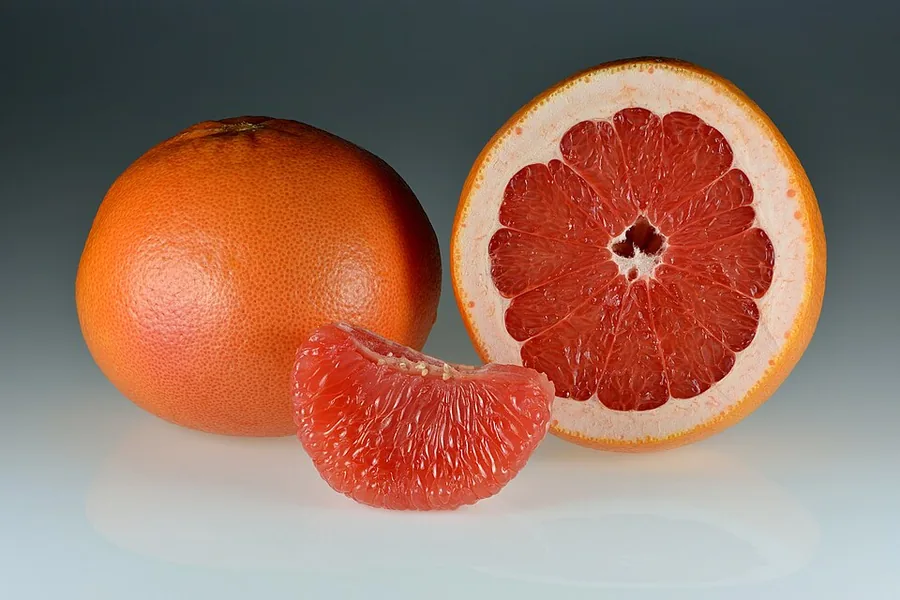
Grapefruit is a large evergreen citrus with heavy glossy foliage, notable among fruit trees for holding ripe fruit through the cool season. It arose as a hybrid of the pomelo and the sweet orange, first recorded in the Caribbean before entering commercial cultivation. A well-grown specimen attains 15 to 20 feet (4.5 to 6 m), so the site must offer genuine vertical and lateral clearance.
Temperature governs its performance more than any other factor. Grapefruit succeeds in USDA zones 9 to 11, where mild winters avoid freeze injury and long, hot summers supply the accumulated heat the fruit needs to develop sugars. Where winters fall below that range, dwarf trees in containers can be relocated under protection through the cold months.
Cultural demands are modest once the tree is established. Full sun, deep and well-spaced irrigation, and a consistent citrus feeding program address nearly all of its requirements. Meet those and a single tree can yield more fruit than one household consumes, ripening gradually from fall into spring.
Care
The short version: full sun and frost-free warmth, deep watering once the top few inches dry, well-drained sandy loam, and a citrus fertilizer supplying micronutrients across the growing season.
Light
Grapefruit requires full sun, and yield tracks the light it receives. In shade the canopy grows leggy, fruit set falls, and the fruit that forms sweetens poorly for lack of photosynthate. Site it in the most open, brightly lit position available.
Water
Irrigate deeply, then allow the top few inches of soil to dry before watering again, an interval that typically falls near every 7 to 14 days. Shorten it during heat and for container trees, whose limited root volume dries faster. Even, steady moisture is what prevents the fruit from splitting.
Soil
Establish the tree in well-drained sandy loam, because citrus roots are prone to rot in saturated ground. A pH of 6.0 and 7.5 keeps nutrients available, and adequate drainage outweighs soil fertility.
Temperature
Grapefruit performs across a broad band, roughly 55°F to 100°F (13°C to 38°C), but has no tolerance of hard frost. A freeze injures the fruit and, at sufficient depth, the woody structure of the tree.
Humidity
Average ambient humidity near 40% to 60% satisfies a grapefruit tree, and outdoors there is no target to manage. Good air movement through the canopy contributes more to tree health, by limiting fungal conditions, than any humidity figure.
Feeding
Supply a citrus fertilizer carrying nitrogen together with micronutrients such as iron, zinc, and manganese. Apply through the growing season from spring into late summer, then reduce as temperatures fall, since late feeding forces soft, pest-susceptible growth.
Pruning
Grapefruit demands little pruning. In late winter to early spring, remove dead, damaged, or crossing branches and cut away suckers arising below the graft union, which would otherwise divert vigor. Allow the tree to develop its natural full canopy thereafter.
Repotting
A container-grown dwarf tree needs a larger pot every 2 to 3 years. Roots protruding from the drainage holes, arrested growth, and water passing straight through the medium all indicate the roots have filled the container.
Size & spacing
A full-size grapefruit reaches 15 to 20 feet (4.5 to 6 m) in height and spreads almost as far, roughly 12 to 15 feet (3.6 to 4.5 m). Allot that clearance so the canopy develops fully and air circulates freely through it.
When to plant
Grapefruit follows a long, heat-driven cycle that tolerates no frost. Transplant young trees in spring after cold has passed, anticipate flowering around March and April, and harvest from late fall into spring as the fruit reaches maturity.
Northern hemisphere
Southern hemisphere
Typical months for a temperate climate: start earlier in warm zones, later where spring frosts linger.
- Plant: Spring, after all danger of frost has passed.
- Harvest: Blooms in spring (mainly March to April); fruit matures over fall to spring and is harvested roughly November to May depending on variety.
Hardiness
USDA hardiness zones: 9–11
Temperature: down to -7°C
Troubleshooting
Grapefruit registers stress first in its foliage and its fruit, and the visible pattern usually identifies the cause. Match the description below, then intervene before the disorder becomes established.
Leaves turning yellow
Chlorosis reflects either a nutrient shortfall or compromised roots, and the pattern on the leaf tells them apart. Uniform yellowing across the blade indicates a nitrogen shortage, whereas yellow tissue framed by green veins signals iron or magnesium, both of which move poorly when uptake is limited. Because waterlogged roots produce the same discoloration by starving the tree of oxygen, confirm drainage before you correct the feed.
Fix:
- Apply a balanced citrus fertilizer with micronutrients
- Correct drainage and avoid waterlogging
Fruit dropping early or splitting open
Both symptoms follow uneven soil moisture acting on developing fruit. When a dry period ends in heavy irrigation or rain, the pulp takes up water and expands faster than the rind can grow to accommodate it, so the skin ruptures. Deep watering on a consistent schedule, reinforced by mulch that buffers the soil against wide swings, keeps expansion gradual and the rind intact.
Fix:
- Provide consistent, deep irrigation
- Mulch to buffer soil moisture
Silvery winding trails on curled new leaves
Serpentine silver mines are the feeding galleries of the citrus leafminer, whose larvae burrow inside the soft cuticle of expanding foliage. The insect can only exploit immature tissue, so a mature tree tolerates the damage with no measurable loss and needs no treatment. Restraint with nitrogen matters here, because each nitrogen-driven flush of tender growth supplies exactly the young leaves the moth targets.
Fix:
- Tolerate light damage on mature trees
- Avoid excess nitrogen that triggers vulnerable new flushes
Toxicity
The pulp is a healthful food for people, but the remainder of the tree behaves differently. Peel and leaves hold essential oils and psoralens that produce mild digestive upset in cats, dogs, and horses and can sensitize skin to sunlight. Keep peels, leaves, and fallen fruit away from animals, and note that for people the salient hazard is grapefruit's pronounced interaction with many medications.
Toxic to
Cats · Dogs · Horses · Rabbits · Livestock · Birds
Safe for
People
Cats Mild
The essential oils and psoralens concentrated in peel and leaf tissue irritate a cat's digestive tract, producing vomiting, loose stools, and lethargy. The psoralens are photosensitizing, so skin exposure can make an affected cat more reactive to sunlight.
Dogs Mild
In dogs the same peel oils and psoralens provoke vomiting, diarrhea, and dullness once the rind or leaves are chewed. The pulp carries far lower concentrations of these compounds, which is why the oily skin is the fraction that warrants control.
Horses Mild
Citrus oils and psoralens can disturb a horse's gastrointestinal function and depress its energy. Voluntary intake is uncommon, so exposure typically comes from windfall fruit or discarded peel left within reach of the animal.
Rabbits Caution
Citrus falls outside a rabbit's evolved herbivore diet, and the volatile oils in the rind readily disturb a fermentation-dependent gut. Withhold peel and leaves without exception, and regard even the flesh as unsuitable.
Livestock Caution
Cattle, goats, and sheep may sample windfall fruit, but the peel oils can disrupt rumen microbial balance and suppress feed intake. Removing fallen grapefruit from grazed pasture eliminates the principal exposure.
Birds Caution
Many pet birds handle a little ripe pulp, yet the peel and its concentrated oils are not tolerated. Restrict offerings to small, peeled portions and exclude the rind and leaves entirely.
People Flesh safe
The pulp is a nutritious food eaten routinely. The material risk lies in pharmacology: furanocoumarins can elevate the plasma concentration of numerous medications, so anyone on prescriptions should confirm compatibility with a pharmacist.
Grapefruit furanocoumarins (such as bergamottin) inhibit intestinal CYP3A4, producing the well-known grapefruit drug interaction that can raise blood levels of many medications including some statins, blood pressure drugs, and anti-anxiety drugs; consult a pharmacist if you take affected medicines (FDA, NIH).
Helpline numbers

United States
ASPCA Animal Poison Control: (888) 426-4435 (fee applies)
Poison Control: (800) 222-1222



Canada
Poison Centres: 1-844-764-7669
Varieties
Grapefruit selections separate mainly by flesh pigmentation and seed content. The cultivars below are the ones most often encountered, spanning the historic white types through the deeply pigmented reds.
Ruby Red (Redblush)
This cultivar was the first red-fleshed grapefruit to be patented and remains valued for its pink-red pulp and near-seedless fruit.
Marsh
A white seedless selection with pale yellow flesh, Marsh served as the commercial benchmark for many decades.
Star Ruby
Star Ruby yields intensely red, nearly seedless fruit but shows notably lower tolerance of cold and herbicides than other selections.
Rio Red
A Texas commercial standard, Rio Red retains its deep red flesh color reliably across the entire harvest season.
How to propagate
Grapefruit is propagated by two methods that differ sharply in outcome and in time to fruit. Grafting delivers a predictable tree without long delay, while seed offers an easy but genetically uncertain and slow alternative.
GraftingModerate
Spring to summer when bark slips easily · 1 to 2 years to a transplantable tree
Grafting is the standard nursery method, and its advantages are practical. Performed in spring or summer while the bark slips easily, it preserves the parent cultivar's identity and confers the disease and cold tolerance carried by the rootstock. Expect 1 to 2 years before the grafted plant develops into a tree ready to transplant.
SeedEasy
Spring · Several years; fruiting may take 5 or more years
Seed propagation is easy to attempt but genetically unreliable. Pips sown in spring germinate readily, yet the resulting seedlings need not resemble the parent and may require 5 or more years to fruit. Treat it as an instructive exercise rather than a dependable route to harvest.
Myths
Grapefruit juice is a harmless, natural way to wash down medication.
Grapefruit contains furanocoumarins that irreversibly inhibit intestinal CYP3A4, the enzyme that metabolizes many oral drugs, so blood levels can rise into a hazardous range. Because the enzyme must be resynthesized, the effect persists for most of a day and cannot be avoided simply by separating the juice from the dose. Consult a pharmacist or physician before combining grapefruit with any prescription.
Citrus fruit is completely safe for dogs and cats.
The ASPCA classifies grapefruit as toxic to cats and dogs, chiefly because of the essential oils and psoralens concentrated in the peel. Ingestion of rind or leaves can lead to vomiting, diarrhea, and depression in an affected animal. Store peels and trimmings where pets cannot reach them.