Tree · Rutaceae
Kumquat
Citrus japonica
Provide full sun, even moisture, and shelter from hard frost, and this compact citrus fruits through the winter.
Full sun
Every 5–10 days
USDA 8–11
8–15 ft · 2.4–4.6 m
Overview
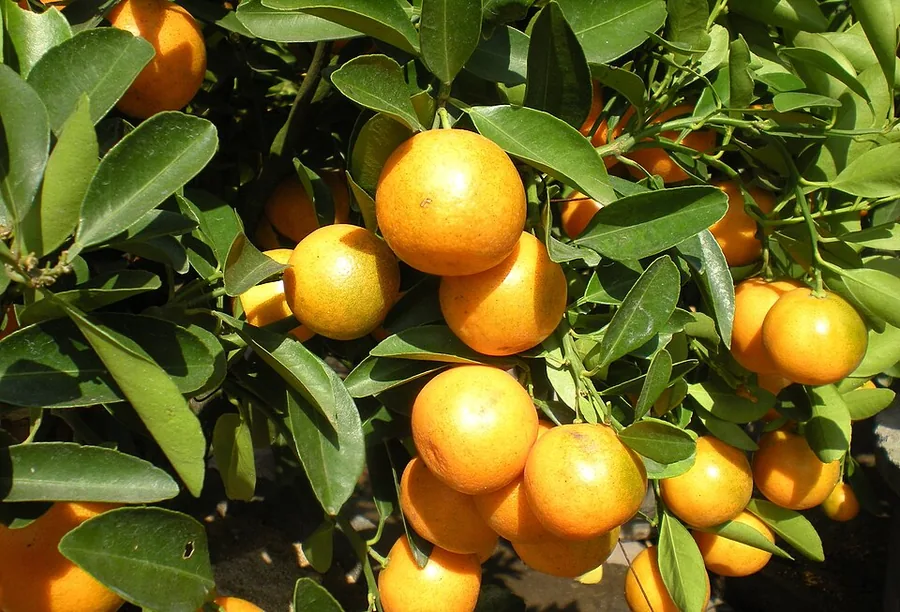
The kumquat is a compact, slow-growing member of the citrus group that ripens thumb-sized fruit eaten whole, rind and all. Native to East Asia, it performs well in a sunny site or a large container that can be moved under cover as temperatures fall. Its defining oddity is an inverted flavor structure, a sweet rind enclosing tart flesh, which reverses the usual citrus arrangement.
Its practical advantage over other citrus is exceptional cold tolerance. Where a lemon or lime declines below freezing, a kumquat endures a short cold spell and retains fruit on the branch. Combined with a slow, restrained growth habit, that hardiness makes it one of the more manageable citrus in climates with genuine winters.
Cultural demands are modest once the tree is established. Sun, consistent moisture, and feeding through the active season cover nearly all of its requirements. The critical variable is drainage, because saturated roots account for more kumquat failures than cold exposure ever does.
Care
The short version: full sun, fast-draining loamy soil, and consistent moisture that never leaves the roots saturated. Feed monthly through spring and summer, and shelter the tree from a hard freeze.
Light
Site a kumquat in full sun, six or more hours daily, since maximum light drives the heaviest crop and the best fruit sweetness. It tolerates light afternoon shade in hot climates, but deep shade thins the canopy and reduces yield.
Water
Maintain the soil evenly moist, allowing the surface to dry slightly between waterings, which usually falls near every 5 to 10 days. Heat and container culture accelerate drying and warrant more frequent irrigation, yet free drainage remains essential, because saturated roots are the fastest route to decline.
Soil
Grow it in loamy, well-draining medium on the acidic side, near a pH of 6.0 to 6.5. Drainage outweighs fertility here, since standing water, not low nutrition, is what kills kumquats.
Temperature
The tree performs across a broad span, roughly 10°F to 100°F (-12°C to 38°C), placing it among the hardier citrus. It nonetheless benefits from protection during a hard freeze, particularly in its early years.
Humidity
Ambient humidity of about 40% to 60% satisfies a kumquat, so outdoor levels require no adjustment. Indoors, where winter heating dries the air, supplemental humidity prevents leaf-margin browning.
Feeding
Fertilize monthly through spring and summer during active growth with a balanced citrus formulation. Select one supplying the micronutrients citrus requires, specifically iron, zinc, and manganese, since a deficiency in these is what induces leaf yellowing.
Pruning
The tree needs minimal pruning. Remove dead, damaged, or crossing branches and any rootstock suckers in late winter to early spring, after the harvest concludes.
Repotting
A container-grown kumquat needs a larger pot every 2 to 3 years, or sooner once roots circle and water passes through too rapidly. Roots emerging from drainage holes and a decline in growth are the remaining indicators.
Size & spacing
Growth is slow toward a mature height of about 8 to 15 feet (2.4 to 4.5 m) with a 6 to 10 foot (1.8 to 3 m) spread. Container culture restrains it toward the lower end, which is why it adapts so readily to indoor placement.
When to plant
The kumquat follows a long, cool-season cycle. Flowering occurs in late spring, around May and June, after which the fruit ripens gradually through the colder months, extending the harvest from October into March. Establish new trees in spring, once the danger of frost has passed.
Northern hemisphere
Southern hemisphere
Typical months for a temperate climate: start earlier in warm zones, later where spring frosts linger.
- Plant: Spring, after danger of frost has passed
- Harvest: Blooms late spring (May to June); fruit ripens October through March
Hardiness
USDA hardiness zones: 8–11
Temperature: down to -12°C
Troubleshooting
Most kumquat disorders register in the foliage or the fruit and resolve to three underlying factors: water, nutrition, or cold. Reading the early signs lets you correct the cause before it advances. Identify the pattern below, then intervene while intervention still changes the outcome.
Chlorosis in the foliage
The distribution of the yellow tells you the cause. Yellowing confined to the tissue between green veins signals a micronutrient deficiency, typically iron or zinc, because those elements move poorly within the plant and the newest leaves starve first, whereas a uniform pale wash across older leaves points to nitrogen. Waterlogged, poorly drained soil produces the same chlorosis by suffocating the roots and blocking uptake, so correct drainage, ease off the water, and supply a chelated citrus fertilizer the roots can actually absorb.
Fix:
- Apply a citrus fertilizer with chelated micronutrients
- Correct drainage and reduce watering frequency
Fruit abscission and poor set
A kumquat aborts developing fruit under physiological stress, and inconsistent soil moisture is the leading trigger, since both drought and waterlogging disrupt the root function that supports the crop. Cold injury and abrupt temperature swings force the same abscission response. Audit recent irrigation and weather for shriveled or cold-burned tissue, then hold the soil evenly moist and shelter the tree ahead of a frost to keep the fruit attached.
Fix:
- Maintain consistent soil moisture
- Protect the tree from frost during cold snaps
Sooty mold over sticky foliage
The black film is sooty mold, a saprophytic fungus that colonizes the sugary honeydew excreted by sap-feeding insects rather than attacking the leaf itself. Its presence is therefore a symptom of an infestation, so examine the leaf undersides and stems for soft scale, whiteflies, or aphids. Suppress the insects with horticultural oil or insecticidal soap, which removes the food source, and the residual mold can then be washed away.
Fix:
- Treat the insect pest with horticultural oil or insecticidal soap
- Wash off the mold once pests are controlled
Toxicity
The fruit is safe and enjoyable for people, but the remainder of the tree is not suitable for pets. Peel, leaves, and stems contain essential oils and psoralens that irritate the digestive tract, so a cat, dog, or horse that ingests them usually develops a mild stomach upset. Remove prunings and dropped fruit from areas where animals graze.
Toxic to
Cats · Dogs · Horses · Rabbits · Livestock · Birds
Safe for
People
Cats Mild
Ingesting peel or leaf tissue provokes gastrointestinal irritation in cats, presenting as drooling, vomiting, and loose stools. Direct contact with the essential oils can also produce localized skin redness.
Dogs Mild
A dog that chews foliage or fallen fruit typically shows vomiting, diarrhea, and lethargy. The reaction generally remains mild and resolves without intervention.
Horses Mild
The same essential oils and psoralens irritate an equine digestive tract, producing colic-like discomfort and loose droppings. Excluding prunings and windfall from the paddock removes the exposure.
Rabbits Caution
A rabbit's sensitive hindgut is easily disrupted by the oil-laden peel and bitter foliage. For that reason kumquat should not be fed as forage.
Livestock Caution
Goats, sheep, and cattle may sample windfall with little effect, yet a substantial quantity of oily peel and foliage can disturb rumen function and depress feed intake. Restricting access to fallen fruit is the sensible precaution.
Birds Caution
Avian digestion is sensitive to citrus essential oils, which readily cause gut irritation. A small portion of flesh is tolerated, but the peel and leaves warrant exclusion.
People Fruit safe
The entire fruit, rind included, is edible and widely enjoyed. Prolonged handling of cut peel or foliage may irritate sensitive skin owing to the essential oils.
The fruit flesh is edible to people, but pets chewing peel, leaves, or large amounts of plant material can get mild GI irritation; essential oils may also irritate skin.
Helpline numbers

United States
ASPCA Animal Poison Control: (888) 426-4435 (fee applies)
Poison Control: (800) 222-1222



Canada
Poison Centres: 1-844-764-7669
Varieties
Only a small number of kumquats reach gardens and markets, and they are distinguished chiefly by fruit shape, sweetness, and cold tolerance. The selections below are the ones worth knowing.
Nagami
Nagami is the most widely cultivated kumquat, bearing an oval fruit whose tart flesh contrasts with a sweet, edible rind.
Meiwa
Meiwa carries a round, larger, nearly seedless fruit of higher sweetness, which makes it the preferred selection for fresh eating.
Marumi
Marumi produces a round, slightly tart fruit on a thorny tree that exhibits better cold tolerance than the others.
How to propagate
Kumquats are propagated by grafting, cuttings, or seed, and the method chosen governs both how quickly the tree fruits and how faithfully it reproduces the parent.
GraftingModerate
Spring to early summer when bark slips · 1 to 2 years to a sizable tree
Grafting is the standard commercial technique because it preserves the cultivar exactly. Performed in spring or early summer while the bark slips and the cambium separates cleanly, the union yields a true-to-type tree that grows vigorously and retains the parent's cold tolerance, developing into a sizable tree within 1 to 2 years.
Stem cuttingsModerate
Late spring to summer · Several months to root
Cuttings taken in late spring or summer will root, though slowly and unevenly, often requiring several months to form a viable root system. Applying rooting hormone and supplying bottom heat raises the rooting percentage and shortens the wait.
SeedEasy
Spring · Several years to fruiting
Seed sown in spring is the least demanding method but the least predictable, since the seedlings frequently fail to reproduce the parent and may need several years to reach fruiting. Consequently seedlings serve chiefly as rootstock or as an experiment rather than a dependable fruiting crop.
Myths
You should peel a kumquat before eating it because the skin is the bad part.
The kumquat is the uncommon citrus consumed whole. Its sweetness resides in the rind and its acidity in the flesh, inverting the arrangement of an orange, so removing the peel discards the most palatable portion. The rind is entirely edible to people and is intended to be eaten.
Kumquats are too tender to survive any frost.
Among cultivated citrus, the kumquat ranks with the most cold-tolerant. It withstands brief excursions well below freezing, with sources documenting hardiness to approximately 10°F (-12°C).