Tree · Rutaceae
Key Lime
Citrus × aurantiifolia
Provide full sun, warmth, and free-draining soil, and this thorny citrus repays the effort with sharp, aromatic limes.
Full sun
Every 5–10 days
USDA 9–11
6–13 ft · 1.8–4 m
Overview
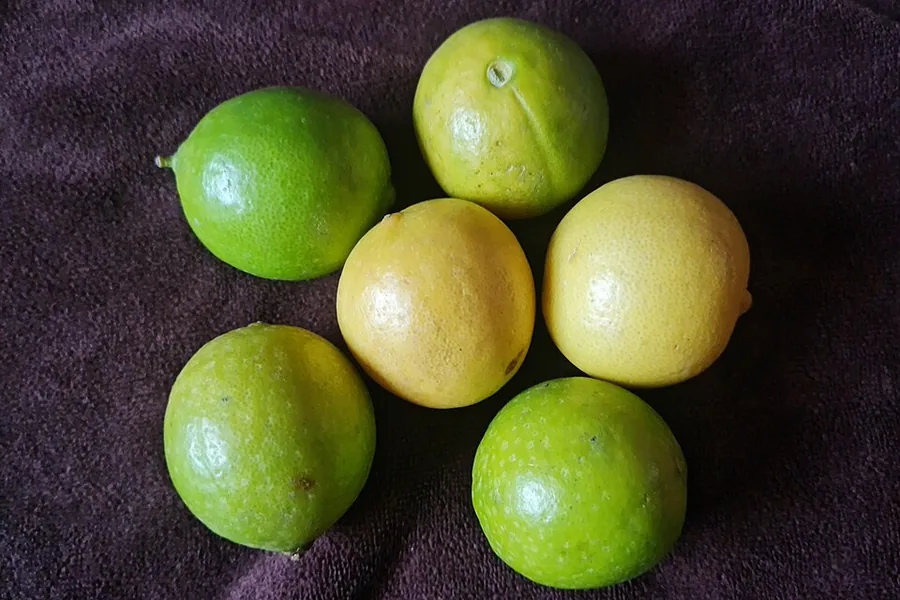
The Key lime is a small, thorny citrus tree cultivated for its tart, intensely aromatic fruit. It reached the New World by way of the Caribbean and adapted so readily to the Florida Keys that the islands attached their name to it. Each lime is small, an inch or two across, and dense with seeds and volatile oils, which is precisely what qualifies it as the fruit behind an authentic Key lime pie.
As an everbearing species, it flowers and sets fruit across a long window rather than in a single concentrated crop. The heaviest bloom occurs in spring, and the fruit matures through summer into fall, harvested while the rind is still green. Unchecked, the tree attains 6 to 13 feet (1.8 to 4 m) in height, but it responds well to container culture and pruning, which hold it to a manageable size on a patio or in a bright interior.
Cold sensitivity is the tree's defining limitation. It requires heat, direct sun, and rapidly draining soil, and it withstands a brief dry interval better than most citrus. The more consequential threat is disease, since citrus canker and citrus greening have redrawn the map of where and how this tree can be grown.
Care
The short version: full sun and warmth, soil that drains freely, and steady moisture once the tree is established. Feed lightly through the growing season, protect it from frost, and prune only to shape the tree or restrain its size.
Light
Key lime demands full sun, since flowering and fruit sugar accumulation both depend on maximum light. It tolerates partial sun, but the yield diminishes and the canopy elongates as available light drops. Indoors, position it at the brightest available window.
Water
Allow the top half of the soil to dry between waterings, which corresponds to roughly every 5 to 10 days according to heat and pot volume. The tree endures a short drought better than most citrus, yet it carries its heaviest crop under steady moisture. Standing water in the soil must be avoided at all times.
Soil
Grow it in well-drained loam, silt, or sandy soil, because rapid drainage matters to this species more than any other soil factor. It is indifferent to pH across a broad 6.0 to 8.0 band. Heavy, waterlogged ground is the single condition it will not tolerate.
Temperature
Key lime is the most cold-sensitive of the common citrus, thriving in genuine warmth and functioning from 32°F to 100°F (0°C to 38°C) but injured by frost at the lower limit. A hard freeze is lethal, so reserve in-ground planting for mild-winter regions and bring container specimens indoors before cold arrives.
Humidity
The tree favors air on the humid side, around 50% to 80%. A warm outdoor climate supplies that naturally. In dry indoor winter air, cluster it with other plants or stand it on a pebble tray to raise the local humidity.
Feeding
Feed through the spring and summer growing season with a balanced citrus fertilizer carrying micronutrients, applied sparingly rather than heavily. Citrus is prone to minor-nutrient deficiencies, so a citrus-specific formulation outperforms a generic one. Withdraw feeding as growth slows toward the end of the season.
Pruning
Key lime requires little pruning. Remove dead, damaged, crossing, or low branches and cut away any suckers below the graft, which arise from the rootstock rather than the lime scion. Otherwise, prune only to contain size or to train it as a container tree.
Repotting
A container Key lime needs fresh potting every 2 to 3 years. Repot when roots circle the pot or emerge from the drainage holes, when water runs straight through, or when growth stalls. Advance by a single pot size and renew the medium rather than overpotting into an oversized container.
Size & spacing
Left unchecked, the tree reaches 6 to 13 feet (1.8 to 4 m) in height and spreads 5 to 15 feet (1.5 to 4.5 m) across. Allow an in-ground tree adequate room to develop, or rely on routine pruning to keep a patio specimen compact.
When to plant
Key lime is governed by temperature rather than a fixed date. Set it outdoors in spring once frost has passed, and only within zones 9 to 11 where winters remain mild. Bloom peaks in spring and the green-skinned fruit follows from summer into fall, while an established tree flowers intermittently through the year.
Northern hemisphere
Southern hemisphere
Typical months for a temperate climate: start earlier in warm zones, later where spring frosts linger.
- Sow: Late winter to early spring from seed in cold climates; often bought as a grafted nursery tree
- Plant: Spring after all danger of frost has passed; zones 9-11 only
- Harvest: Everbearing; main bloom in spring with fruit ripening summer to fall, picked while still green
Hardiness
USDA hardiness zones: 9–11
Temperature: down to -7°C
Troubleshooting
Most Key lime disorders declare themselves first on the leaves, twigs, or fruit, and several of the most damaging are incurable bacterial diseases. The critical skill is distinguishing a fungus you can prune away from a quarantine disease that must be reported. Identify the symptom below, then intervene before it advances through the rest of the tree.
Corky raised spots ringed with yellow on leaves and fruit
Those scabbed, yellow-haloed lesions are the signature of citrus canker, a bacterial infection that colonizes leaf, twig, and fruit tissue and forces premature leaf drop. Because the bacterium cannot be eradicated from an infected tree, management shifts to removing and bagging colonized growth, applying a copper bactericide to protect clean tissue, and honoring the quarantine and reporting rules that limit its spread. Certified stock and dry foliage matter because the pathogen enters through wet leaf surfaces and wounds.
Fix:
- Remove and bag infected leaves, twigs, and fruit
- Apply copper-based bactericide per label
- Comply with local quarantine and reporting rules; there is no cure
Blotchy mottled leaves with small lopsided fruit that stays green
Asymmetric mottling paired with small, misshapen fruit that fails to color is diagnostic of citrus greening, or HLB, the gravest disease in citrus and the one that ends a tree's productive life. The Asian citrus psyllid vectors the pathogen from tree to tree, a laboratory test confirms it, and no treatment reverses an established infection. Sound practice is to remove and destroy affected trees, suppress the psyllid population that would otherwise spread it, and report the case to the agricultural authority.
Fix:
- No cure; remove and destroy infected trees
- Control Asian citrus psyllid populations
- Report to local agricultural authority
Young shoot tips dying back with blighted blossoms
Dying tips and browned flowers indicate lime anthracnose, or withertip, a Colletotrichum fungus that attacks the succulent new growth where its spores gain the easiest entry. Cutting affected twigs back to healthy wood removes the fungal inoculum, and a copper fungicide protects the tissue that remains. Because the pathogen thrives on trapped moisture, opening the canopy and clearing deadwood lowers the humidity in which it reproduces.
Fix:
- Prune out affected twigs back to healthy wood
- Apply copper fungicide
- Improve air circulation and remove deadwood
Wilting and dropping leaves while the soil stays soggy
A tree wilting in saturated soil is failing to draw water because root rot has destroyed the fine roots, a consequence of overwatering or drainage that excludes oxygen from the root zone. Correcting it means reducing irrigation and improving drainage, and for a potted tree, repotting into a fresh well-drained mix while cutting away the dark, mushy roots. The principle is simple: roots cannot survive standing water, so the tree must never be left sitting in it.
Fix:
- Reduce watering and improve drainage
- Repot into fresh well-drained mix and trim rotted roots
Toxicity
The flesh and juice are entirely safe for people, but the remainder of the tree is not suitable for a pet to ingest. The peel, leaves, and seeds hold essential oils and psoralens that irritate an animal's digestive tract and can render skin reactive to sunlight. Keep cats, dogs, and horses away from the foliage and prunings, and wash your hands after handling the fruit before going into the sun.
Toxic to
Cats · Dogs · Horses · Rabbits · Livestock · Birds
Safe for
People
Cats Mild
In a cat that has chewed the peel or leaves, the essential oils typically provoke drooling, then vomiting, diarrhea, and a dull, depressed mood. The same oils can leave the skin photosensitive, so sun exposure compounds the reaction.
Dogs Mild
A dog that ingests foliage or rind commonly shows gastrointestinal upset, drooling, and a flat, listless demeanor. The reaction generally stays mild, though the citrus oils can sensitize the skin to sunlight.
Horses Mild
The peel and leaves can produce digestive upset and a sluggish, off condition in a horse. Because horses seldom choose citrus, exposure is uncommon unless discarded prunings fall within their reach.
Rabbits Caution
The aromatic oils concentrated in the rind and foliage disagree with a rabbit's sensitive digestive tract, so every part of the tree belongs outside the hutch. Trimmings warrant caution rather than being offered as forage.
Livestock Caution
Goats, sheep, and cattle may sample fallen leaves or fruit, and the citrus oils can bring on mild digestive upset. Serious cases are rare, but there is no justification for letting them graze the prunings.
Birds Caution
The essential oils that concentrate in the peel and leaves make the foliage unsuitable around birds. A small amount of flesh poses far less risk than an equivalent quantity of rind or leaf.
People Flesh safe
The flesh and juice are edible and pose no toxic risk. The concern lies in the peel oil and sap, which contain photoactive compounds: contact followed by sun exposure can induce phytophotodermatitis, a blistering rash, so the hands should be washed before going outdoors.
Lime juice and peel oils combined with sunlight can cause phytophotodermatitis (a blistering skin rash) in people; wash hands and avoid sun exposure after handling fruit or foliage.
Helpline numbers

United States
ASPCA Animal Poison Control: (888) 426-4435 (fee applies)
Poison Control: (800) 222-1222



Canada
Poison Centres: 1-844-764-7669
Varieties
Key lime is represented by only a few forms, but knowing how they differ is useful before selecting a tree.
Mexican (West Indian) Key lime
This is the true Key lime of authentic Key lime pie, a thorny tree bearing small 1 to 2 inch fruit that is markedly seedy and intensely aromatic.
Thornless Key lime
A nearly spineless selection that fruits much as the original does while proving considerably easier to handle and harvest.
How to propagate
Key lime is atypical among citrus in that its seed comes largely true to type, which broadens the realistic options from a self-raised seedling to a grafted nursery tree.
SeedEasy
Spring · 3-6 years to first fruit
Seed is the practical route for Key lime precisely because it is largely polyembryonic and comes fairly true to type, a trait most citrus lack. Sow in spring, but plan for a long juvenile phase, as a seedling requires 3 to 6 years before its first fruit.
GraftingModerate
Spring to summer · 2-3 years to fruit
Nurseries bud or graft onto a rootstock because it confers disease resistance and uniform, dependable vigor that seedlings cannot guarantee. Performed from spring through summer, the grafted tree bypasses much of the juvenile phase and fruits in roughly 2 to 3 years.
Stem cuttingsModerate
Spring to summer · 1-2 years
Semi-hardwood cuttings taken in spring or summer will root and establish a tree on its own roots within a year or two. The method is viable, though seed and grafting remain the standard choices for most growers.
Air layeringModerate
Warm season · 1-2 years
Air-layering in the warm season yields an own-rooted tree in about 1 to 2 years. It is a legitimate option for citrus, if slower and more labor-intensive than raising a plant from seed.
Myths
A Key lime is just a small Persian lime.
The two are distinct species, not size variants of one. Key lime is Citrus x aurantiifolia, whereas the Persian or Tahiti lime is Citrus x latifolia, a larger, seedless fruit with greater cold tolerance. A visual resemblance does not make them the same fruit.
Citrus is safe for cats and dogs because people eat it.
Human edibility is not a measure of animal safety. The ASPCA classifies lime as toxic to cats and dogs because the peel, leaves, and seeds contain essential oils and psoralens that induce gastrointestinal upset and can sensitize skin to sunlight. That the fruit is edible for you tells you nothing about its safety for them.
Key limes grown from seed won't resemble the parent tree.
Seedling variability is the norm for most fruit trees, but Key lime is the exception because of its reproductive biology. Its seed is largely polyembryonic, producing nucellar seedlings that come fairly true to type and reliably match the parent.