Tree · Rutaceae
Blood Orange
Citrus × sinensis
Pair full sun with cold winter nights, and the blood orange lays down flesh the color of garnet.
Full sun
Every 7–14 days
USDA 9–11
8–30 ft · 2.4–9.1 m
Overview
The blood orange is a sweet orange whose interior tells a different story. Cut the fruit and the flesh grades from streaked orange to deep garnet, a color built from anthocyanins, the same class of pigment that reddens berries. As a member of the Rutaceae citrus family it grows into an evergreen tree, fragrant at bloom and carrying its crop through the cooler months.
What distinguishes the fruit is the mechanism behind that color. Anthocyanins accumulate only when warm days are met by cold winter nights, so the identical tree grown under a mild, even climate yields paler flesh. That temperature dependence explains why the most pigmented fruit traces to regions like Sicily, where the chill descending from Mount Etna intensifies the color season after season.
Cultural requirements are those of any sweet orange. The tree calls for full sun, free-draining soil, and protection from hard frost, and it responds to consistent management rather than intervention. A grafted specimen needs a few years to establish, after which it remains productive for decades.
Care
The short version: site the tree in full sun and free-draining soil, and irrigate steadily but with restraint so the root zone never stays waterlogged. Feed across the growing season, protect against frost, and rely on cold winter nights to drive the pigment that colors the fruit.
Light
Site the tree in full sun, since irradiance drives both yield and the sugar concentration of the fruit, so more is better. It will accept light partial shade, but shading reduces flowering and consequently lowers fruit set.
Water
Irrigate young trees roughly twice a week for the first month to support root establishment, then taper as the root system extends. Mature trees draw on soil reserves and need supplemental water mainly during drought, while waterlogging must be avoided because saturated soil deprives citrus roots of oxygen.
Soil
Grow it in well-drained loam, silt, or sandy soil so water drains rather than ponds around the roots. A mildly acidic pH of 5.5 to 6.5 is optimal, though drainage governs root health more decisively than the precise pH value.
Temperature
The tree functions across a broad range of about 41°F to 100°F (5°C to 38°C), but a hard freeze injures leaves and twigs through ice formation. Cold nights are beneficial at fruiting, because the day-to-night temperature swing is what induces the red pigment.
Humidity
Average relative humidity of 40% to 60% suits the tree, so most climates within its range present no issue. Adequate air movement, which limits foliar disease, matters more than meeting a precise humidity figure.
Feeding
Apply a balanced citrus fertilizer such as 8-8-8 with micronutrients through the growing season, approximately February to October. Distributing the applications across spring through fall sustains even growth and avoids the flushes that follow a single heavy feeding.
Pruning
The tree requires minimal pruning. Remove dead, damaged, or crossing branches and any suckers below the graft union, and time the work for after fruit ripens, since the flowers are borne on new wood.
Repotting
Repot a container-grown tree into a larger vessel every 2 to 3 years. Roots circling the pot, roots emerging through the drainage holes, or slowed growth all signal that the root system has outgrown its container.
Size & spacing
In the ground the tree can attain 8 to 30 feet (2.4 to 9 m) in height with a canopy spreading 8 to 15 feet (2.4 to 4.5 m) wide. Allot that spacing so the entire canopy receives full sun and air circulates freely, which limits humidity and disease within the tree.
When to plant
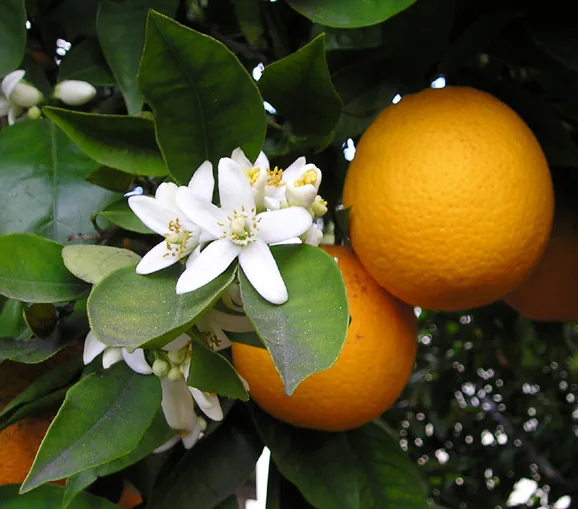
Blood orange phenology follows a winter cycle. Establish young trees in spring once frost risk has passed, expect fragrant white flowers later in spring, and harvest from winter into early spring, once a sustained period of cold nights has reddened the flesh.
Northern hemisphere
Southern hemisphere
Typical months for a temperate climate: start earlier in warm zones, later where spring frosts linger.
- Plant: Spring, after danger of frost has passed
- Harvest: Fragrant white flowers in spring; blood oranges ripen winter to early spring (about December to April), developing deepest flesh color after cool nights
Hardiness
USDA hardiness zones: 9–11
Temperature: down to -7°C
Troubleshooting
Most blood orange problems originate from insects, cold, or a single serious disease. Identifying the early symptoms gives you a realistic chance to save the tree, or at minimum to slow the decline. Match the description below to what you observe, then intervene before it advances.
Asymmetric leaf mottling with misshapen, bitter fruit
Asymmetric mottling and lopsided, bitter, green-bottomed fruit are the signature of citrus greening, the bacterial disease known as Huanglongbing and the gravest threat to any citrus. The Asian citrus psyllid moves the pathogen between trees as it feeds, and because the bacterium colonizes the phloem and starves the canopy, no treatment can clear an infected tree. The only sound response is to remove and destroy the tree, replant exclusively with certified disease-free stock, and suppress the psyllid vector before it establishes.
Fix:
- Remove and destroy infected trees
- Control the Asian citrus psyllid vector
- Plant certified disease-free stock
Defoliation and twig dieback following a freeze
Defoliation and dying twig tips after low temperatures indicate freeze damage. Ice rupture leaves the foliage water-soaked, which then browns and abscises while the distal twigs die back. Provide cover during freezes and site the tree in the warmest available microclimate, then delay pruning until new growth resumes in spring, because dormant buds on apparently dead twigs frequently break and reflush once temperatures rise.
Fix:
- Provide cold protection during freezes
- Prune out dead wood only after new growth resumes in spring
Sooty black film across leaf and fruit surfaces
The black surface film is sooty mold, a saprophytic fungus that colonizes the sugary honeydew excreted by aphids, whiteflies, scale, or mealybugs. It draws no nutrients from the plant and wipes away cleanly, so the real significance is diagnostic: its presence confirms a sap-feeding infestation overhead. Apply horticultural oil to the responsible insects and rinse the foliage, and once the honeydew supply ends the mold has no substrate left to grow on.
Fix:
- Control the honeydew-producing insects with horticultural oil
- Rinse foliage to remove mold
Toxicity
The flesh is a culinary staple, but the remainder of the tree is unsuitable for animals. Peel, leaves, and seeds contain essential oils and psoralens that irritate the digestive tract and skin of pets. Keep cats, dogs, horses, and grazing stock away from the rind, foliage, and prunings.
Toxic to
Cats · Dogs · Horses · Rabbits · Livestock · Birds
Safe for
People
Cats Mild
In a cat, ingestion of peel or leaf tissue typically produces hypersalivation, vomiting, and soft stools, along with transient lethargy. Direct contact with the rind oils can also redden and irritate the skin.
Dogs Mild
A dog that consumes rind or foliage commonly shows gastrointestinal upset, vomiting, or diarrhea, since the essential oils irritate the digestive lining. The same oils can inflame the skin where they make contact.
Horses Mild
The ASPCA classifies sweet orange as toxic to horses, the gut irritation tracing to the same peel oils and psoralens. Exclude prunings and windfall peels from the paddock to remove the exposure.
Rabbits Caution
Peel and leaf tissue carry the identical irritant oils, so neither makes a safe forage item for a rabbit. The flesh in small, occasional amounts is tolerable, but the rind and foliage should be withheld.
Livestock Caution
Goats, sheep, and cattle tolerate limited pulp, yet a large intake of bitter peel and leaves provokes digestive disturbance. Restrict access to the tree and its trimmings to prevent overconsumption.
Birds Caution
Small portions of the juicy flesh are palatable and acceptable for many birds, whereas the oil-laden peel and pith are better excluded from the diet.
People Flesh safe
The flesh is fully edible and poses no hazard. Prolonged handling of peel may, through the psoralens in the oil, sensitize the skin and cause a tingling phototoxic response in sunlight.
The fleshy fruit pulp is edible, but keep peels, leaves, seeds, and concentrated peel oils away from pets.
Helpline numbers

United States
ASPCA Animal Poison Control: (888) 426-4435 (fee applies)
Poison Control: (800) 222-1222



Canada
Poison Centres: 1-844-764-7669
Varieties
Three blood orange cultivars recur across cultivation, each defined by its own balance of pigmentation, sweetness, and harvest season. The following are the cultivars worth identifying by name.
Moro
Moro develops the deepest and most consistent crimson-to-burgundy flesh of the three because it accumulates the highest anthocyanin content, and its flavor carries a distinct raspberry-like berry note.
Tarocco
Tarocco, Italy's most widely planted blood orange, is prized for sweet, low-acid fruit that is nearly seedless, with pigmentation that ranges from orange to red.
Sanguinello
Sanguinello is a late-season Spanish cultivar bearing few seeds and moderate red coloration, and its fruit holds soundly on the tree well past ripening.
How to propagate
Blood oranges are propagated almost exclusively by grafting, which reproduces a selected tree precisely. Seed is feasible but secondary, since it demands years of growth and offers no guarantees.
GraftingDemanding
Spring to summer when the bark slips · 1 to 2 years to a sellable tree; about 3 to 5 years to fruiting
Grafting is the standard propagation method for virtually all commercial blood orange production, because it preserves the cultivar's genotype exactly. A bud of the scion is united with a rootstock in spring or summer, while active cambium lets the bark slip, which both fixes fruit identity and confers the rootstock's disease resistance and cold tolerance. The technique demands skill, and the timeline runs 1 to 2 years to a salable tree and 3 to 5 years to fruiting.
SeedModerate
Spring · Several years; many seedlings come true due to nucellar embryony but are slow to fruit
Seed propagation in spring is technically straightforward, yet nurseries avoid it for sound reasons. Many citrus seeds reproduce the maternal genotype through nucellar embryony, a form of apomixis, but the resulting seedlings pass through a thorny juvenile phase and require several years to reach fruiting. The outcome is a slow, variable tree rather than a rapid, reliable replica of the parent.
Myths
Blood oranges are a man-made cross or a genetically modified fruit.
The red pigmentation derives from anthocyanins, the same naturally occurring compounds that color berries and red cabbage. A blood orange is simply a pigmented form of the ordinary sweet orange, Citrus x sinensis, that arose spontaneously as a mutation, with no laboratory intervention or deliberate crossbreeding involved.
Blood oranges need a hot tropical climate to turn red.
The physiology runs the other way. Anthocyanin synthesis is triggered by a wide swing between warm days and cold nights, which is why the most intense color develops in regions with cold winters, such as the slopes around Mount Etna in Sicily, rather than under uniform tropical heat.