Tree · Rutaceae
Calamondin Orange
Citrus × microcarpa
A container citrus that carries fragrant bloom and sour fruit simultaneously, year round in a sunlit window.
Full sun
Every 5–10 days
55–86°F · 13–30°C
USDA 10–11
Overview
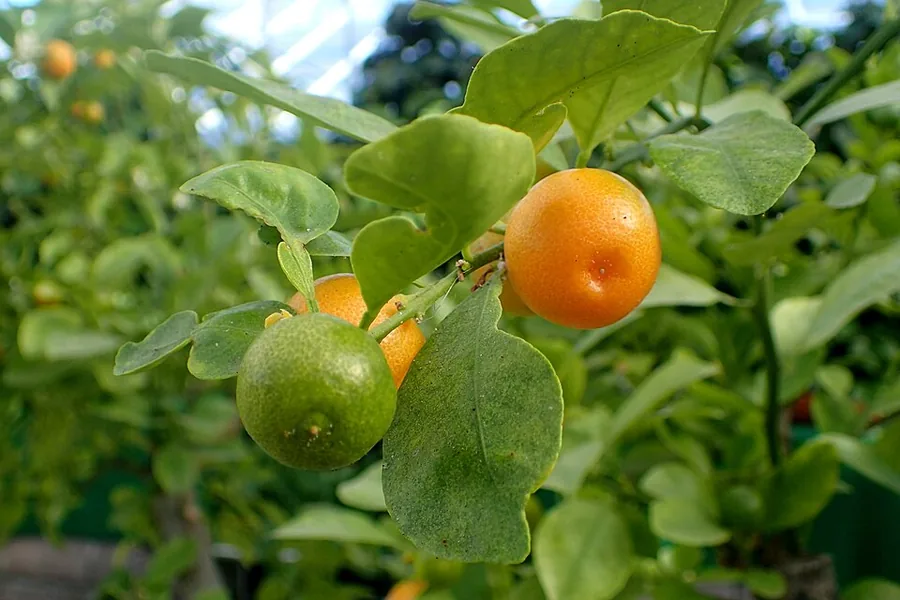
The calamondin is the citrus best suited to indoor culture, a compact hybrid generally interpreted as a cross of kumquat and mandarin. Its value to the grower lies in an everbearing habit: flowering and fruiting run concurrently rather than in separate seasons. Positioned in a bright window, it produces fragrant white bloom and small sour oranges together across much of the year.
In the warmth of zones 10 and 11 it develops into a small tree outdoors, but in cooler regions it is grown as a container specimen and moved under cover before frost, which the species cannot withstand. That portability defines its cultivation. The plant responds well to hard pruning, so its size can be held to the space available without sacrificing a crop.
It does not yield a sweet dessert orange. The fruit is markedly tart, valued for marmalade, juice, and as an acidulant in cooking rather than for fresh eating. Supplied with strong light, even soil moisture, and a regular citrus feed, the plant performs reliably and delivers both fragrance and color.
Care
The short version: provide the strongest light you can, ideally full sun, keep the soil evenly moist through the growing season and drier in winter, apply a citrus fertilizer monthly from late winter into fall, and maintain a warm, draft-free position.
Light
Provide full sun wherever possible, which indoors means the brightest window, preferably a south-facing exposure, because flowering and fruiting are driven by light energy. The plant persists in bright indirect light or partial shade, but reduced irradiance directly lowers bloom and fruit set.
Water
Hold the soil evenly moist through active growth, allowing the top inch or so to dry between waterings, then reduce frequency in winter when growth slows and uptake falls. An established plant tolerates a brief dry interval, but sustained drought aborts developing fruit, so the moisture target matters most during fruiting.
Soil
Grow it in a rich, well-drained medium, a loose all-purpose potting mix in a container or a sandy to clay loam in the ground, so the roots are aerated. Maintain a pH of 6.0 to 7.0, the band in which citrus take up iron and the other micronutrients that keep foliage green.
Temperature
Keep it within roughly 55°F to 86°F (13°C to 30°C), as the species is frost-sensitive and cannot survive freezing. Site it clear of cold drafts and heating vents, since abrupt temperature swings stress the canopy and can precipitate leaf drop.
Humidity
Hold humidity around 40% to 60%, a band easily met outdoors and in most homes. The arid air of a heated room favors spider mites, so a humidifier or occasional misting through winter helps deny them the conditions they need.
Feeding
Feed monthly from about February to October with a balanced citrus fertilizer that includes micronutrients. The supplied iron, zinc, and manganese counter the interveinal yellowing to which a heavy-feeding citrus is prone when those elements run short.
Pruning
Prune lightly to shape the canopy and to remove dead, weak, or crossing wood that wastes the plant's resources. Remove any suckers below the graft union, which arise from the rootstock and divert vigor from the cultivar, and trim as needed to contain a container specimen.
Repotting
Repot every 2 to 3 years in spring, ahead of the roots circling the container or emerging through the drainage holes. Water passing straight through or rapid wilting both indicate the root mass has filled the pot and is outpacing the available substrate.
Size & spacing
At maturity it attains 6 to 20 feet (1.8 to 6 m) in height with a spread of 6 to 10 feet (1.8 to 3 m), though container culture and routine pruning hold it well below that. Allow an in-ground specimen the full spread so air can circulate through the canopy and limit fungal pressure.
Troubleshooting
Most problems on a calamondin register first in the foliage, and they generally trace to a fault in light, water, or an insect that has established itself. Reading the early symptoms lets you correct the underlying cause before the canopy thins. Match the signs below, then address the source.
Leaves yellow and abscise soon after the autumn move indoors
A calamondin reads a rapid shift from bright outdoor sun to a dim, warm interior as stress, and it responds with shock leaf drop over the first days to weeks. The plant cannot photosynthesize at its former rate in low light, so it sheds the foliage it can no longer support. Set it in the brightest window available, hold temperatures steady away from vents and drafts so the canopy is not stressed further, let the soil surface dry before watering to protect roots that now use less water, and lift humidity with a humidifier or misting. New growth resumes once it adjusts to the lower light.
Fix:
- Place in the brightest available window (a sunny southern exposure)
- Keep temperatures stable and away from heat vents or cold drafts
- Mist or use a humidifier
- Let soil surface dry before watering
Foliage pales while the veins remain green
Yellowing on citrus is chlorosis, a breakdown in chlorophyll that follows either a nutrient shortfall or roots compromised by saturated soil. The pattern tells you which: interveinal yellowing on new growth, with the veins still green, indicates a micronutrient deficiency the youngest leaves feel first, whereas a uniform pallor across the canopy signals low nitrogen. Apply a balanced citrus fertilizer carrying micronutrients, correct any drainage fault so the roots can take up nutrients again, and bring the pH toward the slightly acidic range that keeps iron available.
Fix:
- Apply a balanced citrus fertilizer containing micronutrients
- Improve drainage and avoid waterlogging
- Correct soil pH toward slightly acidic
Sticky residue, a sooty black film, or fine webbing on foliage
Sticky leaves under a black film mark an infestation of scale or mealybugs: these sap-feeders excrete honeydew, a sugary waste on which sooty mold colonizes. Fine webbing with stippled, faded leaves instead indicates spider mites, which reproduce fastest in the dry air of a heated room. Wipe the insects off and treat with horticultural oil or insecticidal soap to smother them, raise humidity to suppress mite reproduction, and isolate the plant so the pests do not move to neighbors before control takes hold.
Fix:
- Wipe off pests and treat with horticultural oil or insecticidal soap
- Raise humidity to discourage spider mites
- Isolate the plant from other houseplants until controlled
Toxicity
The fruit is edible, but the remainder of the plant is not safe for animals. The leaves, peel, and fruit hold essential oils and psoralens that irritate the digestive tract and can render skin photosensitive. Keep pets and livestock away from the foliage and prunings, and wash your hands after handling, since the oils transfer readily.
Toxic to
Cats · Dogs · Horses · Rabbits · Livestock · Birds
Safe for
People
Cats Mild
A cat that ingests leaf or peel tissue commonly shows drooling, vomiting, and loose stools, along with lethargy and reduced appetite as the gut reacts. The psoralens can also leave the skin photosensitive after the oils contact it.
Dogs Mild
In a dog, chewing the foliage or fruit typically brings gastrointestinal upset, with vomiting or diarrhea and lowered energy. The same citrus oils can leave exposed skin prone to a sunlight-triggered rash.
Horses Mild
The essential oils and psoralens in the leaves and peel disturb a horse's digestion and can leave it dull and unwell. Remove clippings and dropped fruit from the paddock so the animal does not graze them.
Rabbits Caution
The irritant citrus oils make the leaves and peel unsuitable for rabbits, whose sensitive digestion gives every reason to keep them well clear of the plant.
Livestock Caution
Goats, sheep, and cattle should be expected to react to the foliage oils as other mammals do, so fence the plant off and dispose of prunings rather than leaving them within reach.
Birds Caution
The essential oils concentrated in the leaves and peel warrant treating those parts as off limits for pet birds, even though a thin sliver of ripe flesh is sometimes offered.
People Fruit safe
The sour ripe fruit is a culinary staple and safe for human consumption. Wash your hands after pruning, since the oils in the leaves and peel can irritate skin and leave it photosensitive.
Leaves, peel, and fruit contain irritant citrus oils; wash hands after pruning or handling fruit and keep fallen leaves and peels away from pets.
Helpline numbers

United States
ASPCA Animal Poison Control: (888) 426-4435 (fee applies)
Poison Control: (800) 222-1222



Canada
Poison Centres: 1-844-764-7669
Varieties
Only a small number of forms reach homes and garden centers, and they are separated chiefly by foliage appearance.
Variegata (variegated calamondin)
Its foliage is variegated in green and creamy white, and the immature fruit carries green-and-white striping that disappears as the fruit colors up at maturity.
Standard calamondin
The plain glossy-green type is the form grown most widely as an ornamental indoor citrus.
How to propagate
A calamondin can be propagated at home by cuttings or seed, though grafted nursery plants give the fastest and most predictable results.
Stem cuttingsModerate
Late spring to summer · About 6 to 10 weeks to root
Stem cuttings taken in late spring or summer root best when the cut ends are treated with rooting hormone and the cuttings are held warm and humid under cover, which limits moisture loss before roots form. Under those conditions they establish in about 6 to 10 weeks and grow on genetically identical to the parent.
SeedModerate
Spring · Several weeks to germinate; years to bear fruit
Fresh seed sown in spring germinates within a few weeks. Because calamondin seed is frequently polyembryonic, much of the seed gives rise to nucellar seedlings that reproduce the parent fairly faithfully, though these are slow to develop and require years to reach first fruiting.
GraftingDemanding
Spring to summer · Several weeks for the union to take
Commercial nursery stock is usually grafted in spring or summer onto a vigorous rootstock, with the graft union callusing and knitting over several weeks. It is the most exacting technique to perform at home, but the established root system delivers faster growth and earlier fruit than seedlings.
Myths
Calamondin fruit is poisonous to people.
The fruit is highly acidic rather than toxic, and it is fully edible, which is why it is processed into marmalade, juice, and a tart seasoning. Acidity, not poison, accounts for its sharpness. The genuine hazard sits with pets, since the oils in the leaves and peel are irritant to them.
Calamondin is a true orange species.
The common name overstates the relationship, since the plant is a hybrid, Citrus x microcarpa, generally interpreted as a cross between kumquat and mandarin. It is not a true orange, and that hybrid ancestry largely explains the marked tartness of the fruit.