Ornamental · Brassicaceae
Sweet Alyssum
Lobularia maritima
A low carpet of honey-scented bloom that flowers spring to fall while recruiting beneficial insects.
Full sun
42–56 days
USDA 5–9
3–10 in · 8–25 cm
Overview
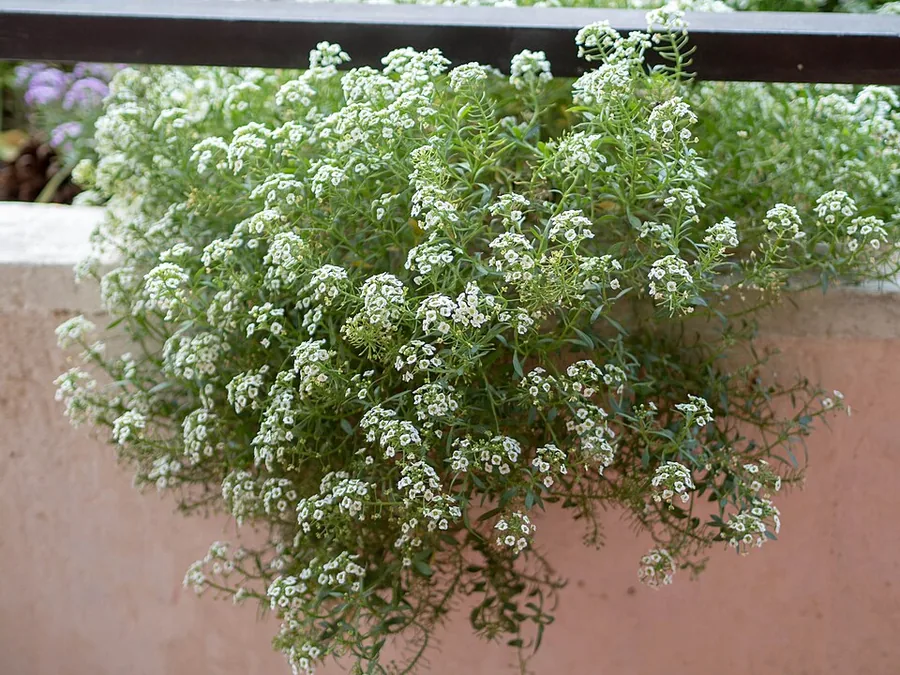
Sweet alyssum belongs to Brassicaceae, the cabbage family, and grows as a low, mounding annual that works well at a path edge or cascading over a wall. Its dense mats disappear beneath tiny honey-scented flowers in white, pink, or purple, carried from spring through fall. Its low demands and long bloom explain its place as a garden staple.
It performs as a cool-season annual, keyed to the mild temperatures of spring and fall. In peak summer heat its metabolism slows, bloom tapers, and the plant idles until cooler weather resumes growth. Mature height stays under 10 inches with a spread near a foot, so the plants form a low mat rather than gaining height.
Its horticultural value extends past ornament. The flowers supply nectar to hoverflies and parasitic wasps, whose larvae consume aphids, so an alyssum strip functions as an insectary that supports biological pest control.
Care
The short version: full sun, average but sharply drained soil, and restraint with both water and fertilizer. Shear the plants when summer heat halts bloom, and flowering resumes as fall arrives.
Light
Sweet alyssum flowers most heavily in full sun, though light afternoon shade helps in hot-summer regions where intense heat suppresses bloom. Higher light in spring and fall drives denser flowering.
Water
Water regularly during establishment to build the root system, after which the plant is drought tolerant. It will not accept saturated soil, so allow the soil to dry between waterings and avoid standing water, which the plant cannot tolerate and which leads to rot.
Soil
Average, well-drained soil suffices, and the plant tolerates poor ground. Its non-negotiable requirement is sharp drainage, because saturated soil around the crown drives stem and crown rot.
Humidity
Ambient outdoor humidity is adequate, so no target range applies. Air movement matters more, since still, damp conditions around crowded plants favor downy mildew.
Feeding
Feed lightly through the growing season, on the order of once a month. Excess fertilizer shifts the plant toward foliage at the expense of flowers, so a restrained feeding program sustains bloom.
Pruning
Deadheading spent flowers keeps new ones forming, and diseased or damaged growth should be cut away. A harder shear when summer heat stalls the planting resets it for a fresh fall flush.
Size & spacing
Expect a low habit: 3 to 10 inches (8 to 25 cm) tall by 6 to 12 inches (15 to 30 cm) wide. Space plants close enough to merge into a continuous mat while preserving the air movement that limits foliar disease.
When to plant
Sweet alyssum is timed to the cool shoulders of the season. Sow indoors 6 to 8 weeks before the last frost, or direct sow a few weeks ahead of that date, and the plants flower from spring through fall with a heat-driven pause in midsummer. Fall sowing succeeds in mild-winter climates because the plant favors cool growing conditions.
Northern hemisphere
Southern hemisphere
Typical months for a temperate climate: start earlier in warm zones, later where spring frosts linger.
- Sow: 6 to 8 weeks before the last spring frost
- Plant: A few weeks before to around the last spring frost; can also sow in fall in mild climates
- Harvest: Spring through fall, flushing in spring and fall and slowing in peak summer heat
Hardiness
USDA hardiness zones: 5–9
Temperature: down to -29°C
Troubleshooting
Most sweet alyssum failures reduce to two causes: excess heat or excess water. Identifying the early signs below lets you intervene before a stalled planting is lost. Match the symptom to its cause, then correct it.
Wilting tied to stem and crown rot
Waterlogged soil is responsible. Stem and crown rot develops where soil remains wet or water collects at the base, and the plant wilts because the submerged roots fail. Remove the affected plants, correct the drainage, and reduce watering.
Fix:
- Improve soil drainage
- Avoid overwatering and standing water
- Remove affected plants
Leaf yellowing with downy growth beneath
Downy growth on the leaf undersides paired with yellowing above indicates downy mildew, a disease favored by cool, wet weather that keeps foliage damp. Increase air circulation, switch from overhead to basal watering, and remove infected debris to break the cycle.
Fix:
- Improve air circulation
- Avoid overhead watering
- Remove and discard infected plant debris
Flowering ceases and plants brown in midsummer
The cause is heat stress, not death. As a cool-season annual, sweet alyssum slows its growth and flowering once summer heat peaks. Shear the plants back by roughly half, apply water and light fertilizer, and expect renewed flowering as temperatures fall.
Fix:
- Shear plants back by about one-half
- Water and lightly fertilize to encourage a new flush
- Allow plants to rebound in cooler fall weather
Toxicity
For households with animals, the toxicology is reassuring: sweet alyssum is non-toxic. Cats, dogs, and other animals can contact or ingest the foliage and flowers without poisoning. The honey-scented blooms are equally safe for children to handle.
Safe for
People · Cats · Dogs · Horses · Rabbits · Livestock · Birds
Cats None
Non-toxic to cats; an exploratory bite of foliage or flowers will not cause poisoning.
Dogs None
Listed as non-toxic to dogs, so an incidental mouthful presents no hazard.
Horses Safe
Horses may graze in its vicinity without harm, as the plant contains no toxins that affect them.
Rabbits Safe
Rabbits can consume the leaves and flowers safely, though any new green matter is best introduced in modest quantities.
Livestock Safe
Cattle, goats, and sheep are unaffected, since the plant holds nothing toxic to grazing stock.
Birds Safe
Birds are safe near it, and its flowers attract the bees and butterflies that birds may prey on.
People Safe
Harmless to people; the honey-scented flowers pose no risk to children who handle them.
Varieties
A handful of named selections are worth knowing, distinguished mainly by flower color and by their tolerance of summer heat.
Carpet of Snow
A compact, low-spreading selection to about 3 to 4 inches tall, blanketed in white flowers.
Royal Carpet
A violet-purple selection and 1953 All-America Selections winner, reaching roughly 3 inches tall.
Snow Princess
A vigorous white-flowered sterile hybrid whose bloom persists through heat well beyond the older cultivars.
Snow Crystals
A tetraploid selection bearing larger white flowers with improved heat tolerance.
Easter Bonnet
An early-flowering series offered as a mixture of colors.
Companions
Sweet alyssum earns its place beside vegetables by drawing in the insects that hunt aphids, which is why it's grown in flower strips next to crops like lettuce.
Plant near
Lettuce: Planted as insectary flower strips, sweet alyssum attracts hoverflies (syrphid flies) and parasitic wasps whose larvae prey on aphids, providing biological aphid control in lettuce and other vegetable crops
How to propagate
Sweet alyssum propagates readily, by seed for the species and by cuttings for the sterile hybrids that set little viable seed.
SeedEasy
Direct sow several weeks before the last spring frost, or start indoors 6 to 8 weeks before transplanting; can also sow in fall in mild climates · Blooms about 6 to 8 weeks from seed
Seed is the standard route for the species. Surface sow and barely cover, since the seed requires light for germination, either outdoors a few weeks before the last frost or indoors 6 to 8 weeks before transplanting. Flowering follows in roughly 6 to 8 weeks, and established plants self-sow freely.
Stem cuttingsModerate
During active growth · A few weeks to root
Cuttings propagate the sterile hybrids, which set little or no viable seed, cultivars such as Snow Princess among them. Taken during active growth, they root within a few weeks and reproduce the parent exactly.
Myths
A browned, non-blooming sweet alyssum in summer has died.
In most cases it has only slowed, since this is a cool-season annual reacting to heat. Cut it back, maintain moisture, and the cooler conditions of fall return it to bloom. A ragged midsummer plant is idling, not dead.
Heavy feeding is required for good flowering in sweet alyssum.
Excess fertilizer produces a leafy plant with sparse flowers. A light feed yields markedly better bloom, because flowering is strongest when the plant is not driven with nutrients.