Ornamental · Brassicaceae
Candytuft
Iberis sempervirens
Set it in full sun over fast-draining soil and candytuft answers with a sheet of white flowers each spring.
Full sun
Every 7–10 days
USDA 3–8
6–12 in · 15–30 cm
Overview
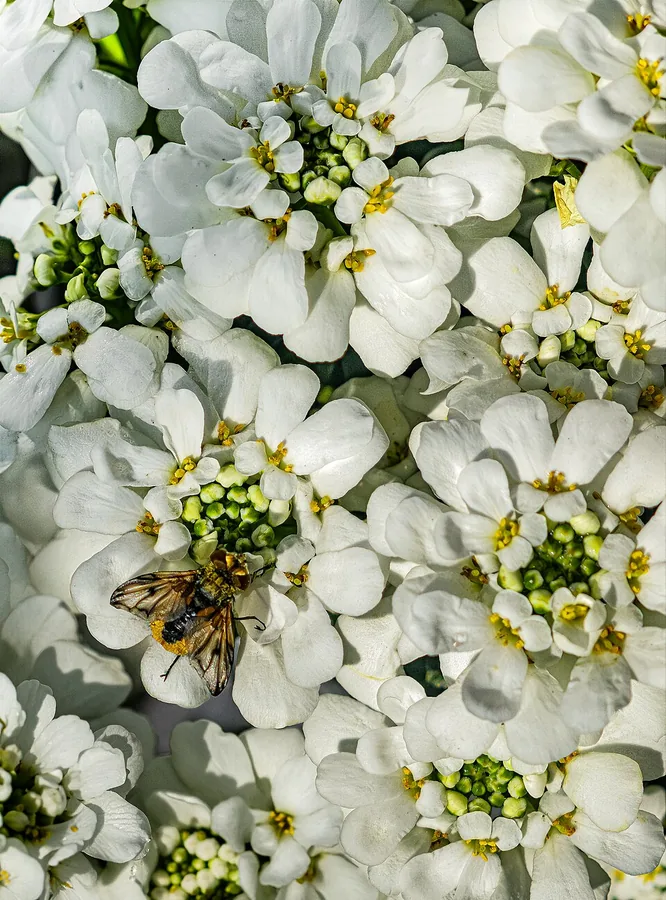
Candytuft is an evergreen perennial of the cabbage family that grows as a low, woody-based mat and flowers in spring. The narrow dark leaves persist on a creeping framework, so the mat reads as green through winter in milder zones rather than dying back. By April the foliage is largely obscured beneath small white flowers, an early nectar source that draws bees before much else is open.
Its habit fits the edge of a bed, the face of a wall, or a rock garden, where the prostrate stems trail over stone and merge into a carpet 6 to 12 inches tall. Cold hardiness extends down to zone 3, and an established root system confers genuine drought tolerance, which is why the plant performs in lean, dry sites. The limiting factor is drainage, since standing moisture around the crown is what the plant cannot survive.
Effective culture reduces to three controls: ample sun, soil that sheds water, and a shear once flowering ends. Meeting those, a single plant persists for years and broadens slowly into a compact evergreen mound, holding structure in the planting well after the bloom has passed.
Care
The short version: full sun and fast-draining soil are the controlling factors, irrigation should be sparing once the plant is established, and a shear taking off about a third of the growth should follow flowering.
Light
Flowering is heaviest in full sun, where high light keeps the mat compact and the bloom dense across the surface. Partial shade is tolerated, but reduced light produces looser, more open growth and a thinner display of flowers.
Water
An established plant is drought-tolerant and performs best on a dry-down cycle that lets the root zone breathe between waterings. Allow the top half of the soil to dry, then water at intervals of every 7 to 10 days at most. Persistent soggy soil is the chief cause of loss, because saturation rots the crown.
Soil
Drainage governs success more than any other soil property. The plant accepts clay, loam, or sand and tolerates a neutral to alkaline pH of 6.0 to 8.0, but it will not endure ground that holds water around the roots.
Temperature
Cold hardiness is exceptional, the species withstanding -40°F (-40°C) at the low end and tolerating heat to about 90°F (32°C). The evergreen foliage overwinters unaided throughout that range.
Humidity
Ambient garden humidity is adequate, so no target figure applies to this plant. What matters is air movement, since still, humid air around the canopy favors the mildews that mar the foliage.
Feeding
The plant is a light feeder with modest nutrient demand. A single application of slow-release general fertilizer in early spring supplies the season, and excess nitrogen only produces soft, lax growth at the expense of form.
Pruning
A post-bloom shear is the one operation that preserves the habit. Cutting the stems back by about one-third as the flowers fade removes spent growth and stimulates the new shoots that keep the mound compact.
Repotting
Candytuft seldom requires repotting and responds poorly to root disturbance. Move it up a size only when roots circle the drainage holes or the medium dries almost immediately after watering, both signs the container has been outgrown.
Size & spacing
Mature plants remain low at 6 to 12 inches (15 to 30 cm) tall and spread to roughly 12 to 18 inches (30 to 45 cm) across. Spacing at that interval maintains airflow between the mounds and keeps the foliage dry enough to resist disease.
When to plant
Candytuft follows a spring schedule in temperate gardens. Sow seed indoors in late winter, transplant once hard frost has passed or in early fall, and expect the white bloom from April into May, occasionally extending into early summer.
Northern hemisphere
Southern hemisphere
Typical months for a temperate climate: start earlier in warm zones, later where spring frosts linger.
- Sow: Late winter, about 6-8 weeks before the last spring frost
- Plant: Spring after danger of hard frost has passed, or in early fall
- Harvest: Early to late spring (April to May), sometimes into early summer
Hardiness
USDA hardiness zones: 3–8
Temperature: down to -40°C
Troubleshooting
Candytuft is undemanding, and almost every disorder it shows resolves to one of two causes: excess soil moisture or stagnant air around the foliage. Because both leave early signs on the crown and leaves, an attentive grower can intervene before damage spreads. Match the symptom below, then correct the underlying condition rather than the symptom alone.
Wilting collapse with crown browning and decay
A sudden collapse with a browning, decaying crown is crown and root rot, the single disorder that reliably kills candytuft, and it is driven by waterlogging rather than an airborne pathogen you can treat. Saturated soil starves the roots and crown of oxygen, so the tissue at the soil line softens and the plant lifts away on blackened, failed roots. Remove and destroy the worst cases, then correct the underlying drainage with grit or a raised bed before replanting, since the cause is the site, not the plant.
Fix:
- Remove and destroy severely affected plants
- Improve drainage by amending soil with organic matter or planting on a slope or raised bed
- Reduce watering and avoid wetting the crown
Powdery coating or fungal spotting on foliage
A pale, powdery surface film indicates powdery or downy mildew, whereas discrete spots and rust pustules indicate fungal leaf infection, and both establish where stagnant air keeps the leaf surface damp long enough for spores to germinate. Removing the colonized foliage takes out the inoculum already present. Spacing the plants 12 to 18 inches apart and watering at the base then dries the canopy quickly enough to stop reinfection.
Fix:
- Remove and dispose of affected foliage
- Improve air circulation by spacing plants 12-18 inches apart
- Avoid overhead watering and water at the base
Ragged feeding holes in leaves and flowers
Irregular holes appearing after damp weather point to slugs and snails, with caterpillars contributing at times, because these soft-bodied feeders are most active when moisture lets them move and rasp the tissue overnight. The slime trails and nocturnal pattern of damage distinguish them from chewing insects. Handpicking after dark removes the active population, while baits or traps and the clearing of sheltering mulch and debris reduce the daytime refuges that sustain them.
Fix:
- Handpick slugs, snails, or caterpillars
- Use slug baits or traps where appropriate
- Remove debris and mulch that harbors slugs near plants
Toxicity
For households with animals or children, the toxicological position is reassuring: candytuft is not toxic. The ASPCA does not list the species among harmful plants, and extension and botanical sources record no poisoning concerns. Incidental ingestion or trampling causes no harm, so the plant is suited to a family garden without restriction.
Safe for
People · Cats · Dogs · Horses · Rabbits · Livestock · Birds
Cats None
The species does not appear on the ASPCA toxic list, so foliage sampled by a curious cat presents no recognized hazard.
Dogs None
No toxic principle is recorded for this plant, so a dog that chews or disturbs the leaf mat is at no risk of poisoning.
Horses Safe
The plant carries no compounds documented as harmful to equines, so grazing horses face no toxic exposure.
Rabbits Safe
Because no part of the plant is toxic, rabbits can browse the low groundcover without consequence.
Livestock Safe
Cattle, goats, and sheep encounter no poisoning risk from a garden planting, the species lacking any known livestock toxin.
Birds Safe
Garden birds and backyard poultry can forage around candytuft with no documented harm to them.
People Safe
The plant is safe to handle and poses no concern around children, though it is cultivated as an ornamental rather than an edible.
No special handling precautions are required; routine gardening hygiene such as washing hands after contact is sufficient.
Varieties
Garden candytuft is sold chiefly as named cultivars, which differ mainly in stature and in the density of bloom rather than in culture. The following are the selections most worth recognizing.
Snowflake
A vigorous selection distinguished by broad foliage and large, dense inflorescences of pure white flowers.
Purity
A compact, free-flowering form valued for the uniform sheets of bright white bloom it produces in spring.
Alexander's White
A low, dense mound covered in white flowers, well suited to use as a clean edging plant.
Little Gem
A dwarf cultivar reaching only 6 to 8 inches tall, making it appropriate for containers and confined spaces.
How to propagate
Candytuft is best increased by cuttings or seed, because its thin main root makes the clump division that suits most perennials unreliable for this species.
Stem cuttingsEasy
Early to midsummer, right after flowering has finished · A few weeks to root, then transplant once established
Stem cuttings are the most reliable means of reproducing candytuft true to the parent. Once flowering finishes in early to midsummer, sever pieces about 6 inches long and insert them into a moist, free-draining medium such as sand or vermiculite, which supplies the aeration the cut bases need. Roots form within a few weeks, after which the rooted cuttings can be transplanted.
SeedEasy
Sow indoors in late winter or outdoors in spring · Germinates in a couple of weeks; blooms typically the following season
Seed is the simplest method but the slowest to flower. Sow indoors in late winter or direct outdoors in spring and germination follows within a couple of weeks, though seedlings generally defer flowering until the following season as they build a crown. Leaving a portion of spent flowers in place allows the plant to self-sow.
DivisionModerate
Early spring or fall · Several weeks; success is variable
Division is the least reliable option for this species. Lift a clump in early spring or fall and separate it so each division retains roots and sound stems, but anticipate inconsistent results, because the thin main root tolerates being cut poorly. Establishment takes several weeks where it succeeds at all.
Myths
Candytuft is easily divided like most spreading perennials.
Unlike clumping perennials with fibrous crowns, candytuft forms a thin main root over a woody base, so cutting it apart frequently severs the structure the plant depends on and the divisions fail. Propagation by post-flowering stem cuttings or by fresh seed gives a far higher strike rate and respects the plant's root architecture.