Ornamental · Brassicaceae
Stock
Matthiola incana
Grown cool and in full sun, stock sets dense, sweetly scented flower spikes on strong upright stems.
Full sun
Every 3–7 days
80–100 days
USDA 6–10
Overview
Stock (Matthiola incana) is an ornamental in the cabbage family, Brassicaceae, valued for dense flower spikes and a clove-like fragrance that carries on cool air. It behaves as a cool-season annual, meaning its growth and flowering align with the mild temperatures of spring and fall rather than midsummer. Warm conditions cut the display short, so the plant is best matched to a cool window.
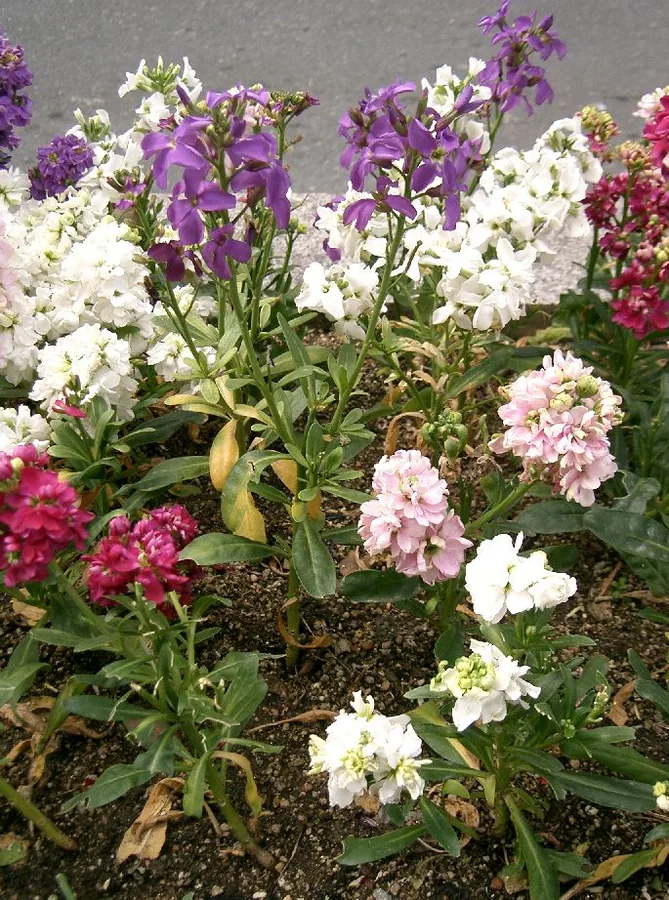
Flower color spans pink, purple, cream, and white, on plants reaching 1 to 3 feet (30 to 91 cm) in height. Because the tall selections produce long, fragrant stems that hold in water, growers favor them for cutting, while more compact strains suit edging and containers. Stem length and vase life separate the cutting types from the bedding ones.
The defining requirement is a cool exposure during flower initiation. Established early, in evenly moist soil and full sun, the plant converts that cool period into weeks of bloom. Planted late, once heat precedes the cool window, it stays vegetative or declines, because the temperature cue that switches it into flowering never arrives.
Care
The short version: stock performs in full sun and cool temperatures, with consistent moisture in fertile, well-drained, non-acidic soil, and it must be established early so flowering completes before heat arrives.
Light
Full sun drives the photosynthesis behind sturdy stems and heavy flowering. Stock accepts light partial shade, useful where spring warms quickly, but under deep shade it stretches into weak, leggy growth and sets few blooms.
Water
Consistent moisture supports active cool-season growth, so the soil should stay evenly moist and never dry out. Irrigate about every 3 to 7 days, increasing in dry spells, and deliver water at the base, since leaf wetness is what fungal disease exploits.
Soil
Stock roots best in fertile, well-drained loam, sand, or clay amended with organic matter. It favors a pH of 6.0 to 8.0, slightly alkaline rather than acidic, and performs poorly in sour, acidic soils.
Temperature
This is a cold-tolerant, heat-sensitive species. It withstands light frost and grows best through the cool of spring or fall, functioning across roughly 28°F to 81°F (-2°C to 27°C), then declining rapidly once temperatures exceed the upper end of that range.
Humidity
Ambient outdoor humidity poses no issue, which is why the record sets no target. The operative factor is air movement, because still, damp air around crowded plants is the condition under which white mold establishes.
Feeding
A balanced, general-purpose fertilizer worked into the bed at planting supplies the base nutrition, with monthly reapplication sustaining growth. Steady feeding maintains spike production without forcing the soft, floppy growth that excess feeding brings.
Pruning
Stock demands little pruning. Removing spent spikes keeps the plant tidy, and stems cut for arrangements are simply harvested while fresh. Grown as a short-lived annual, it requires no structural cutting.
Size & spacing
Mature plants stand 1 to 3 feet (30 to 91 cm) tall with a spread near 9 to 18 inches (23 to 46 cm). Spacing to that width preserves the air movement between plants that suppresses fungal establishment.
When to plant
Temperature governs both growth and flowering here, so stock is timed more tightly than most annuals. Start seed indoors in late winter, set seedlings out in early spring while it stays cold, and bloom follows from late spring into early summer, ending as heat builds.
Northern hemisphere
Southern hemisphere
Typical months for a temperate climate: start earlier in warm zones, later where spring frosts linger.
- Sow: 6 to 8 weeks before the last spring frost; seed germinates in 7 to 14 days at 65 to 75°F (18 to 24°C)
- Plant: Transplant in early spring while weather is still cool; plants tolerate light frost. In mild-winter regions plant in fall or late winter.
- Harvest: Blooms May through July under cool conditions; cool exposure near 50 to 55°F (10 to 13°C) is needed to trigger flowering
Hardiness
USDA hardiness zones: 6–10
Temperature: down to -23°C
Troubleshooting
Two mechanisms account for most failures in stock: excess moisture in crowded stands, which lets fungal rot establish, and temperatures that fall outside the plant's cool-season range. Identifying the cause early lets you correct spacing, support, or timing before the planting collapses.
White mold colonizing stems and lower leaves
The cause is white mold, the fungus Sclerotinia, which colonizes tissue during the mild, wet, humid conditions of stock's growing season. Remove and destroy every plant bearing the cottony growth and water-soaked rot, because the pathogen persists on infected material. Wider spacing, base watering, and steady air movement deny the spores the sustained leaf wetness they require.
Fix:
- Remove and discard affected plants
- Improve air circulation by proper spacing
- Avoid overhead watering and excess moisture
Decline coinciding with rising heat
Stock is heat-intolerant, and temperatures above 80°F (27°C) end both flowering and the plant. Once that threshold is crossed the display stops and decline is rapid, with no effective remedy for an affected stand. The reliable control is scheduling, so the crop matures in spring or fall and is cut before sustained heat sets in.
Fix:
- Grow as a cool-season crop and harvest before summer heat
- Time plantings for spring or fall cool periods
Vegetative plants that never initiate flowers
Green, vigorous plants that produce no spikes have missed the cool cue required for flower initiation. Stock needs exposure near 50°F to 55°F (10°C to 13°C) while young for that switch to occur. Supplying the cool conditioning at the correct leaf stage, or choosing early strains that flower after a shorter cool period, corrects it.
Fix:
- Expose young plants to cool temperatures near 50 to 55°F (10 to 13°C)
- Choose early varieties for short cool windows
Stems lodging after transplanting
This is lodging, a mechanical failure rather than disease. The tall, top-heavy spikes exceed what their stems can hold once wind or heavy irrigation loads them, so they bend or fall. Horizontal netting installed at planting, combined with adequate spacing, guides the stems upward through the mesh and keeps them vertical.
Fix:
- Install a layer of horizontal support netting
- Provide even moisture and avoid overcrowding
Toxicity
Stock presents no toxicity concern. The ASPCA records it among the non-toxic flowers, so cats, dogs, and other garden animals face no poisoning risk, and the fragrant blooms are edible. It can be sited freely near pets and children.
Safe for
People · Cats · Dogs · Horses · Rabbits · Livestock · Birds
Cats None
Non-toxic to cats. The ASPCA lists stock among safe, non-poisonous flowers, so incidental nibbling causes no poisoning.
Dogs None
No toxic principle affects dogs. The plant is non-poisonous, though ingesting a large volume of any vegetation can produce transient gastrointestinal upset.
Horses Safe
Horses are unaffected, since stock contains no compound harmful to them and can be grazed near safely.
Rabbits Safe
Rabbits face no toxicity. The foliage and flowers are harmless if browsed.
Livestock Safe
Cattle, goats, and sheep are at no risk from stock within grazing reach.
Birds Safe
Birds are unaffected and may take the plant or its seed without harm.
People Safe
Stock is non-toxic to people, and its sweetly scented flowers are edible as a garnish.
Varieties
The named strains of stock separate chiefly by flowering speed and cold requirement. The three below cover the range most growers encounter.
Harmony Series
This series, represented by Harmony Cherry Blossom and Harmony Purple, was selected for tolerance of warmer climates such as Florida.
Brompton Stock
A biennial-type strain that growers overwinter so it flowers heavily the following spring.
Ten Weeks Stock
A rapid annual named for flowering about ten weeks after sowing.
How to propagate
Stock is propagated by seed. Germination is straightforward, so the limiting step is the cool conditioning that shifts a vegetative plant into flowering.
SeedModerate
Sow indoors 6 to 8 weeks before the last frost, or in seedling trays for transplanting; germinates in 7 to 14 days at 65 to 75°F (18 to 24°C) · 30 to 50 days to reach transplant size
Stock is raised from seed. Sow indoors 6 to 8 weeks before the last frost; germination occurs in 7 to 14 days at 65°F to 75°F (18°C to 24°C), and seedlings need a further 30 to 50 days to reach transplant size. Successive sowings every couple of weeks extend the flowering period, and young plants must receive a cool exposure to initiate bloom.
Myths
Stock flowers are toxic and hazardous to cats and dogs.
The ASPCA classifies stock (Matthiola incana) among its non-toxic flowers, the group considered safe in cut arrangements. No toxin makes it dangerous to cats or dogs, so it can be grown and cut without restriction.
Adequate sun alone will make stock bloom in any season.
Light is not the trigger. Stock is a cool-season species whose flowering depends on a cool exposure, and it deteriorates once heat passes about 80°F (27°C). Grow it through spring or fall, when the temperature cue is available.