Ornamental · Asteraceae
Marigold
Tagetes
Sited in full sun and well-drained soil, the marigold blooms from early summer until frost.
Full sun
Every 5–7 days
59–86°F · 15–30°C
45–90 days
Overview
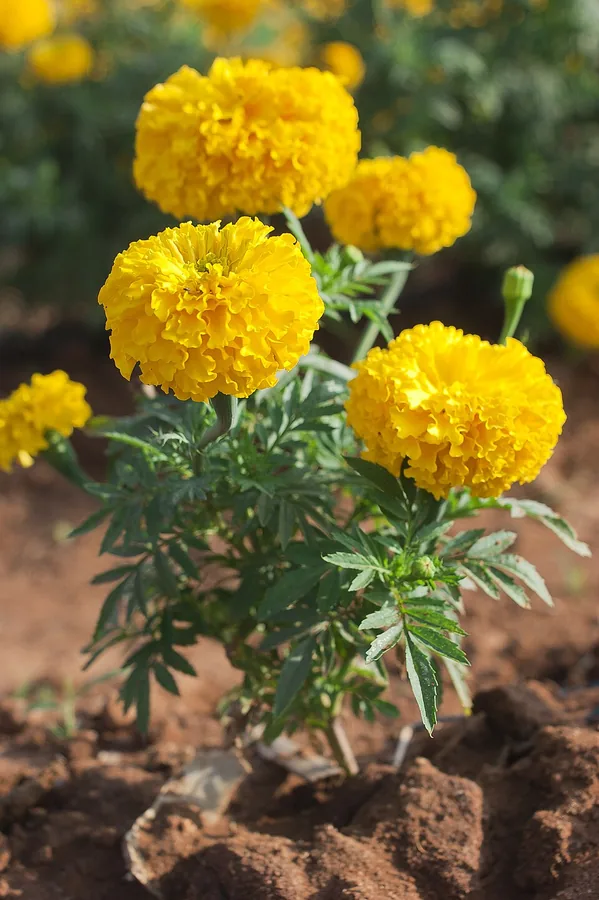
The marigold is a member of the daisy family native to Mexico and Central America, cultivated across a broad range of climates as a fast, easygoing annual. Its single and double flower heads in gold, orange, and red open from early summer and continue until the first fall frost ends the plant's single season of growth.
The genus resolves into several cultivated groups whose habit governs their placement. French marigolds remain low and bushy, African types reach knee height or more and carry large pompon heads, and the Signet marigolds form low mounds beneath finely divided, citrus-scented foliage. Identifying the group in hand establishes both the spacing it needs and its ultimate height.
Marigolds are tolerant of most cultural error because their requirements are modest: full sun and free-draining ground, with periodic deadheading, sustain months of bloom. The failures that do occur trace to the same causes, since overwatering and crowding in damp shade create the moist conditions that favor mites, rot, and mildew.
Care
The short version: site marigolds in full sun and well-drained soil, water only when the top of the soil dries, feed lightly at planting, and deadhead spent flowers to sustain bloom.
Light
Marigolds require full sun, meaning at least six hours of direct light daily, to develop their fullest bloom. They will persist in partial sun, but genuine shade produces etiolated, floppy growth and markedly fewer flowers, because low light cannot support dense flowering.
Water
Allow the top half of the soil to dry between waterings, which typically falls around every 5 to 7 days once plants are established. Marigolds are drought tolerant and fare better slightly dry than saturated, since sustained wetness is what encourages the rot and disease that overwatering brings on.
Soil
Establish plants in well-drained loam at a pH of 6.0 to 7.0, near neutral. Fertility is not the limiting factor for marigolds; ground that remains wet is, so drainage takes precedence over soil richness.
Temperature
The plants perform in the warmth between 59°F and 86°F (15°C to 30°C). Frost is lethal, so transplanting should wait for settled conditions.
Humidity
Marigolds favor drier air in the range of 30% to 50% humidity. Damp, stagnant conditions promote gray mold, which is why air movement governs plant health more than any measured humidity value.
Feeding
Incorporate a balanced general-purpose fertilizer into the bed at planting and provide nothing further. Additional feeding is rarely warranted, since surplus nitrogen drives leaf growth at the expense of flowers.
Pruning
Deadhead the spent flowers as they fade to sustain new bloom over months. Removing the old flowers also eliminates the soft, decaying tissue on which gray mold establishes in humid weather.
Repotting
Repotting is seldom relevant, because most plants complete their single season in place. Watch instead for roots circling the cell or emerging from the drainage holes, the sign that a seedling has been held too long before transplanting.
Size & spacing
Mature height ranges from 6 to 47 inches (15 to 120 cm) according to group, spanning the low French marigolds to the tall African types. Allow each plant a spread of 6 to 12 inches (15 to 30 cm) so air circulates and the foliage dries between waterings.
When to plant
Marigolds require warm soil and freedom from frost, since frost terminates the plant. Sow seed indoors in spring or direct-sow once the cold has passed, and the plants flower from early summer until the first fall frost closes the growing season.
Northern hemisphere
Southern hemisphere
Typical months for a temperate climate: start earlier in warm zones, later where spring frosts linger.
- Sow: 6 to 10 weeks before the last spring frost
- Plant: After the last spring frost when the soil has warmed
- Harvest: Early summer until the first fall frost
Hardiness
USDA hardiness zones: 2–11
Temperature: down to -46°C
Troubleshooting
The earliest symptoms of marigold trouble register on the foliage or the spent flowers, generally following a period of weather that stressed the plant. Reading those signs early allows intervention before a localized problem spreads. Match the observed symptom below, then act while treatment remains effective.
Stippled yellow foliage under fine webbing
Yellow stippling and delicate webbing are the signature of spider mites, which reproduce rapidly under the hot, dry conditions that stress the plant. Confirm them by tapping a leaf over white paper and watching the dislodged specks move. A forceful jet of water strips the colonies from the foliage, insecticidal soap treats the worst leaves, and steady soil moisture removes the drought stress that let the infestation build.
Fix:
- Spray plants with a strong jet of water to dislodge mites
- Apply insecticidal soap or horticultural oil to affected foliage
- Remove heavily infested leaves
Chewed foliage and blooms with slime trails
Irregular holes across leaves and flowers, accompanied by silvery slime trails, mark nocturnal feeding by slugs and snails, which are most active in damp conditions. Inspect at dawn, when the trails and fresh damage are clearest. Handpicking in the evening removes the active feeders, iron phosphate bait targets those that remain, and clearing mulch and debris eliminates the cool, moist daytime refuges the mollusks require.
Fix:
- Handpick slugs and snails in the evening
- Set out traps or iron phosphate slug bait
- Remove debris and mulch that provide hiding places
Gray mold decaying aging blooms
The gray fuzz colonizing aging or damaged blooms is Botrytis gray mold, a fungus that establishes under the humid, wet conditions that keep flower surfaces moist. Remove and discard the infected flowers to eliminate the inoculum, and deadhead spent blooms before the decaying tissue offers the fungus an entry point. Base watering keeps the foliage dry, and adequate spacing improves air movement so surfaces dry faster and infection is checked.
Fix:
- Remove and discard affected flowers and debris
- Deadhead spent blooms promptly
- Improve air circulation around plants
Colonies of soft-bodied insects on new growth
Green or black colonies on the tender shoots and flower buds are aphids, feeding on sap and excreting the sticky honeydew that coats the surrounding tissue. A strong stream of water dislodges the bulk of the population, and insecticidal soap clears the remainder once numbers rise. Because aphids are drawn to the soft, succulent tissue that nitrogen promotes, restrained feeding limits the flush of growth they exploit.
Fix:
- Spray aphids off with a strong stream of water
- Apply insecticidal soap if populations are high
- Encourage beneficial insects such as ladybugs
Toxicity
Marigold ranks among the safer flowers to grow around pets, livestock, and children. Garden marigold is regarded as essentially non-toxic, and the petals are edible, appearing in salads and as a garnish. The single qualification concerns the sap, which can mildly irritate sensitive skin, so gloves are advisable during extended handling.
Safe for
People · Cats · Dogs · Horses · Rabbits · Livestock · Birds
Cats Safe
Garden marigold is regarded as essentially non-toxic to cats, so ingestion carries no meaningful risk. In a sensitive individual the sap may produce minor oral or dermal irritation and nothing further.
Dogs Safe
Dogs tolerate marigold with no adverse effect from chewing the plant. The sap, at most, provokes mild drooling or transient skin irritation that resolves without treatment.
Horses Safe
Marigold is not documented as a poisoning hazard to horses and is considered safe in their company. Contact with the foliage may leave a faint dermal irritation on a sensitive animal.
Rabbits Safe
Rabbits may graze marigold without danger, and the flowers are a harmless food. Only the sap, in rare cases, accounts for any minor irritation.
Livestock Safe
Cattle, goats, and sheep sustain no ill effect from marigold. The mild sap is the sole consideration, and it seldom produces a measurable reaction.
Birds Safe
Marigold presents no poisoning risk to birds, and the pigmented petals are frequently taken as food. No aspect of the plant warrants caution here.
People Safe
The petals are edible and used in salads and as a garnish, so marigold is safe for people to consume. The single qualification is that the sap can mildly irritate sensitive skin, which gloves address during prolonged handling.
Wear gloves when handling, as the sap may irritate skin.
Helpline numbers

United States
ASPCA Animal Poison Control: (888) 426-4435 (fee applies)

United Kingdom
Animal PoisonLine: 01202 509000 (fee applies)

Australia
Animal Poisons Helpline: 1300 869 738
Varieties
Marigolds span a wide range of sizes and forms, though cultivation concentrates on a few recognized groups. These are the ones worth distinguishing by name.
French marigold (Tagetes patula)
This compact species holds at 6 to 12 inches tall and produces smaller single or double blooms that are frequently bicolored across red, orange, and yellow.
African/American marigold (Tagetes erecta)
This is the tall species, attaining 3 to 4 feet and bearing large pompon double flowers that measure up to 5 inches across.
Signet marigold (Tagetes tenuifolia)
This mounded species stays at 6 inches or less and carries small edible citrus-scented single flowers above finely divided, lacy foliage.
Triploid hybrids
These sterile crosses between French and African types bloom heavily throughout the season precisely because they set little seed.
Companions
Marigolds earn their keep beside vegetables, but only when grown as a full-season cover crop in the soil you plan to plant later.
Plant near
Vegetable crops: French and African marigolds grown as a season-long pre-plant cover crop produce alpha-terthienyl that suppresses root-knot nematode populations, benefiting susceptible vegetables grown in the same soil afterward.
How to propagate
Marigolds are among the most readily propagated flowers, growing quickly from seed and frequently self-sowing to reappear the following year.
SeedEasy
Spring
Seed sown in spring is the standard method, and germination and early growth proceed quickly with minimal intervention. Sow directly in the intended site or raise transplants indoors in advance; an established planting commonly self-sows, releasing seed that germinates on its own the following year.
Myths
Pot marigold and true marigold are the same plant.
The two occupy entirely separate genera. Pot marigold is Calendula officinalis, which is non-toxic to pets, whereas the true marigolds belong to Tagetes. The shared common name conceals a genuine botanical distinction, and the plants are not interchangeable.
A few marigolds among the vegetables instantly protect them from root-knot nematodes.
Nematode suppression depends on marigolds occupying the soil as a dense pre-plant cover crop for a full season. Isolated plants set among vegetables do not reliably reduce root-knot nematode pressure.