Shrub · Theaceae
Camellia
Camellia japonica
Provide acidic soil, dappled shade, and steady water, and the camellia flowers when little else in the garden will.
Partial shade
Every 5–10 days
USDA 7–9
6–13 ft · 1.8–4 m
Overview
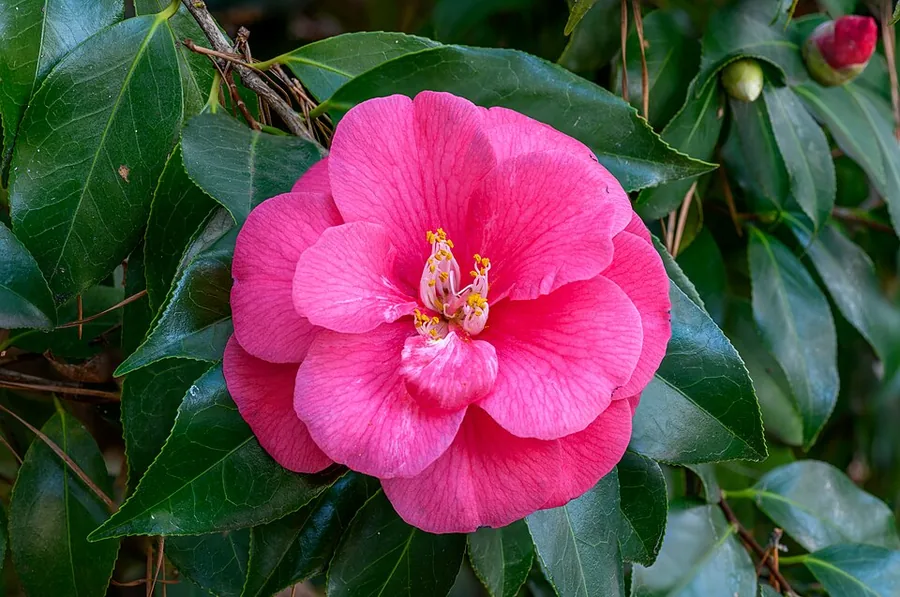
Camellias flower at the cold end of the year, filling a gap when most shrubs have entered dormancy. The common or Japanese camellia opens from late winter into spring, while the sasanqua species flowers in fall and early winter, so a planting of both spans the cold months. The thick, glossy evergreen foliage carries the structure of the shrub through the rest of the year.
This is a slow-growing, long-lived woody shrub that establishes a permanent presence in the garden. Mature height reaches roughly 6 to 13 feet (1.8 to 4 m) over many years at an unhurried rate, so the plant is sited once for the long term. Rated for zones 7 to 9, it depends on acidic, well-drained soil and a sheltered position away from intense sun and drying winter wind.
Site selection matters more than ongoing intervention with this shrub. Acidic soil, dappled light, and steady moisture together let the plant largely regulate itself. Alkaline ground locks out iron and induces chlorosis, and excessive afternoon sun stresses the buds, so the wrong site produces yellowing leaves and dropped buds in place of flowers.
Care
The short version: site it in partial shade out of hot afternoon sun, in acidic well-drained soil rich in organic matter, with steady moisture through summer, a light acid-forming feed in spring, and pruning carried out as soon as the flowers fade.
Light
Camellias perform best in partial shade that screens hot afternoon sun. They tolerate partial sun and even full shade, but a position receiving morning light and afternoon protection maximizes flowering and prevents foliar scorch.
Water
Maintain soil that is evenly moist but well drained, irrigating roughly every 5 to 10 days and more often in summer heat. Drought during bud set precipitates bud drop, since the developing buds are sensitive to water stress. Avoid overhead irrigation, because wetting the flowers favors petal blight.
Soil
Grow it in acidic, well-drained soil high in organic matter, within a pH of 5.5 to 6.5. Alkaline soil renders iron unavailable and induces chlorosis, the yellowing of leaves with green veins, which is why a misplaced camellia never reaches its potential.
Temperature
The shrub withstands a broad range, from about 5°F to 95°F (-15°C to 35°C), consistent with zones 7 to 9. Sharp fluctuations or a hard freeze during bud development still abort flowers, so a sheltered site buffers that risk.
Humidity
Ambient outdoor humidity meets the plant's needs, so no target value applies. Air movement is the more consequential factor, because still, humid conditions create the leaf-surface wetness that petal blight and leaf gall exploit.
Feeding
Apply a light spring feeding of an acid-forming azalea or camellia fertilizer. Over-application scorches the leaf margins and triggers leaf drop, so restraint protects the foliage.
Pruning
Prune immediately after flowering, and confine hard cutting to the window from mid-February through May 1. Remove dead or weak stems whenever they appear, and clearing infected and fallen blooms reduces the petal blight inoculum at the source.
Repotting
Given its slow growth and long life, a container specimen needs repotting only every 2 to 3 years or once rootbound. Use an acidic, well-drained mix, and treat roots circling the pot or water passing straight through as the diagnostic signal.
Size & spacing
A mature shrub attains 6 to 13 feet (1.8 to 4 m) in height and 5 to 10 feet (1.5 to 3 m) in spread over time. Allowing that room at planting promotes air circulation through the canopy and suppresses disease.
When to plant
A slow-growing evergreen, the camellia is sited once and left for decades. Plant in spring or fall into a sheltered, partly shaded position, and expect japonicas to flower from late winter into spring and sasanquas from fall into early winter.
Northern hemisphere
Southern hemisphere
Typical months for a temperate climate: start earlier in warm zones, later where spring frosts linger.
- Plant: Spring or fall in a sheltered, partially shaded site protected from hot afternoon sun and cold drying winter wind.
- Harvest: Camellia japonica blooms late winter to spring (about February-April); Camellia sasanqua blooms fall to early winter.
Hardiness
USDA hardiness zones: 7–9
Temperature: down to -18°C
Troubleshooting
Camellia disorders concentrate on the flowers and foliage, and the fungal ones perpetuate through fallen debris that harbors inoculum. Match the symptom below, then sanitize beneath the plant before the problem amplifies. Sanitation accomplishes as much as any fungicide spray.
Central petal browning with a netted vein pattern
Browning that radiates from the flower's center and darkens the veins into a netted pattern points to petal blight, the fungus Ciborinia camelliae working outward through the petal tissue. The starting point separates it from cold injury, which scorches the petal margins first and leaves the veins normal. Remove and destroy every infected and fallen bloom, because the sclerotia overwinter in the soil for years and the airborne spores disperse over long distances.
Fix:
- Hand-remove and destroy infected blooms and fallen blossoms promptly
- Rake up and remove fallen petals and debris under the plant
- Replace surface mulch with fresh pathogen-free organic mulch
- Apply a labeled fungicide during bloom as supplementary control
Yellow blotches above, crusted scales below
The yellow blotches on the upper surface are chlorosis caused by tea scale, the armored insect Fiorinia theae feeding on sap from the leaf underside. As the colony draws sap across successive generations, blooming falls off and leaves drop. Horticultural oil smothers the scales when it coats the undersides thoroughly, and a systemic insecticide such as dinotefuran reaches the feeding insects from within the plant once an infestation runs heavy.
Fix:
- Apply horticultural oil to thoroughly coat leaf undersides, repeating as needed
- Use insecticidal soap during crawler emergence
- Apply a systemic soil insecticide such as dinotefuran in early spring or fall for heavy infestations
- Prune out and destroy heavily infested branches
Flower buds aborting prior to opening
Buds that abort before opening usually trace to irregular moisture, most often drought stress during summer while the buds are being set. Wide temperature swings, freezing, poor drainage, and nutrient deficiency act as secondary triggers on the same developing buds. Consistent summer irrigation, a site with afternoon shade to moderate heat, and cultivars matched to local frost timing each address one of those stresses at the source.
Fix:
- Provide consistent soil moisture, especially during summer bud development
- Improve drainage and relocate plants from extreme exposures
- Correct nutrient imbalances based on a soil test
- Choose cultivars suited to the local frost timing
Black sooty coating over leaf and stem surfaces
The black coating is sooty mold, a fungus colonizing the sugary honeydew that scale and aphids excrete rather than parasitizing the plant. Because it grows only on that residue, it wipes free and does no direct tissue damage. Suppress the sap-feeders generating the honeydew and the mold loses the substrate it depends on.
Fix:
- Control the underlying scale or aphid population producing honeydew
- Wash foliage to remove mold once the insect source is controlled
Distorted fleshy spring growth that pales and browns
New growth that emerges abnormally thick, fleshy, and pale is leaf gall, the fungus Exobasidium camelliae distorting young tissue, with sasanqua types the most susceptible in spring. On the undersides a whitish spore layer develops before the galls firm up and turn brown. Detaching and destroying the galls before that spore layer matures removes the inoculum that would otherwise carry the disease forward.
Fix:
- Remove and destroy young galls before they produce spores
- Apply a labeled fungicide from budbreak through June at 7-14 day intervals for partial protection
Toxicity
For pet owners, the ornamental camellia is safe. The ASPCA lists the common camellia as non-toxic to cats, dogs, and horses, and the plant contains no compound that would poison other animals or people. As with any ornamental, ingestion in quantity is inadvisable, but an incidental nibble carries no toxicological risk.
Safe for
People · Cats · Dogs · Horses · Rabbits · Livestock · Birds
Cats None
The ASPCA classifies the common camellia as non-toxic to cats, so there is no poisoning compound for a curious nibble to deliver. Volume alone can still irritate a cat's gut, so a large quantity of any leaf may produce a transient upset.
Dogs None
No toxic principle in the shrub puts a dog at risk of poisoning, even when it mouths the foliage. The likely result of a large helping is mild, self-limiting gastrointestinal upset rather than true toxicity.
Horses None
Listed as non-toxic to horses, the plant presents no poisoning hazard if a leaf is grazed. No additional handling around a paddock is warranted on toxicity grounds.
Rabbits None
The camellia contains no compounds that would make it toxic to rabbits. Because bulk fibrous foliage can disturb the gut of any small herbivore, restrict intake to an occasional nibble rather than a full meal.
Livestock None
Cattle, goats, and sheep face no documented poisoning risk from camellia. As an ornamental it has no place in a feed ration, so it should be kept out of forage on that basis alone.
Birds None
Backyard and pet birds can occupy the same space as a flowering camellia without exposure to any harmful compound. A peck at a leaf or petal carries no toxicological consequence.
People None
Cultivated for its flowers rather than for consumption, the shrub still presents no poisoning hazard to people. Beyond the general practice of discouraging children from chewing garden plants, no precaution is indicated.
No special toxicity handling is needed; as with any plant, discourage pets and children from chewing ornamental foliage to avoid mild stomach upset.
Varieties
Camellias divide first at the species level, by bloom season, and then into named cultivars selected for flower form and color. The following are the principal ones to know.
Camellia japonica
The common or Japanese camellia is a slow grower bearing large glossy leaves and showy late-winter to spring blooms, and it performs best with shelter from hot afternoon sun.
Camellia sasanqua
Faster in growth with smaller leaves and flowers, the sasanqua blooms from fall into early winter and tolerates more sun than the japonica.
Kramer's Supreme
A japonica cultivar distinguished by large, fragrant, red peony-form blooms.
White by the Gate
A japonica cultivar valued for its formal double white flowers.
How to propagate
Camellias can be propagated by several methods, all of which proceed slowly. Selection of method follows the objective: faithful clonal reproduction of a cultivar versus rootstock production or breeding.
Stem cuttingsModerate
Take semi-hardwood cuttings of current-season growth in summer. · Several weeks to a few months to root; slow to establish overall.
Take semi-hardwood cuttings of current-season growth in summer and insert them in a well-drained acidic medium, treating the base with rooting hormone to improve the strike rate. Rooting spans several weeks to a few months, and establishment remains slow even once roots have formed.
LayeringEasy
Spring through summer. · Several months to over a year for a layered branch to root.
Layering is the most reliable method because the branch draws on the parent while rooting: wound a low branch and pin it into acidic soil while it stays attached. Carried out from spring through summer, it requires several months to over a year for the branch to root.
Air layeringModerate
Spring to summer on healthy stems. · Several months for roots to form before severing.
Air-layering applies the same attached-rooting principle to larger stems that cannot be bent to the ground, rooting them in situ while the parent sustains them. Performed on healthy stems in spring or summer, it needs several months to form roots before the new plant is severed.
GraftingDemanding
Late winter to early spring. · Several months to establish a successful graft union.
Grafting is the most demanding technique, uniting a selected cultivar with vigorous rootstock. Done in late winter to early spring, it allows several months for the graft union to knit and become functional.
SeedModerate
Sow fresh seed in fall after harvest. · Slow; seedlings do not come true to the parent cultivar.
Sow fresh seed in fall after harvest, but recognize that seedlings do not come true to the parent cultivar because of genetic recombination. The process is slow and serves breeding or rootstock production rather than the faithful reproduction of a named variety.
Myths
The camellia grown for show is identical to the tea-producing species.
Tea derives from a distinct species, Camellia sinensis, not from the ornamental shrubs. The garden plants are Camellia japonica and Camellia sasanqua, selected for their flowers rather than for harvestable leaf for infusion.
The camellia is toxic to dogs and cats.
The ASPCA lists the common camellia (Camellia japonica) as non-toxic to cats, dogs, and horses, so a pet that chews a leaf faces no poisoning. The only likely consequence of a large mouthful of any foliage is a brief, non-toxic gastrointestinal upset.