Tree · Theaceae
Franklin Tree
Franklinia alatamaha
A small tree grown for its late-summer flowers and vivid fall foliage, absent from the wild since roughly the early 1800s.
Full sun
Every 3–7 days
USDA 5–8
10–25 ft · 3–7.6 m
Overview
Few American garden trees carry a story like Franklinia, a small member of the tea family that survives only in cultivation. John and William Bartram located it on the banks of Georgia's Altamaha River in the 1760s and brought seed back, and that lone gathering seeded every plant now growing. The wild stand was gone by the early 1800s.
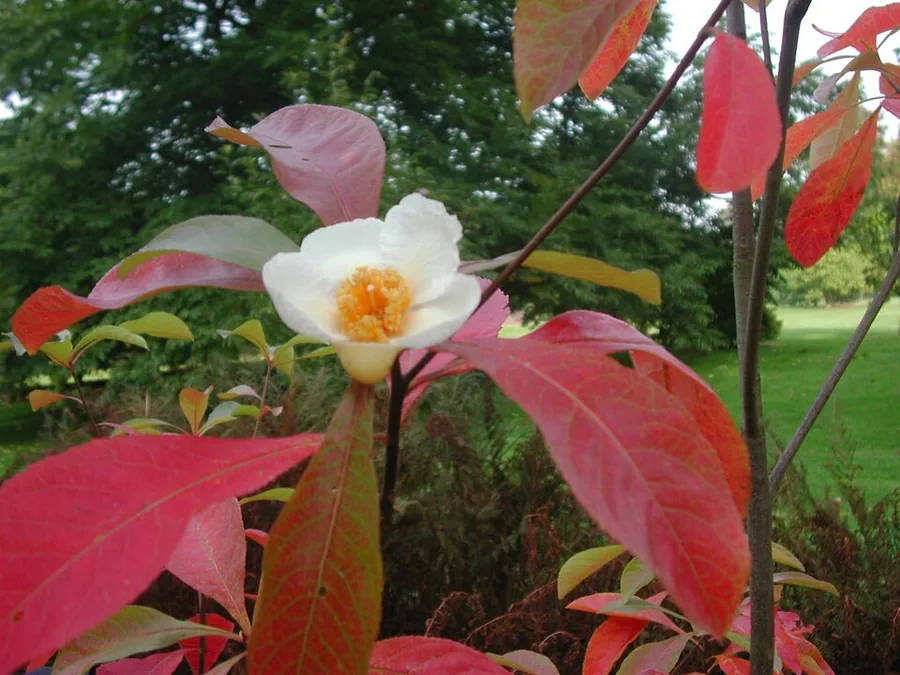
Its garden value rests on a late-season display few trees can match. Cup-shaped white flowers set off by a knot of gold stamens open from late summer into early fall, frequently overlapping with foliage already shifting to deep red and orange. Growth stays compact, topping out at 10 to 25 feet (3 to 7.6 m) as a slow, single-trunk or multi-stemmed form.
Rarity buys it no forgiveness in the garden. Franklinia rates as demanding to grow, exacting about drainage, and prone to fatal root rot on the wrong site. Settle it into cool, moist, sharply drained acidic soil, keep clay and heat away from the roots, and you stand a real chance with one of the most singular trees available.
Care
The short version: site it in full sun to part shade in rich, acidic, freely draining soil that never holds water. Hold the root zone evenly moist, shield the tree from heat, drought, and clay, and treat root rot as the threat that matters most.
Light
Site the Franklin tree in full sun to partial shade. Strong light drives the best flowering and fall color, but light shade over the hottest hours eases the tree through warm-summer conditions it would otherwise resent.
Water
Hold the soil consistently moist but never waterlogged, the balance this tree lives or dies by. It carries no tolerance for drought or standing water, so irrigate through dry stretches while keeping the ground free-draining. Saturated soil is exactly what feeds the root rot that claims most Franklin trees.
Soil
Set it in organically rich, well-drained, acidic sandy loam at a pH of 4.5 to 6.0. Drainage pulls as much weight as fertility with this species, so blend in generous organic matter and keep it away from heavy clay, where water lingers against the roots.
Temperature
Cold hardiness runs wide, roughly -20°F to 95°F (-29°C to 35°C), placing it in USDA zones 5 through 8. Sustained heat works against it, so the cooler part of that band is where the tree performs best.
Humidity
Ambient outdoor humidity serves it well, with no target level to chase. Sharp drainage and moving air matter far more to this tree than any moisture the air can hold.
Feeding
Apply an acidic, slow-release fertilizer for acid-loving plants in spring. A single seasonal feeding covers it, and matching the acidity of the feed to the tree's preference for low pH supports steady, even growth.
Pruning
Franklinia needs very little pruning. Cut away dead, damaged, or crossing branches in late winter, and use the same window to shape the canopy if you are training it as a single-trunk specimen.
Repotting
A tree in the ground is never repotted, and even a container plant is rarely stepped up. Roots spiraling the pot, roots escaping the drainage holes, or water that pours straight through signal that a potted tree has outgrown its container.
Size & spacing
Count on a mature height of 10 to 25 feet (3 to 7.6 m) and a spread of 6 to 15 feet (1.8 to 4.6 m). Set it as a freestanding specimen with room around it, where the late bloom and autumn color carry the display on their own.
When to plant
Franklinia keeps to a slow, cool-climate rhythm. Sow seed from late winter into early spring once a stretch of cold stratification has broken dormancy, move young trees outdoors in spring after the last frost or during early fall, and expect flowers from late summer up to the first frost.
Northern hemisphere
Southern hemisphere
Typical months for a temperate climate: start earlier in warm zones, later where spring frosts linger.
- Sow: late winter to early spring after cold stratification
- Plant: spring after last frost or early fall
- Harvest: late summer to early fall (July to first frost)
Hardiness
USDA hardiness zones: 5–8
Temperature: down to -29°C
Troubleshooting
Nearly every problem with a Franklin tree begins at the roots and the moisture surrounding them. The key skill is separating rot from wilt from ordinary drought, because each demands a different response. Compare your tree against the cases below and move quickly, since this species leaves little room to wait.
Rapid collapse and branch death from decayed roots
A tree that wilts, yellows, and drops branches while its roots turn dark and soft is showing Phytophthora root rot, the pathogen responsible for more Franklinia deaths than anything else. It moves in wherever soggy, compacted, or clay ground keeps water sitting against the root zone, and by the time the stem base discolors the damage is usually past reversing. Fix the drainage the moment you see it, lift any survivor onto a raised mound of sharp, acidic soil, and destroy the failing trees so the pathogen has nowhere left to spread.
Fix:
- Improve drainage immediately and stop overwatering
- Plant or transplant into a raised bed or mound of well-drained, organically rich acidic soil
- Remove and destroy severely affected plants to limit spread
Foliar wilt on freely drained, evenly moist soil
If the foliage wilts and branches die back even though the soil drains freely and stays evenly damp, the cause is likely wilt disease, which strikes this species hard, or drought stress in a tree with no reserve for dry ground. Prune out the affected wood, bag it, and hold the root zone at steady moisture without ever letting it turn wet. Because the trigger is stress, the real protection is a cool, moist, well-drained acidic site kept clear of heat, drought, and pollution.
Fix:
- Remove and dispose of affected branches
- Maintain even soil moisture without waterlogging
- Avoid stressing the plant with drought, heat, or transplanting
Foliage skeletonized and notched by larval feeding
Foliage left ragged, notched, or reduced to a lace of veins points to sawfly larvae working over the canopy during the growing season. A young tree is small enough that hand removal or a firm blast of water clears the larvae without any chemistry. Hold insecticide back for a genuine outbreak, and scout the leaves on a regular pass so you catch the feeding stage before it spreads.
Fix:
- Hand-pick larvae from small trees
- Use a strong spray of water to dislodge larvae
- Treat with an appropriate insecticide only if infestation is heavy
Toxicity
Households with animals can relax about this one: Franklinia is not toxic. It appears on no roster of plants that poison cats or dogs, and that clean record extends to the other animals a garden attracts. A pet that chews a leaf may get a short bout of stomach upset from the fiber, and no more.
Safe for
People · Cats · Dogs · Horses · Rabbits · Livestock · Birds
Cats Safe
No toxin is present in the Franklin tree, so a cat that samples a leaf is in no danger. The only likely effect from a large mouthful of any non-food plant is a bit of drooling or a passing bout of stomach upset that settles by itself.
Dogs Safe
Since the tree appears on no list of plants that poison dogs, chewed foliage does no harm. Should a dog truly overeat, look for nothing worse than brief vomiting that resolves on its own.
Horses Safe
The leaves, bark, and flowers hold nothing toxic to horses, so a nibble taken in passing does no damage.
Rabbits Safe
A rabbit can browse the foliage without risk. Offer any unfamiliar green in a small portion at the start so the digestive tract has time to adapt.
Livestock Safe
Cattle, goats, and sheep run no risk of poisoning from this tree, and a mouthful grabbed in the pasture leaves them unbothered.
Birds Safe
There is no chemical hazard to birds here, whether they roost in the branches or peck at the ripening seed capsules.
People Safe
Every part of the Franklin tree is non-poisonous to people. It carries no food value, though, so there is no cause to put it on a plate.
No special handling precautions are required for pets, though ingestion of any non-food plant can cause mild stomach upset.
Varieties
The species has produced no garden cultivars of its own, yet one hybrid and a handful of close tea-family relatives are worth knowing.
x Gordlinia grandiflora (Mountain Gordlinia)
This semi-evergreen intergeneric cross of Franklinia and Gordonia, raised at NC State in 2002, outpaces both parents in growth and opens larger blooms that reach 5 inches (13 cm) wide.
Gordonia lasianthus (Loblolly Bay)
An evergreen relative from the same tea family whose hardiness carried into the Gordlinia cross as one of its two parents.
Schima and Stewartia relatives
Schima and Stewartia fill out the Franklin tree's nearest relations in the tea family (Theaceae), and Schima sits alongside Gordonia and Franklinia in the tribe Gordonieae.
How to propagate
Raising more Franklin trees calls for patience and a thick skin for setbacks. Seed is the dependable path, while cuttings amount to a gamble worth taking only when you have plants to lose.
SeedModerate
Sow in late winter to spring after cold stratification · Several years to reach flowering size
Seed remains the standard method for propagating Franklinia, taken from the woody capsules in the same way that every plant in cultivation descends from the Bartrams' first collection. Chill the seed through a period of cold stratification to break dormancy, then sow from late winter into spring. Plan for the long haul, since a seedling needs several years before it flowers.
Stem cuttingsDemanding
Softwood cuttings in summer · Slow and challenging to root
Softwood cuttings taken in summer offer a second option, though the success rate stays low. Roots form slowly and grudgingly, and the species resists establishment however you propagate it, so count on losing many before one holds.
Myths
Native stands of Franklinia persist in the wild along Georgia's Altamaha River.
No wild plant has been found since the early 1800s, and repeated field searches have come up empty every time. The whole cultivated population descends from seed the Bartrams gathered before the species disappeared from the only place it was ever recorded.
A scarce cultivated ornamental of this stature ought to establish itself easily anywhere.
Scarcity is no measure of how forgiving a plant is, and this species has a well-earned name for being difficult. Root rot takes it fast, and it will not tolerate clay, standing water, drought, heat, or pollution. Provide cool, moist, sharply drained acidic soil, or count on losing the tree.