Shrub · Theaceae
Tea
Camellia sinensis
Kept in acidic soil, dappled shade, and even moisture, this evergreen shrub produces the leaf flushes that become every cup of tea.
Partial shade
Every 5–10 days
USDA 7–9
3–7 ft · 0.9–2 m
Overview
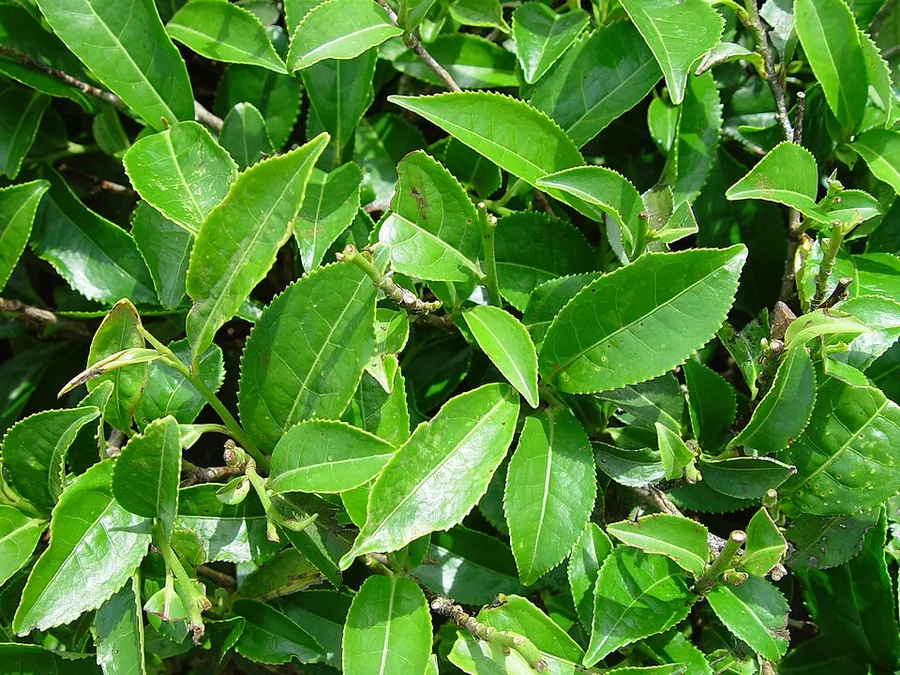
The tea of commerce is a single species, the evergreen shrub Camellia sinensis, and green, black, and oolong all derive from its leaves. As a member of Theaceae and a near relative of the ornamental garden camellia, it shares that group's requirement for acidic soil and dappled shade. Its natural habit reaches above head height, but cultivation keeps it clipped to a low, leafy hedge for easier picking.
Growth is slow and proceeds in distinct flushes, each a terminal bud with the top two leaves, and it is precisely these tender tips that are harvested. Because the plant is grown for foliage, its fragrant white flowers, borne in fall, are a secondary feature rather than the objective.
Cold tolerance is greater than the tropical reputation implies. The China type withstands light frost once established and performs outdoors across USDA zones 7 to 9, while container culture allows it to be overwintered indoors in colder regions. Given correctly acidified soil and free drainage, its remaining demand is chiefly time.
Care
The short version: part shade, acidic and well-drained soil held evenly moist, a seasonal acid fertilizer, and a late-winter prune that maintains a pickable harvest height.
Light
Tea performs best in part shade, the dappled light beneath a canopy. It accepts greater sun in cooler climates and tolerates full sun where soil moisture is reliable, but in hot regions strong afternoon light exceeds what the foliage can dissipate and scorches the leaves.
Water
Hold the root zone evenly moist but never waterlogged, which in practice means irrigating about every 5 to 10 days and more frequently during drought or active leaf flushing, when demand peaks. Mulch reduces evaporative loss and buffers that moisture. Saturated soil excludes oxygen from the roots and leads directly to root rot.
Soil
The plant is a calcifuge that requires acidic, well-drained loam rich in organic matter, at a pH of 4.5 to 6.5, because that range keeps iron and manganese available for uptake. Incorporate ample organic matter, and avoid sites where water stands.
Temperature
Once established, tea tolerates roughly 5°F to 86°F (-15°C to 30°C). The China type endures light frost, but a hard freeze injures unlignified new growth, so shelter young plants and move containers under cover during the coldest periods.
Humidity
Average relative humidity of 40% to 60% suffices and matches most temperate gardens. Outdoor humidity is not a variable to manage, though plants grown indoors benefit from modest supplementary moisture in the air.
Feeding
Fertilize seasonally from spring through summer during active growth with an acidic azalea or camellia fertilizer. Such formulations maintain the soil within the acidic range the roots require and sustain the leaf flushes taken at harvest.
Pruning
Prune in late winter to early spring to hold the shrub at a serviceable hedge of about 90 to 120 cm. Tipping the young flushes through the season is functionally dual: it directs branching and removes the very leaves used for tea.
Repotting
Repot container specimens every 2 to 3 years, or when roots circle the pot, emerge from the drainage holes, or allow water to pass straight through, all indicators of a rootbound state. Slowed growth is a further sign, and fresh acidic medium in a larger pot restores vigor.
Size & spacing
Managed as a hedge, the shrub attains 3 to 6.5 feet (90 to 200 cm) in height with a comparable spread of 3 to 5 feet (90 to 150 cm). Allot that spacing to maintain air movement through the canopy and to keep pruning access practical.
When to plant
Because tea grows slowly and flushes over a long season, timing is a matter of sequence rather than a narrow window. Propagate by seed or cuttings in late winter, establish young plants outdoors in spring once frost has passed, and harvest the young leaf flushes from spring through summer. Flowering follows in fall.
Northern hemisphere
Southern hemisphere
Typical months for a temperate climate: start earlier in warm zones, later where spring frosts linger.
- Sow: late winter in a warm propagator
- Plant: spring after the last frost
- Harvest: Fragrant white flowers in fall; harvest young leaf flushes (bud and top two leaves) from spring through summer.
Hardiness
USDA hardiness zones: 7–9
Temperature: down to -18°C
Troubleshooting
The majority of tea disorders resolve to soil chemistry that has left the acidic range or drainage that keeps the roots saturated, with scale insects a less frequent cause. Both the foliage and the root zone give diagnostic signs. Identify the symptom below and correct the underlying condition before it advances.
Wilt and dieback on saturated ground
Root rot develops where drainage fails and the roots remain submerged, depriving them of oxygen. Confirm it by inspecting for dark, softened root tissue and by noting decline that intensifies after heavy rain. Tissue that is extensively rotted will not recover, so remove the plant, correct the drainage, and replant where water moves freely through the profile.
Fix:
- Improve drainage and stop overwatering
- Remove and discard severely affected plants
- Replant in raised or amended well-drained beds
Interveinal yellowing with veins remaining green
The pattern is interveinal chlorosis, produced when the soil pH rises above the acidic range and iron and manganese become unavailable for uptake. Acidify the soil with elemental sulfur or an acidifying fertilizer, then mulch with pine bark or pine needles to sustain the lower pH. A chelated iron application restores color to new growth rapidly while the soil correction takes effect.
Fix:
- Lower soil pH with elemental sulfur or an acidifying fertilizer
- Apply chelated iron for quick correction
- Mulch with pine bark or pine needles
Sticky foliage, sooty film, and encrustations beneath the leaves
Tea scale and allied insects colonize the leaf undersides and excrete honeydew, on which sooty mold subsequently grows. Confirm by examining the undersides for small white or brown scale bodies near the leaf base. Apply horticultural oil at the labeled rate, excise the most heavily infested branches, and conserve natural predators to suppress the remainder.
Fix:
- Treat with horticultural oil following label rates
- Prune out heavily infested branches
- Encourage natural predators
Toxicity
The processed leaf is safe for people and the reason the plant is cultivated, yet the living foliage still contains the caffeine and theobromine present in the beverage. These methylxanthines are poorly tolerated by animals, so exclude cats, dogs, horses, and other pets from the foliage, and take greater care with brewed tea, dried leaves, and spent grounds, in which the compounds are far more concentrated.
Toxic to
Cats · Dogs · Horses · Rabbits · Livestock · Birds
Safe for
People
Cats Caution
The foliage carries the same caffeine and theobromine as the brewed leaf, and cats metabolize these compounds poorly. A minor nibble often passes, but a larger dose can produce vomiting, restlessness, a racing heart, and tremors.
Dogs Caution
In dogs, chewed foliage delivers caffeine and theobromine, the same methylxanthines responsible for chocolate toxicity. A larger quantity may cause vomiting, hyperactivity, an elevated heart rate, and trembling.
Horses Caution
Horses tolerate caffeine poorly, so the hedge should be kept beyond their reach. Ingested leaves can leave a horse agitated, with an accelerated pulse and muscle tremors.
Rabbits Caution
The methylxanthines that affect cats and dogs act on rabbits as well, and their small body mass means a slight intake produces effects. Exclude them from the plant to avoid a racing heart and agitation.
Livestock Caution
Cattle, goats, and sheep should not browse tea foliage, as the caffeine load can disturb gut function and elevate heart rate. Fence the shrubs off from grazing stock.
Birds Caution
Birds are markedly sensitive to caffeine, and even a small amount of leaf can overstimulate their limited body mass. Keep pet birds away from both the plant and any tea within reach.
People Leaves safe
For people this is the source plant of the beverage, its leaves picked, processed, and brewed without hazard. Here the caffeine is the intended effect rather than a risk.
Keep brewed tea, dried tea leaves, and used grounds well out of reach of pets, as these are the most concentrated and dangerous forms.
Helpline numbers

United States
ASPCA Animal Poison Control: (888) 426-4435 (fee applies)

United Kingdom
Animal PoisonLine: 01202 509000 (fee applies)

Australia
Animal Poisons Helpline: 1300 869 738
Varieties
Cultivated tea derives almost entirely from two botanical varieties of the single species, supplemented by a few selections bred for cold tolerance. The following are the ones of practical note.
var. sinensis
The China type is the hardier, smaller-leaved variety suited to cooler climates, and it supplies both green and black teas.
var. assamica
The Assam type is a large-leaved variety of warm, tropical origin that is processed predominantly into black tea.
'Sochi'
'Sochi' is a cold-hardy Russian selection favored where tea is grown in a temperate garden.
Companions
Tea grows best among the other acid-loving shrubs that want the same soil and the same dappled light.
Plant near
Azalea: Shares the same acidic, well-drained soil and part-shade preferences.
Camellia japonica: Same Theaceae cultural needs for acidic soil and dappled shade.
Rhododendron: Acid-loving understory shrub with matching light and moisture requirements.
How to propagate
Tea is propagated by cuttings or by seed, neither of which is rapid. Both require several years to reach a harvestable size, and cuttings, being clonal, yield a more uniform plant.
Stem cuttingsModerate
Late summer from semi-hardwood growth · Several months to root, then 2-3 years to harvestable size
Cuttings are the reliable method because they reproduce the parent clonally. Take semi-hardwood material in late summer, treat the base with rooting hormone, and maintain it in a warm, humid medium. Rooting requires several months, after which the plant needs 2 to 3 years to reach a harvestable size.
SeedModerate
Sow fresh seed in late winter to spring · Germinates in weeks; plants take about 3 years before leaf harvest
Seed is viable but genetically variable. Soak fresh seed and sow from late winter into spring, and germination follows within weeks. Because seedlings segregate rather than come true, cuttings remain the preferred route for uniform clones, and in either case the first leaf harvest is about 3 years away.
Myths
Green tea and black tea come from different plants.
Both originate in one shrub, Camellia sinensis. The difference lies entirely in processing: black tea is fully oxidized after picking, whereas green tea is oxidized very little.
The tea plant is strictly tropical and cannot survive frost.
Tea is an evergreen shrub hardy to approximately USDA zone 7 that tolerates light frost once established. The Assam type does require warmth, but the China type and cold selections such as 'Sochi' succeed in a temperate garden.