Tree · Theaceae
Japanese Stewartia
Stewartia pseudocamellia
A slow, exacting tree that repays correct siting with summer flowers, fall color, and exfoliating bark.
Partial shade
Every 3–7 days
USDA 5–8
12–40 ft · 3.7–12.2 m
Overview
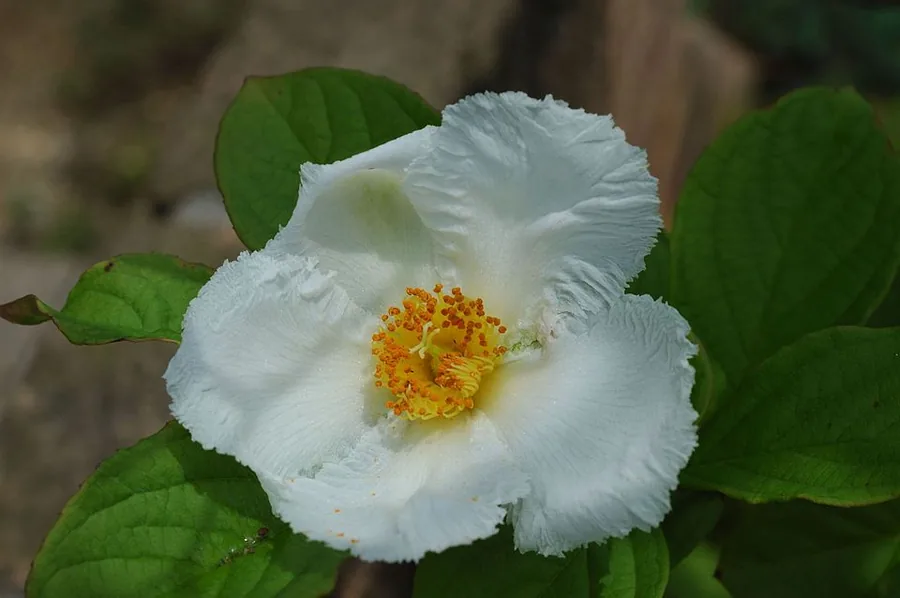
Japanese stewartia is a small deciduous member of the tea family, the clade that also holds the camellias, and it carries ornamental value through every season. White cup-shaped flowers open across early and mid summer, the foliage develops deep red and orange autumn color, and the trunk bears exfoliating bark mottled in gray, orange, and rust that remains a feature through winter.
This tree suits the gardener prepared to wait, not one seeking a quick canopy. Its growth rate is slow, it establishes reluctantly in a new position, and it tolerates neither drought, extreme heat, nor waterlogged roots. Match the site to those requirements, however, and its subsequent demands are modest, which is much of its appeal as a specimen.
Position it within regular view, since each season contributes a distinct feature. Provide moist, acidic, well-drained soil and a site with morning sun and protection from severe afternoon exposure, and it returns years of restrained, four-season interest for that initial patience.
Care
The short version: site it in part shade protected from hot afternoon sun, in moist, acidic, well-drained soil that neither dries out nor stays saturated, and allow time while it establishes slowly.
Light
Stewartia performs best in part shade with protection from hot afternoon sun. It will accept full sun in cooler climates, but in regions with hot summers the foliage scorches because transpiration outruns water supply, so a position with morning light and afternoon shade preserves leaf quality.
Water
Maintain evenly moist soil, watering deeply every 3 to 7 days in dry weather. The species has no drought tolerance, so a root zone that dries out quickly injures the tree, and a mulch layer conserves soil moisture and moderates root temperature.
Soil
Establish it in moist, well-drained, acidic soil enriched with organic matter, ideally a sandy loam, at a pH of 5.0 to 6.5. It performs poorly in heavy clay or in dry, rocky, or waterlogged ground, because those substrates either starve the roots of moisture or of oxygen, so amend the site before planting.
Temperature
The tree is hardy from about -20°F to 86°F (-29°C to 30°C), withstanding cold winters but faltering under extreme summer heat. In hot regions, afternoon shade and consistent soil moisture offset the heat that would otherwise scorch the canopy.
Humidity
Average outdoor humidity is adequate, so there is no target reading to meet. The decisive factors are consistent soil moisture and shelter from drying heat, since dry, superheated air is what desiccates and scorches the foliage.
Feeding
Apply a single feeding in early spring using a balanced or acid-forming slow-release fertilizer formulated for acid-loving woody plants. One seasonal application suffices, and an acid-forming product helps hold the soil within the acidic range the species requires.
Pruning
The tree requires very little pruning. Remove only dead, damaged, or crossing branches in late winter or early spring during dormancy, when cuts stress the tree least, and otherwise allow its naturally graceful habit to develop.
Repotting
Stewartia is rarely repotted and resents root disturbance, so leave an established plant undisturbed. Roots circling the drainage holes, water passing straight through with little uptake, or stalled new growth indicate a containerized young tree that needs more root volume.
Size & spacing
Allow generous space, as the tree can reach 12 to 40 feet (3.7 to 12 m) in height and spread 8 to 25 feet (2.4 to 7.5 m) over many years. Site it well clear of structures and other trees so its open canopy and patterned bark can develop and display fully.
When to plant
Because stewartia responds poorly to transplanting, timing and careful handling are decisive. Set out young container-grown trees in spring so the root system has a full season to establish before summer stress, and expect the white flowers from June into August.
Northern hemisphere
Southern hemisphere
Typical months for a temperate climate: start earlier in warm zones, later where spring frosts linger.
- Plant: Spring, using young container-grown plants for best establishment
- Harvest: White cup-shaped flowers in early-to-mid summer (June to August)
Hardiness
USDA hardiness zones: 5–8
Temperature: down to -29°C
Troubleshooting
This tree hosts few serious pests, and most of its disorders are cultural rather than the work of insects or pathogens. Watch the roots and the foliage, because waterlogged conditions and dry summer heat account for nearly every problem. Match the symptom below and correct the growing conditions before the tree enters a slow decline.
Wilting and chlorotic foliage with progressive dieback
Wilting paired with yellowing and steady dieback almost always signals root rot in soil that holds too much water. Saturated ground drives out the oxygen roots depend on, so they blacken and soften and can no longer supply the canopy, which declines from the crown down. Lift young trees onto a raised, better-drained site, withhold supplemental water while the soil stays saturated, and incorporate organic matter to open the structure of a heavy planting bed.
Fix:
- Improve drainage or relocate young trees to a better-drained, raised site
- Reduce supplemental watering once soil is saturated
- Amend planting area with organic matter to improve structure
Marginal and tip browning under summer heat
Browning that begins at the margins and tips is leaf scorch, a response to drought and hot, exposed conditions. It concentrates on the aspect exposed to the harshest afternoon sun, and it follows a root zone that has run dry and can no longer keep pace with transpiration. Water deeply through drought, mulch the root zone to conserve soil moisture and moderate root temperature, and provide afternoon shade where exposure is severe.
Fix:
- Water deeply during dry periods
- Apply mulch over the root zone to retain moisture and keep roots cool
- Provide afternoon shade where exposure is harsh
Toxicity
For a household with pets, the verdict is reassuring: Japanese stewartia is not toxic. It does not appear on the ASPCA's poison lists, and no part of it is documented to harm cats, dogs, horses, or other animals. As with any plant, ingesting a large quantity of leaves may cause mild digestive upset, but the tree presents no genuine hazard.
Safe for
People · Cats · Dogs · Horses · Rabbits · Livestock · Birds
Cats Safe
A cat that contacts the foliage or investigates a shed leaf faces no toxic exposure, as the tree contains no known poisonous compounds.
Dogs Safe
A dog that mouths a low branch is not at risk of poisoning, though ingesting a large quantity of foliage may provoke transient, mild gastrointestinal upset.
Horses Safe
Horses grazing near the tree encounter no hazard, since it holds no compounds documented to affect equines.
Rabbits Safe
Rabbits incur no poisoning risk from the foliage or bark, so occasional browsing causes no harm.
Livestock Safe
Cattle, goats, and sheep may graze in proximity to the tree without risk, because no part of it is toxic to ruminant grazers.
Birds Safe
Birds that perch among the branches or forage at the seed capsules take no harm from this non-toxic species.
People Safe
The tree presents no poisoning risk to adults or children. It is cultivated as an ornamental for its flowers and bark, and no part is intended for consumption.
No special handling required; as with any plant, discourage pets from chewing foliage to avoid mild stomach upset.
Varieties
A few named selections and close relatives merit attention, chosen chiefly for larger flowers or superior bark. These are the selections most often offered in the trade.
'Ballet'
A selection valued for its larger flowers carried on a vigorous, spreading form.
'Milk and Honey'
A cultivar selected for pronounced exfoliating bark and consistent flowering.
Stewartia koreana (Korean stewartia)
A close relative treated taxonomically as a synonym or variety of S. pseudocamellia, distinguished by broad, camellia-like white flowers that open flatter.
Stewartia monadelpha (tall stewartia)
A related species identified by smooth cinnamon-brown to tan exfoliating bark, attaining roughly 20 to 25 feet.
How to propagate
Stewartia propagates from seed or from cuttings, though neither is rapid. Cuttings deliver a faster and more predictable result, while seed is a protracted process governed by the seed's dormancy.
SeedDemanding
Collect ripe seed in fall; seed requires warm then cold stratification and may take many months to germinate · 1 to 2 years or more to a transplantable seedling
Seed propagation demands patience because the seed carries a double dormancy. Collect ripe seed in fall and stratify it warm and then cold to satisfy that dormancy, which is precisely why germination is slow and irregular. After emergence, plan on a year or two, and sometimes more, before a seedling reaches transplantable size.
Stem cuttingsModerate
Take softwood cuttings in early summer · Several weeks to root, then grow on for a season or more
Cuttings offer a faster and more reliable route. Take softwood cuttings in early summer, apply rooting hormone, and hold them under mist, and they typically root within a few weeks. Grow the rooted material on for a season or more before setting it out.
Myths
Stewartia is just another kind of camellia.
The floral resemblance is genuine, and both genera sit within the tea family, Theaceae. Even so, stewartia is a distinct genus and a deciduous tree, so unlike the evergreen camellia it abscises its foliage each autumn.
Japanese stewartia is an easy, fast-growing shade tree.
Its growth rate is slow, it establishes reluctantly after planting, and it responds poorly to transplanting. Combined with its sensitivity to drought, heat, and waterlogged roots, that profile defines a demanding tree rather than a beginner's shade tree.