Shrub · Theaceae
Tea Plant
Camellia sinensis
Match its origins with acidic soil, part shade, and steady moisture, and Camellia sinensis yields the leaves behind every cup of tea.
Partial shade
Every 3–7 days
USDA 6–9
6–15 ft · 1.8–4.6 m
Overview
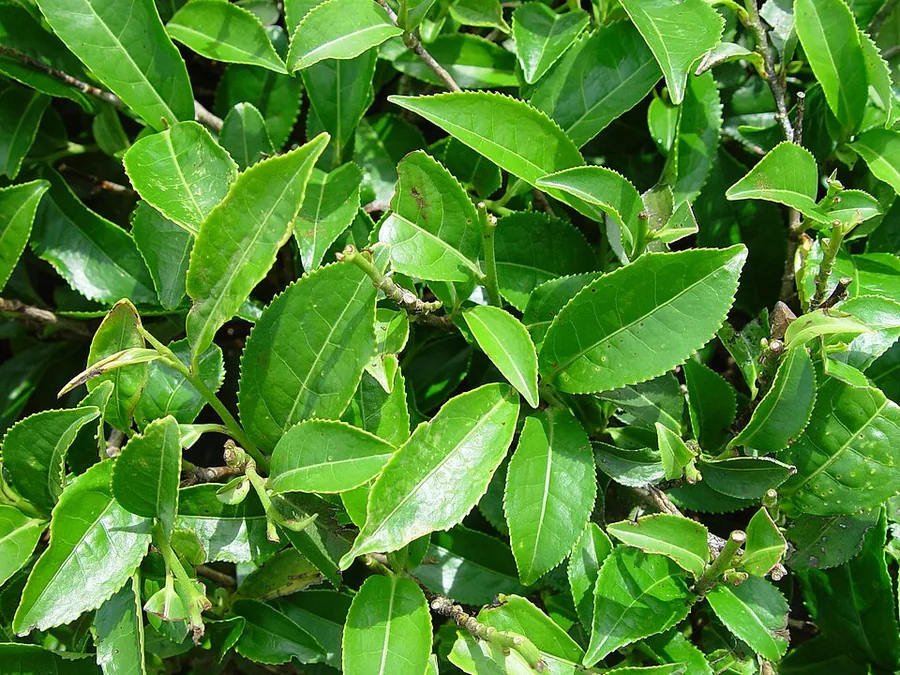
Camellia sinensis is the Theaceae shrub from which all true tea is made. It develops slowly into a dense evergreen carrying glossy foliage and small fragrant white flowers that open in fall and persist into early winter, the late bloom period typical of the genus. Unchecked it attains small-tree proportions, though cultivation usually holds it low and bushy for working access.
Its preferences trace to a forest understory: acidic, organically rich soil and part shade, with greater sun tolerated only where soil moisture remains reliable. Cold hardiness spans zone 6 to zone 9 according to variety, which is why type selection governs winter survival. Growth is slow by nature, so establishment rewards several seasons of patience.
The crop is the point. Harvested in spring, the young leaves and buds are processed into green, white, oolong, or black tea, the differences arising entirely from how the picked leaf is handled rather than from separate plants. Held in acidic, evenly moist soil, a single specimen remains productive for decades.
Care
The short version: part shade, acidic and organically rich soil held evenly moist, a light spring application of an acid-forming fertilizer, and an annual prune to sustain the flush of new harvestable leaves.
Light
Part shade suits it best because it reproduces the dappled understory light of its origin. Part to full sun is tolerated where soil moisture stays reliable, but exposed, dry sun raises transpiration stress on the leaves and developing buds, which is why a sheltered position is preferable.
Water
Hold the soil evenly moist but never waterlogged, since saturated soil excludes oxygen and predisposes the roots to rot. A 2 to 3 inch mulch buffers soil moisture between irrigations, and the bud drop seen in dry summers reflects the moisture stress this species will not tolerate during heat.
Soil
As a calcifuge it requires organically rich, well-drained loam at pH 5.0 to 6.0, the acidity that keeps iron available to the roots. Incorporate ample organic matter, and read any interveinal yellowing as evidence the medium has drifted toward alkalinity.
Temperature
It withstands a broad thermal range, from 0°F to 100°F (-18°C to 38°C) once established. The hardier Chinese variety endures the cold extreme more reliably than the tender Assam variety, a difference rooted in their respective native climates.
Humidity
Ambient outdoor humidity is sufficient, so no target value applies. Air movement is the greater concern, because the stagnant, humid microclimate within crowded foliage is what favors scale and flower blight establishment.
Feeding
Apply an acid-forming azalea or camellia fertilizer lightly in spring. A single seasonal feed meets the demand of this slow grower, and a soil test should govern any decision to supply more.
Pruning
Prune after flowering to shape the canopy, and for sustained leaf yield reduce the plant to 4 to 5 feet just before spring growth to stimulate new shoots. The plant tolerates severe cutbacks from late winter into early May, the dormant-to-early-flush window when recovery is most assured.
Repotting
Container specimens warrant potting on roughly every 3 years. Repot when roots circle the rootball or emerge from the drainage holes, when growth slows, or when the plant has outgrown its container, each a sign the root system has filled the available volume.
Size & spacing
At maturity the shrub reaches 6 to 15 feet (1.8 to 4.5 m) in height with a spread of 4 to 8 feet (122 to 244 cm), though cultivation typically restrains it well below that for harvest access. Allocate spacing to the dimensions you intend to maintain rather than the species maximum.
When to plant
The species runs on a slow phenological cycle. Establish young plants in spring or fall in mild climates, expect the white flowers from fall into early winter, and begin harvesting the fresh young leaves and buds in early spring as new growth flushes.
Northern hemisphere
Southern hemisphere
Typical months for a temperate climate: start earlier in warm zones, later where spring frosts linger.
- Plant: spring or fall in mild climates
- Harvest: fragrant white flowers fall to early winter; young leaves and buds harvested for tea beginning in early spring
Hardiness
USDA hardiness zones: 6–9
Temperature: down to -23°C
Troubleshooting
Most disorders register on the leaves, the flowers, or the roots, and the cool, moist conditions camellias favor are precisely those that promote sap-feeders and fungal pathogens. Diagnose from the early signs below and confirm the cause before the problem advances through the shrub.
Uniform decline of the whole shrub
Whole-plant yellowing and decline following wet conditions point to Phytophthora root rot. Excavated roots appear red-brown to dark brown rather than the healthy white. Because no fungicide cures established infection, remove severely affected plants, correct drainage with raised beds, and apply a mefenoxam drench to protect the remaining stock.
Fix:
- Improve drainage and avoid waterlogged sites; use raised beds
- Remove severely affected plants since fungicides will not cure established infection
- Apply mefenoxam preventatively to protect remaining healthy plants
Yellow stippling above, cottony encrustation beneath
Yellow blotching on the upper surface above a cottony underside indicates tea scale, an armored sap-feeder that colonizes the abaxial leaf surface. Inverting a leaf reveals the dark females and smaller white males within a cottony mass. Excise or prune light infestations, apply horticultural oil in late winter, and follow with insecticidal soap timed to crawler emergence.
Fix:
- Hand-scrape or prune out lightly infested leaves
- Apply 2% horticultural oil in late winter to early spring
- Use insecticidal soap during crawler activity
- Apply systemic dinotefuran or contact acephate/bifenthrin for heavy infestations
A bloom browning within a day
Rapid browning of a flower from a few spots within 24 to 48 hours is camellia petal blight, a fungal infection rather than cold injury. The dark veins traversing the necrotic petals are the diagnostic feature that separates it from frost damage. Remove and destroy infected blooms, clear fallen petals, and renew the surface mulch to deny the pathogen an overwintering substrate.
Fix:
- Promptly remove and destroy all infected flowers
- Rake up fallen blooms and debris and replace surface mulch
- Apply mancozeb sprays or soil drenches in late December through January where blight is established
Interveinal yellowing over green veins
A leaf yellowing between veins that remain green is chlorosis, most often from soil too alkaline for this acid lover to take up iron, occasionally from a magnesium deficit. A soil test establishes which. Lower the pH and apply iron chelate to restore iron availability, reserving Epsom salt for a magnesium shortfall the test confirms.
Fix:
- Lower soil pH toward acidic range for this acid-loving plant
- Apply iron chelate to correct iron-related chlorosis
- Apply Epsom salt solution (1 tablespoon per gallon) if magnesium deficiency is confirmed by soil test
Toxicity
The picked leaf of this species is the source of tea and is safe for human consumption. The relevant hazard is the caffeine it carries. A substantial quantity of fresh foliage can mildly affect cats, dogs, and horses, while brewed tea, tea bags, and dried leaves concentrate the methylxanthines and pose a far greater risk to pets than the living shrub. Keep those processed forms out of an animal's reach.
Toxic to
Cats · Dogs · Horses · Rabbits · Livestock · Birds
Safe for
People
Cats Mild
Because the fresh leaves contain caffeine, a cat ingesting a substantial amount may become restless, hypersalivate, or develop gastrointestinal upset. The processed forms, brewed tea and tea bags, present the greater hazard and belong out of reach.
Dogs Mild
A dog consuming more than a leaf or two can show agitation, panting, and vomiting attributable to the caffeine. Dried leaves and an unattended cup of tea concentrate the dose and should be removed.
Horses Mild
Browsing a quantity of foliage can leave a horse agitated and inappetent through the caffeine. Most horses avoid the bitter shrub, but exclusion is prudent where a bored animal has access.
Rabbits Caution
No reliable safety data exist for rabbits ingesting tea leaves, and the caffeine content justifies caution. Keep both the plant and any dried leaves away from them.
Livestock Caution
Cattle, goats, and sheep generally reject the bitter foliage, yet a hungry animal taking a large amount could experience caffeine effects. Fence the shrub where livestock graze in proximity.
Birds Caution
Their small body mass makes birds acutely sensitive to caffeine, so the leaves and especially brewed tea must be kept from them. The shrub should be treated as off limits for pet birds.
People Safe
This is the species behind every cup of tea, and its young leaves and buds are picked, dried, and brewed for human consumption without harm.
The plant itself is non-toxic, but the harvested, dried/processed tea leaves and brewed tea contain caffeine and theobromine (methylxanthines) which are toxic to pets in quantity; do not let pets consume brewed tea, tea bags, or large amounts of dried leaves.
Helpline numbers

United States
ASPCA Animal Poison Control: (888) 426-4435 (fee applies)

United Kingdom
Animal PoisonLine: 01202 509000 (fee applies)

Australia
Animal Poisons Helpline: 1300 869 738
Varieties
The species resolves into two principal botanical varieties, and the distinction determines both cold tolerance and the style of tea each one's leaves best suit.
Camellia sinensis var. sinensis
The small-leaved Chinese variety is the cold-hardier of the two, persisting into USDA zone 6, and its tender young leaves and buds are processed into green and white tea.
Camellia sinensis var. assamica
The large-leaved Assam variety from northern India is the more tender, suited to zone 7 and warmer, and its more mature leaves are processed into oolong and black tea.
How to propagate
Propagation proceeds by stem cuttings or by seed, and the two methods diverge in exactly the way that matters to a grower: one favors speed and fidelity, the other neither.
Stem cuttingsModerate
Summer, using semi-hardwood new growth · Several weeks to months to root
Cuttings reproduce a selected plant clonally, preserving its traits exactly. Take semi-hardwood material from the current season's growth in summer and root it under humid cover, where rooting proceeds over several weeks to a few months.
SeedModerate
Sow fresh ripe seed in fall · Slow; seedlings take about 4 years to begin flowering
Seed is the slower and genetically variable route, since seedlings segregate from the parent. Sow fresh ripe seed in fall, and expect a long juvenile phase, because a seedling requires about 4 years to reach first flowering.
Myths
The tea plant is the same as the showy garden camellias.
They are congeners, not conspecifics. Camellia sinensis is cultivated for its brewable leaves and bears smaller autumn flowers, whereas C. japonica and C. sasanqua are grown for their large ornamental blooms. Garden camellias are not the source of tea, a distinction of species rather than mere appearance.