Bulb · Asparagaceae
Grape Hyacinth
Muscari armeniacum
Set the small bulbs in autumn and each spring returns rivers of blue.
Full sun
Every 7–14 days
USDA 4–8
4–8 in · 10–20 cm
Overview
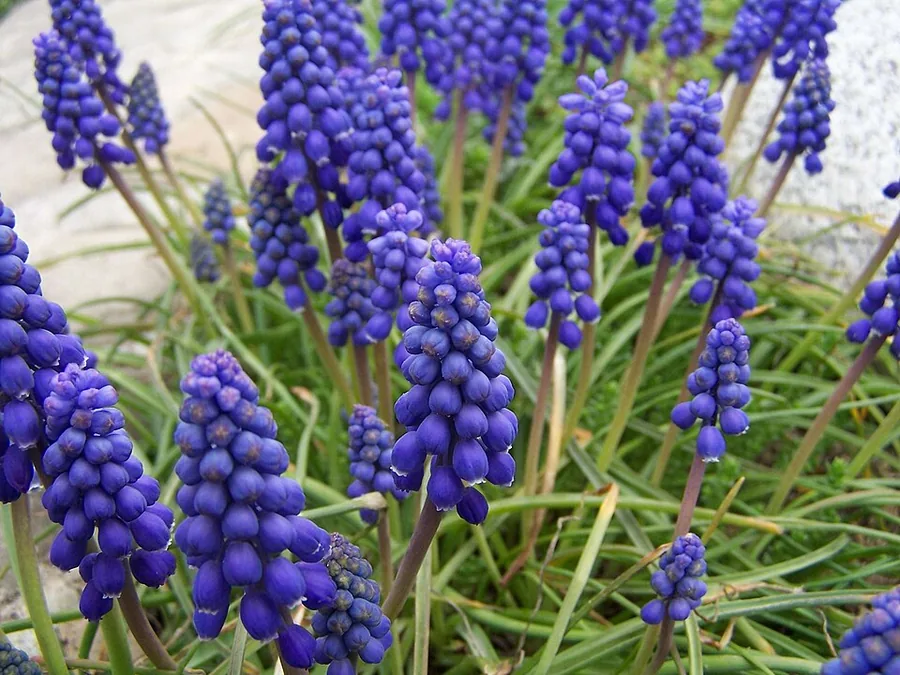
Grape hyacinth takes its common name from the compact racemes of small, rounded, urn-shaped florets that hang together like a cluster of inverted grapes. The bulb is modest in stature at 4 to 8 inches (10 to 20 cm), but massed in drifts and returning each year, it delivers far more effect than its height suggests. Despite the shared common name it has no botanical link to the true hyacinth, belonging instead to its own genus, Muscari.
Few bulbs are simpler to establish. Planted in autumn, the bulbs root before hard frost, carry grassy foliage through winter, and open deep blue racemes in mid-spring in step with tulips and daffodils. The species adapts to a wide range of sites and is exceptionally cold-hardy, withstanding temperatures down to -29°F (-34°C).
The trait that demands attention is its capacity to spread. Grape hyacinth propagates by self-seeding and by offset bulbs, so a modest planting can colonize adjacent turf within a few seasons. That vigor is an asset in a naturalized setting and a liability in a formal border, so site it where some lateral spread is acceptable.
Care
The short version: plant the bulbs in fall in well-drained soil, give them full sun to part shade, keep them moist through spring growth, then ease off the water once the foliage dies back.
Light
Flowering is heaviest in full sun, though the plant performs acceptably in partial sun or partial shade. Higher light yields denser racemes and deeper color, because the plant photosynthesizes more before dormancy, while light afternoon shade is tolerated in hot climates.
Water
Maintain evenly moist soil while foliage and flowers are in active spring growth, when the plant is building next year's reserves. Once the leaves yellow and die back, cut watering sharply, since the dormant bulbs are prone to rot if held wet through summer and fall.
Soil
Average, well-drained soil suits it, and it tolerates clay provided drainage prevents standing water around the bulb. A pH of 6.0 to 7.0 amended with organic matter supports healthy establishment.
Temperature
This is an exceptionally cold-hardy bulb, enduring winter lows of -29°F (-34°C) and growing well up to about 75°F (24°C). The winter chilling period is the physiological trigger that sets a strong spring bloom.
Humidity
Ambient outdoor humidity meets its needs, so no target figure applies. Soil drainage is the governing factor, because bulbs held in saturated ground are the ones that decay.
Feeding
Incorporate bone meal or a balanced bulb fertilizer at planting, and feed again after flowering to replenish the bulb ahead of the next season. Demand is low, so restraint is appropriate.
Pruning
No pruning is required. Allow the foliage to senesce naturally after bloom so the bulb recovers its reserves, then remove the spent leaves; cutting them while still green interrupts that transfer and weakens the following display.
Repotting
Left in the ground the bulbs multiply, and a congested clump should be divided every 4 to 5 years. The indicators are crowded clumps, declining flower count, and bulbs heaving toward the surface.
Size & spacing
Mature plants remain compact at 4 to 8 inches (10 to 20 cm) tall with a spread of only 3 to 6 inches (8 to 15 cm). Space the bulbs closely in groups so the planting reads as a continuous sheet of blue rather than isolated points.
When to plant
Grape hyacinth follows a strict bulb calendar. Set the bulbs in autumn before the ground freezes so they can root and undergo their winter chilling, and they respond with blue racemes in mid-spring, roughly April to May.
Northern hemisphere
Southern hemisphere
Typical months for a temperate climate: start earlier in warm zones, later where spring frosts linger.
- Plant: Fall, before ground freezes
- Harvest: Mid-spring (April to May)
Hardiness
USDA hardiness zones: 4–8
Temperature: down to -34°C
Troubleshooting
Grape hyacinth is undemanding, and the issues that do arise are typically cosmetic or a consequence of overly free spread. The key skill is distinguishing its normal winter shabbiness from an actual disorder, after which little intervention is needed. Match the symptom below before applying any treatment.
Colonies advancing well beyond the original planting
Muscari armeniacum naturalizes by two routes at once, an aggressive self-seeding habit paired with steady production of offset bulbs, which lets a defined patch colonize turf and beds within a few seasons. Cutting the spent scapes before the capsules mature stops the seed route, while lifting and discarding rogue seedlings and offsets clears the vegetative one. Where absolute containment matters, a pot or a physically bordered bed is the reliable control.
Fix:
- Deadhead spent flower spikes before seed sets
- Dig and remove unwanted seedlings and offset bulbs
- Grow in containers or contained beds to limit spread
Yellowing, floppy foliage that reads as ragged across fall and winter
In most cases the cause is the species' normal growth cycle rather than a disorder. Muscari sends up its grassy leaves in autumn and holds them through winter, so the foliage looks worn for months before the spring inflorescences form. Leave those leaves undisturbed until they yellow and senesce on their own, since the bulb is drawing energy back from them, and lift and divide the clump only if crowding has set in.
Fix:
- Leave foliage in place until it yellows and dies back naturally
- Divide crowded clumps every 4 to 5 years
- Reduce watering once foliage begins to die back
Grazed foliage and severed flower scapes
Muscari has no serious pest problems, so torn foliage points not to insects but to deer, which will browse it when preferred forage is scarce. Ragged leaves and missing scapes alongside tracks or droppings confirm the culprit. A repellent spray manages light pressure, while exclusion fencing or interplanting among species deer avoid gives more durable protection where browsing is heavy.
Fix:
- Apply deer repellent
- Use fencing or interplant with less palatable bulbs
Toxicity
Grape hyacinth is a low-toxicity plant and a sound choice for most households. The leaves and flowers are harmless, and the flowers are eaten in some regions, but the bulbs contain mild saponins that can cause drooling or gastric upset if a pet or child digs one up and eats it. Supervise habitual diggers and curious young children, and no further precaution is required.
Safe for
People · Cats · Dogs · Horses · Rabbits · Livestock · Birds
Cats Caution
Foliage and flowers are safe for cats; the concern lies in the bulb, where mild saponins can provoke drooling or nausea if a cat excavates and chews one. Ingestion of a leaf or two carries no meaningful risk.
Dogs Caution
A dog inclined to dig may consume a bulb, and the saponins it contains can produce drooling and gastrointestinal upset. Exposure to the above-ground tissue is of little consequence.
Horses None
Horses may graze the grassy leaves without injury, as the plant contains no compound toxic to them.
Rabbits None
Rabbits browse the foliage safely, since it holds nothing that affects them.
Livestock None
Cattle, goats, and sheep may graze in and around a stand of grape hyacinth with no ill effect from the leaves.
Birds None
The plant does not affect birds, and poultry may forage adjacent to a planting without concern.
People Caution
The flowers are pickled and consumed in some regions, but the raw bulb should not be eaten, as its saponins can cause drooling and gastric upset. Prevent young children from tasting the bulbs.
No special handling precautions are required; the plant is considered pet-safe.
Varieties
Commerce is dominated by the straight species, yet several named cultivars merit attention for their distinct colors and forms.
Cantab
A fragrant, sky-blue cultivar notable for flowering later than the species and reaching roughly 6 to 9 inches in height.
Valerie Finnis
It bears powder-blue flowers on rigid 8-inch scapes that remain self-supporting.
Blue Spike
A double-flowered selection whose densely set florets consolidate each spike into a fuller, plumper raceme.
Saffier
A deep blue, sterile cultivar prized for unusually long-lasting flowers and the absence of self-seeding.
Album
A white-flowered form somewhat less vigorous in growth than the blue species.
Companions
Grape hyacinth shines among other spring bulbs, where its low blue spikes carpet the ground beneath taller flowers that bloom at the same time.
Plant near
Daffodils (Narcissus): Bloom at the same mid-spring time and combine for layered drifts of color.
Tulips: Pairs well in mass plantings and borders for contrasting spring color.
Crocus: Early-blooming companion bulb for naturalized lawn and rock-garden plantings.
How to propagate
Grape hyacinth increases with almost no help, and you can direct that vigor by lifting offsets, dividing clumps, or allowing it to set seed.
Offsets & pupsEasy
Lift and separate offset bulbs in summer dormancy or fall. · Offsets typically flower the following spring.
The most efficient increase comes from the offset bulbs that develop around the parent; lift and separate them during summer dormancy or fall and replant at once. Because these offsets carry a mature storage organ, most flower the following spring rather than waiting years. Performing this division on a congested clump every 4 to 5 years sustains vigorous flowering.
DivisionEasy
When foliage has died back, in summer to early fall. · One season
After the foliage has yellowed and senesced, from summer into early fall, a tired clump can be lifted and split into sections without checking growth. Each division reestablishes within a single season. Division doubles as the practical means of restraining a vigorous colony from advancing further.
SeedModerate
Self-sows readily; collected seed sown after ripening. · Seed-grown plants may take up to 4 years to flower.
Muscari self-sows so freely that deliberate sowing is seldom necessary, though ripened seed can be collected and sown for controlled increase. The trade-off is time, since a seedling must build a flowering-size bulb and can take up to 4 years to reach first bloom. Removing spent scapes before capsules mature is the direct way to curb that volunteer seeding.
Myths
Grape hyacinth is as poisonous to cats and dogs as a true hyacinth.
The ASPCA classifies Muscari armeniacum as non-toxic to dogs and cats, and the plant is taxonomically distinct from the genuinely toxic true hyacinth despite the shared common name. The bulbs do contain mild saponins, so a pet that unearths and ingests one may drool or develop stomach upset, yet the risk is nothing like that of its dangerous namesake.
Grape hyacinth is a kind of true hyacinth.
It is placed in its own genus, Muscari, within Asparagaceae, and not in the genus Hyacinthus. The word hyacinth in the common name refers only to the resemblance of the flower clusters, not to any close taxonomic relationship.