Bulb · Asparagaceae
Tuberose
Polianthes tuberosa
Site it in full sun over free-draining soil, and tuberose perfumes the late-summer evening air on cue.
Full sun
Every 5–10 days
55–84°F · 13–29°C
90–120 days
Overview
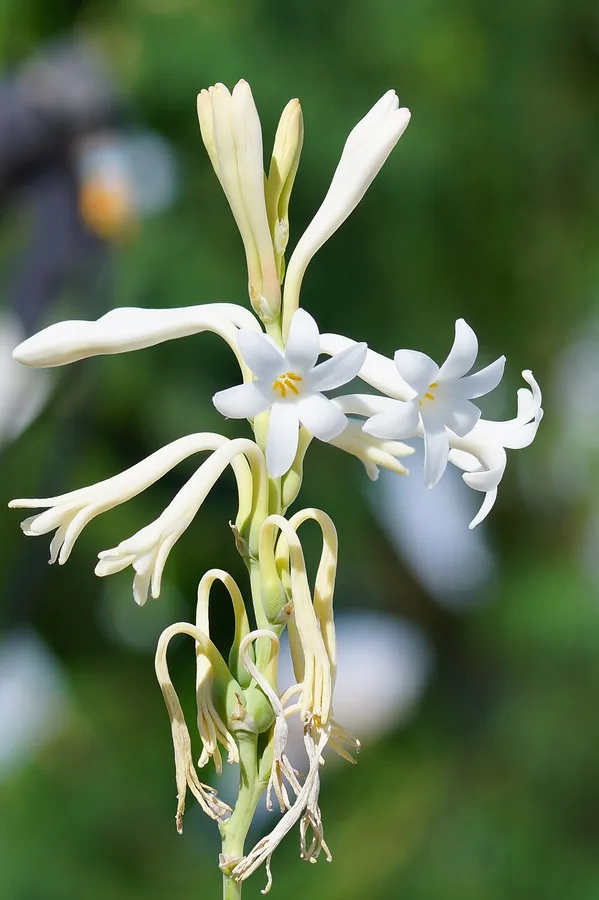
Tuberose is cultivated first and foremost for its fragrance. The tall inflorescences carry creamy white flowers in late summer, and because the scent projects strongly after dusk, the plant has long served both the cut-flower trade and the evening garden. The common name misleads, since there is no botanical link to the rose. Tuberose is a tuberous-rooted relative of the agaves, native to Mexico and cultivated there across many centuries.
Mature plants stand 2 to 3 feet (61 to 91 cm) tall, producing narrow grassy foliage before a flower spike that opens successive blooms over several weeks. As a tender perennial, it performs where summers are warm and winters remain mild. In colder zones the tubers are lifted and stored over winter, on the same principle used for dahlias.
Its requirements reduce to warmth, direct sun, and sharp drainage. Tubers go in during spring, receive steady water through the summer heat, and are eased off as the foliage yellows in fall. The single fatal condition is standing moisture at the roots, because waterlogged, heavy soil leaves the tuber sitting in trapped water and brings on rot.
Care
The short version: full sun, organically rich soil with fast drainage, and consistent moisture through the summer growing season. Feed monthly, withdraw water as the foliage yellows toward dormancy in fall, and divide established clumps every few years to sustain flowering.
Light
Tuberose requires full sun to flower well, meaning a position that receives direct light for most of the day. It tolerates light afternoon shade, but under heavier shade the plant diverts its resources into lax, leafy growth at the expense of bloom.
Water
Maintain evenly moist soil throughout the summer growing season, allowing the top half to dry between waterings so the tuber is never left in saturated ground. In most soils this equates to irrigation every 5 to 10 days. As the foliage yellows in fall, reduce watering to let the plant enter dormancy.
Soil
Grow tuberose in organically rich, free-draining loamy or sandy soil, since drainage is the decisive factor for this species. It accepts a broad pH range of 6.0 to 8.0, so reaction is rarely limiting, provided water passes through freely and never accumulates around the tuber.
Temperature
Tuberose is adapted to warmth, performing across roughly 55°F to 84°F (13°C to 29°C). Being frost-tender, it cannot withstand freezing, so in cold-winter climates the tubers are lifted and stored before the first hard freeze.
Humidity
Ambient outdoor humidity is sufficient, and there is no target level to maintain. The species responds far more to temperature and drainage than to atmospheric moisture.
Feeding
Apply a balanced general-purpose garden fertilizer monthly through spring and summer, during active growth. Sustained feeding supplies the demand of the tall flowering spikes and prolongs bloom production.
Pruning
The plant needs no routine pruning. Remove spent flower spikes once they finish, but leave the foliage intact to senesce naturally in fall, since the dying leaves return stored reserves to the tuber for the following season's bloom.
Repotting
Tuberose is managed by division rather than repotting, which restores vigor to a crowded stand. Lift and separate the clumps every 2 to 3 years, prompted by abundant offsets, a decline in flowering, or tubers rising to the soil surface.
Size & spacing
24–36 in (61–91 cm) tall
When to plant
Tuberose follows a warm-season cycle and tolerates no frost. Tubers are started indoors in early spring and moved out once the danger of cold has passed, and flowering follows from August into September, when the spikes scent the garden through late summer.
Northern hemisphere
Southern hemisphere
Typical months for a temperate climate: start earlier in warm zones, later where spring frosts linger.
- Sow: Early spring, started in containers before last frost
- Plant: Spring after the last frost date, planted 2 inches deep and 6-8 inches apart
- Harvest: August to September (late summer to early fall)
Hardiness
USDA hardiness zones: 7–10
Temperature: down to -18°C
Troubleshooting
Most disorders in tuberose originate at the tuber or express themselves as vegetative growth without bloom. Early diagnosis usually keeps the remedy straightforward. Match the presentation below and intervene before the tuber is compromised.
Softened, decaying tubers with yellowing, collapsing foliage
The presentation points to tuber rot, which develops where the soil holds excess water. Tubers set deep in heavy, water-retentive ground remain in trapped moisture and decay from within. Lift the plant, excise all mushy, foul-smelling tissue, and replant only firm tubers into fast-draining sandy or loamy soil.
Fix:
- Stop watering and improve drainage
- Lift affected tubers and discard rotted ones
- Replant healthy firm tubers in well-drained sandy or loamy soil
Vigorous foliage but scant flowering beyond the first season
Reduced bloom reflects crowded clumps competing for the same soil, or foliage removed before the tuber has replenished its reserves. Divide the clump every 2 to 3 years and permit the leaves to die down naturally each fall. Retain only the largest tubers, as small offsets require a season or more to reach flowering size.
Fix:
- Divide clumps every 2-3 years
- Allow foliage to die down naturally before lifting
- Replant only the largest tubers for reliable bloom
Deformed new shoots hosting colonies of small insects
The distortion is the work of aphids, which colonize the tender new shoots and feed on sap, leaving growth puckered and coated in sticky honeydew. Thrips, spider mites, and scale may compound the damage. Dislodge them first with a strong jet of water, and apply insecticidal soap only if the population persists.
Fix:
- Spray off with a strong jet of water
- Apply insecticidal soap if needed
Toxicity
Tuberose presents no toxicological risk to pets, livestock, or children. It contains no known toxins and does not appear on the ASPCA's toxic plant lists, so incidental nibbling carries no consequence. The one point to note is the sap, which can mildly irritate sensitive skin, so rinse the hands after cutting stems.
Safe for
People · Cats · Dogs · Horses · Rabbits · Livestock · Birds
Cats None
Tuberose is non-toxic to cats and is absent from the ASPCA toxic plant list. A curious nibble of foliage may produce transient, mild gastric upset, as any unfamiliar plant can, but nothing of clinical concern.
Dogs None
Dogs may share a planting of tuberose without risk. The species contains no toxin, so a chewed leaf or flower causes no harm.
Horses Safe
Tuberose poses no danger to horses. It holds no known toxic compounds and is not listed as hazardous to grazing animals.
Rabbits Safe
Rabbits may browse tuberose foliage safely, as the plant contains nothing injurious to them.
Livestock Safe
Cattle, goats, and sheep are unaffected by tuberose, which carries no recorded toxicity for farm animals.
Birds Safe
Birds are safe in the presence of tuberose, whether they peck at it or merely occupy the same space.
People Safe
Tuberose is safe for people, and the flowers are valued for their scent. The only qualification is the sap, which can mildly irritate sensitive skin, so rinse the hands after handling cut stems.
The flowers are intensely fragrant; the strong scent may be overwhelming to some people in enclosed spaces.
Varieties
A small number of tuberose selections account for most of what is grown, separated chiefly by flower form and fragrance intensity. These are the cultivars worth recognizing.
The Pearl
A widely grown double-flowered selection whose fully petaled, waxy white blooms resemble a small gardenia.
Mexican Single
A single-flowered form regarded by most growers as the most strongly scented of all tuberoses.
Sensation
A fragrant cultivar distinguished by its soft pink-tinted flowers.
Marginata
A dwarf form valued as much for its variegated foliage as for its flowers.
How to propagate
Tuberose is most readily increased by lifting and dividing its tubers, the same operation that rejuvenates an aging, declining clump.
Offsets & pupsEasy
Spring, when lifting and dividing dormant tubers · Largest offsets may bloom the next season; small offsets often take a year or more to reach blooming size
Tuberose increases naturally by producing offsets around the parent tuber. Lift and separate these in spring while the tubers are dormant. The largest offsets commonly flower the following season, whereas smaller ones require a year or more of growing on to reach flowering size, so they are worth retaining.
DivisionEasy
Spring, every 2-3 years · One or more growing seasons before reliable flowering
Dividing congested clumps every 2 to 3 years in spring maintains vigor and reliable flowering. Separate the tubers and replant only the largest for the strongest display. Anticipate a growing season or more before the divisions establish and flower dependably.
SeedModerate
Spring · Several years to reach flowering size
Seed propagation is possible from a spring sowing but is decidedly slow. Seedlings take several years to reach flowering size, far longer than offsets, which is why most growers rely on tuber division instead.
Myths
Tuberose belongs to the rose family.
The vernacular name is misleading, for tuberose has no botanical relationship to roses. It is a tuberous-rooted member of the Asparagaceae, classified as Polianthes tuberosa and synonymized as Agave amica. The epithet derives from its swollen tuber, taken from the Latin tuberosa, and not from any resemblance to a flower.