Bulb · Asparagaceae
Common Camas
Camassia quamash
A meadow bulb that wants it wet in spring and dry at rest.
Full sun
Every 3–7 days
USDA 3–8
1–4 ft · 0.3–1.2 m
Overview
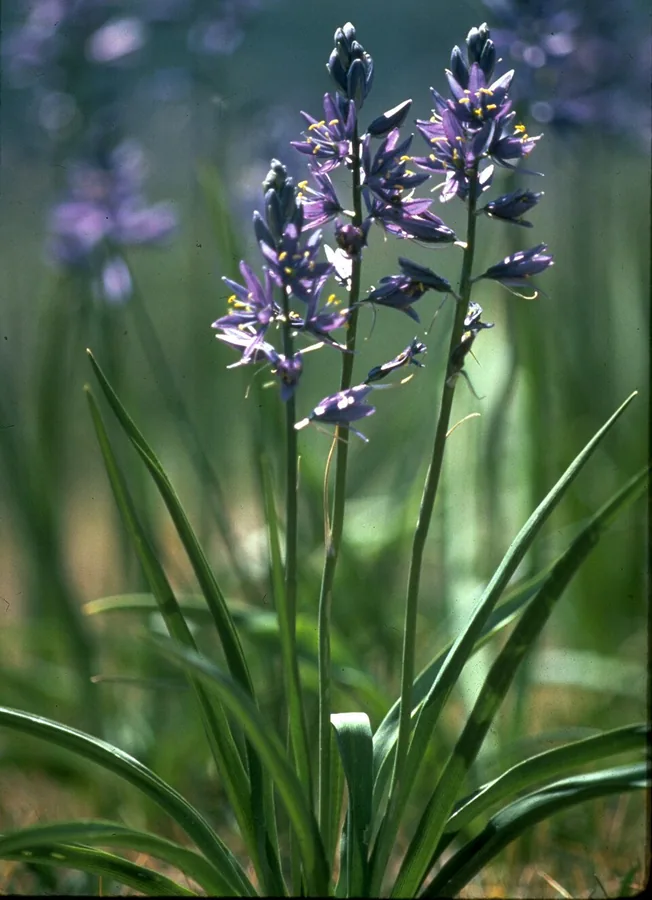
Common camas (Camassia quamash) is a hardy North American bulb in the Asparagaceae family. It is an outdoor perennial, easy to grow, and sends up blue to violet flower spikes that carpet damp meadows each spring, March to June.
Its whole care plan follows one seasonal rhythm. Leaves and tall spikes grow in spring, then the plant dies back and rests underground through summer heat. The resting bulb wants drier soil, while spring growth wants the soil kept wet, which is why a wet-meadow native behaves this way in the garden.
The bulbs were a cooked food of Native American peoples and the plant is not poisonous to people or pets. The one genuine danger is confusing it with the deadly death camas, so no wild bulb should be eaten without expert identification.
Care
The short version: give Common Camas full sun and moist, humus-rich, well-drained soil, keep it watered through spring growth and bloom, then let it dry out and rest through summer. Plant the bulbs in fall, feed lightly at planting, and otherwise leave the clump alone until flowering drops off and it needs dividing.
Light
Site camas in full sun for the best flowering; it tolerates partial sun and light shade but pays for it. Too much shade drives the plant to make leaves rather than spikes, since the bulb cannot fuel flower production without enough light. If a healthy-looking clump refuses to bloom, shade is the first thing to check.
Water
Keep the soil evenly moist through spring growth and bloom. Camas is a wet-meadow native, so it expects steady spring moisture at the roots and rewards water given before the ground dries out. As the foliage dies back into summer dormancy, ease off and let the bulbs run drier, because a resting bulb sitting in wet soil is prone to rot.
Soil
Plant into well-drained, moist, humus-rich soil with plenty of organic matter. Drainage matters because the same ground must hold spring moisture yet shed water once the bulb is dormant. Camas is not fussy about pH, taking anything from 5.5 to 7.5.
Temperature
Camas is cold-hardy across zones 3 to 8, surviving down to about 10°F (-12°C). It handles summer heat up to roughly 86°F (30°C), the point at which it retreats into dormancy rather than pushing through the hottest part of the year.
Humidity
Average outdoor air humidity is no concern for this bulb. What actually matters is moisture at the roots in spring; once that is right, the surrounding air takes care of itself.
Feeding
Feeding is light. Work a balanced bulb fertilizer or compost into the soil at planting in spring, and that single application covers the season. Camas draws most of what it needs from a humus-rich soil, so heavier feeding is unnecessary.
Pruning
No routine pruning is needed. Let the foliage die back on its own after bloom, because those fading leaves are recharging the bulb for next year. Snip spent flower stalks only if you want to stop the plant from self-seeding.
Repotting
Camas is best left undisturbed and rarely needs lifting. Divide only when a clump is so crowded that flowering falls off, or when bulb offsets push up to the soil surface, both signs the planting has outgrown its space.
Size & spacing
Flower spikes reach 1 to 4 feet (30 to 120 cm) tall, and each clump spreads 12 to 24 inches (30 to 60 cm). Given room and time, camas knits itself into natural drifts, so space plantings with that spread in mind.
When to plant
Camas runs on a fixed annual cycle, so timing every task to that cycle is what keeps it thriving. Plant bulbs in fall so they root through winter, expect bloom from March to June, then let the foliage die back as the bulbs settle into their summer rest.
Northern hemisphere
Southern hemisphere
Typical months for a temperate climate: start earlier in warm zones, later where spring frosts linger.
- Plant: Plant bulbs in fall; sow seed outdoors in fall or spring
- Harvest: Spring (March to June)
Hardiness
USDA hardiness zones: 3–8
Temperature: down to -40°C
Troubleshooting
Most trouble with camas traces back to two things: the light it gets above ground and the drainage around the bulb below. The two problems worth knowing are weak flowering on otherwise healthy plants and bulbs going soft underground.
Soft, tunneled bulbs underground
Bulbs that turn soft and mushy below ground point to one of two problems. Larvae of the narcissus bulb fly tunnel into the bulb and hollow it out, while soil that stays saturated through the summer rest period rots a bulb that wants to sit dry. Lift a suspect clump and inspect: grub-like larvae inside or a rotten core tells you which cause is at work.
Fix:
- Remove and destroy infested or rotten bulbs
- Improve soil drainage for summer dormancy
- Avoid leaving wounded bulbs in waterlogged soil
Strong leaves, missing blooms
When the foliage looks fine but flower spikes fail to form, the limiting factor is usually light or root competition rather than plant health. A plant sitting in too much shade puts its energy into leaves instead of spikes, and a clump packed tight with offsets divides its resources too thinly to flower well. Seed-grown plants are a separate case: they simply have not reached blooming size yet.
Fix:
- Site in full sun for best flowering
- Lift and divide crowded clumps of bulb offsets after foliage dies back
- Be patient with seed-grown plants, which need several years to bloom
Toxicity
True common camas carries no toxicity for people, pets, or grazing animals, and every species here is safe. The danger is not the plant itself but misidentification, since edible camas closely resembles the deadly death camas.
Safe for
People · Cats · Dogs · Horses · Rabbits · Livestock · Birds
Cats None
Not poisonous to cats; a curious nibble in the garden gives no cause for concern.
Dogs None
Not poisonous to dogs; a dog that digs up or chews a bulb should be fine.
Horses Safe
No toxicity has been reported in grazing horses.
Rabbits Safe
Rabbits can browse the plant without harm; it holds no toxin for them.
Livestock Safe
Grazing cattle, goats, and sheep are not at risk from true common camas.
Birds Safe
No known hazard to birds.
People Safe
The bulbs were a cooked staple food of Native American peoples and are safe to eat when correctly identified; the one real hazard is mistaking the plant for death camas, so never eat a wild bulb without an expert's confirmation.
The true danger is misidentification: edible camas bulbs closely resemble the highly poisonous death camas (Toxicoscordion/Zigadenus). Never forage or consume wild bulbs without expert identification.
Varieties
Two named selections of Camassia quamash stand out, one for foliage that performs before bloom and one built for naturalizing in a moist meadow.
Camassia quamash 'Blue Melody'
Carries deep blue-violet flowers above cream-edged variegated leaves, so the foliage earns its place in the border before a single spike opens.
Camassia quamash 'Orion'
Sends up tall stems topped with deep blue flowers, making it a strong choice for naturalizing across a moist meadow.
How to propagate
Camas multiplies several ways, most of them easy. The quickest gains come from offsets and division worked during summer dormancy, while seed is the slow route for anyone willing to wait.
Offsets & pupsEasy
After foliage dies back in summer dormancy · 1 to 2 seasons
Once the foliage has died back into dormancy, lift a clump and pull off the offsets clustered around the parent bulb, then replant them in moist humus-rich soil. They settle in over 1 to 2 seasons and are the fastest route to a filled-in drift.
Bulbs & cormsEasy
Fall · 1 to 2 seasons
Set dormant bulbs into moist humus-rich ground in fall so they root through winter and bloom the following spring. Allow 1 to 2 seasons before they put on a full display.
SeedModerate
Sow outdoors in fall or spring · Up to 3 years to flower
Camas self-seeds readily in a moist meadow, and you can sow your own outdoors in fall or spring. Be patient: seedlings need up to 3 years to reach blooming size.
DivisionEasy
During summer dormancy · 1 to 2 seasons
Splitting an established clump during summer dormancy keeps it vigorous and lets you spread it through the garden. Divided pieces re-establish within 1 to 2 seasons.
Myths
Every camas bulb is safe to eat, since Native American peoples ate camas.
Edible common camas is nearly indistinguishable from death camas (Toxicoscordion/Zigadenus), whose bulbs are poisonous and can kill. The two are easiest to confuse out of bloom, once the flower color that separates them is gone. Never eat a wild bulb without expert identification.