Bulb · Asparagaceae
Star of Bethlehem
Ornithogalum umbellatum
A hardy spring bulb bearing white star flowers that shut by afternoon, valued for its ease but flagged for its toxic, spreading bulbs.
Full sun
Every 5–10 days
USDA 4–9
6–12 in · 15–30 cm
Overview
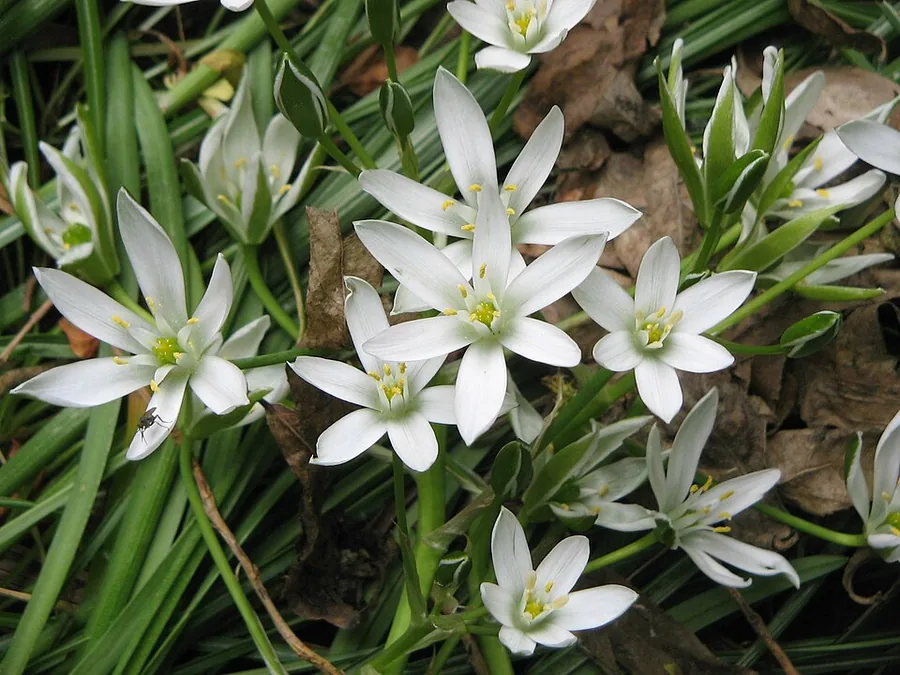
Star of Bethlehem is a small spring bulb producing white, star-shaped flowers marked with a green stripe along the outer petals. The blooms open near midday and close by late afternoon or under overcast skies as the light falls, the response behind the folk name nap-at-noon. Grassy basal leaves emerge first, and the flower stems follow, carrying the blooms low over the foliage in late spring.
It sits in the asparagus family and grows from a true bulb that multiplies by offset bulblets at a rapid rate. That vegetative increase is what makes it nearly indestructible in the garden, and also what drives it into lawns and beyond. Across much of the northern United States it has naturalized out of cultivation into pastures and turf, where it is treated as a weed.
The whole plant is toxic. All tissues contain cardiac glycosides, with the highest concentration in the bulb, and these compounds act on the heart in animals and people alike. It is worth growing for its flowers, but it belongs where children and livestock cannot reach it, and gloves are warranted whenever the bulbs are handled.
Care
The short version: set the bulbs in fall into moist, well-drained soil under full sun to part shade, maintain moisture through spring growth and bloom, then withhold water and let the plant die back through summer dormancy.
Light
Flowering is best in full sun, though the plant performs in partial sun and light shade, tolerating roughly 25 percent shade. It succeeds under deciduous trees precisely because the bulb completes its growth in early spring, before the canopy leafs out and casts deep shade.
Water
Hold the soil evenly moist through spring growth and bloom, watering about every 5 to 10 days when rainfall is short, since active growth depends on that moisture. Once established the plant tolerates summer drought, and it resents wet soil after the foliage goes dormant in late summer, when standing water invites rot.
Soil
Grow it in moist, fertile, well-drained loam enriched with organic matter. It is indifferent to pH across the 6.0 to 7.5 range, so reaction is not the limiting factor; drainage is, because saturated soil rots the bulb regardless of fertility.
Temperature
The bulb is fully cold-hardy, enduring winter lows near 5°F (-15°C) and summer highs around 86°F (30°C). It overwinters underground and resumes growth as the soil warms in spring, so no winter protection is needed within its range.
Humidity
Atmospheric humidity is not a limiting factor; ordinary outdoor air is adequate and there is no target to meet. Root-zone drainage governs success far more than moisture in the air.
Feeding
Nutrient demand is low. A single incorporation of balanced bulb fertilizer or compost at planting, followed by a light feed in early spring as growth emerges, is sufficient. Over-fertilizing is counterproductive, since a fertile bed accelerates the plant's spread.
Pruning
Leave the foliage to senesce naturally after bloom, because the leaves replenish the bulb's reserves for the next season. Removing the spent flower stalks limits self-seeding, and gloves are advisable, as the sap can irritate skin.
Repotting
Lift and divide crowded clumps every 3 to 4 years. The signs that division is due are diminished flowering from competition, bulbs heaving toward the surface, and a dense mass of small offset bulblets pressing on the parent.
Size & spacing
Mature height is modest, only 6 to 12 inches (15 to 30 cm), but each clump attains 12 to 24 inches (30 to 60 cm) of spread and continues to widen through offset production. Allow adequate spacing, or a contained bed, so it does not overrun neighboring plants.
When to plant
This is a fall-planted bulb that flowers the following season. Dormant bulbs go in during September or October and overwinter in place, then push foliage and later white flowers from May into June. The leaves yellow after bloom as the plant enters summer dormancy.
Northern hemisphere
Southern hemisphere
Typical months for a temperate climate: start earlier in warm zones, later where spring frosts linger.
- Sow: not typically started indoors; plant dormant bulbs directly
- Plant: fall (September to October)
- Harvest: late spring to early summer (May to June)
Hardiness
USDA hardiness zones: 4–9
Temperature: down to -34°C
Troubleshooting
For a plant this durable, the two failure modes are opposite in nature: the bulb rots where drainage is poor, yet the plant colonizes aggressively where conditions suit it. Identify which one you have below and intervene early, before a saturated bulb decays or a detached bulblet founds a colony.
Soft, rotting bulbs that fail to emerge
The disorder is bulb rot, driven by soil that holds too much water. Poor drainage or heavy moisture during the bulb's summer dormancy is the operative cause, since saturated tissue cannot resist decay. Confirm it by lifting a suspect bulb and checking for soft, foul-smelling flesh rather than firm white tissue, then discard the rotted bulbs and replant the sound ones in better-drained ground.
Fix:
- Lift and discard affected bulbs
- Improve drainage by amending with grit or organic matter or move to a raised, better-drained site
- Replant healthy firm bulbs in well-drained soil
Dense colonies invading lawn and beds
The mechanism here is offset bulblets, which the plant produces in quantity around each parent and which let it escape a bed into lawns and pastures. Dig the entire clump and remove every small bulblet before it detaches, then bag rather than compost the material, because composted bulblets survive. Repeat the operation over several seasons, since any fragment left behind will resprout.
Fix:
- Dig out clumps removing all bulblets before they detach
- Bag and dispose of dug bulbs rather than composting
- Repeat removal over several seasons as missed bulblets resprout
Toxicity
Regard this as a toxic plant rather than a benign wildflower. Every part contains cardiac glycosides, most concentrated in the bulb, and they affect cats, dogs, horses, and livestock, with a real hazard to people as well. No part is edible, and because even the water from a vase of cut stems has been implicated in poisoning, the whole plant should be kept away from anyone who might ingest it.
Toxic to
Cats · Dogs · Horses · Rabbits · Livestock · Birds · People
Cats Severe
In a cat, ingestion of any part typically brings salivation, vomiting, inappetence, and diarrhea. The bulb poses the greatest hazard because glycoside concentration is highest there, and a larger dose can disrupt cardiac rhythm, producing weakness or collapse.
Dogs Severe
Dogs are most exposed when they excavate and chew the bulbs. The early signs are drooling, loss of appetite, vomiting, and diarrhea, and any ataxia, weakness, or irregular heartbeat indicates cardiac involvement and warrants emergency care.
Horses Severe
A grazing horse may salivate heavily and show colic-like abdominal pain, diarrhea, and muscle tremors. As the glycoside load rises the cardiac rate and rhythm turn fast and erratic, which is the point at which the case becomes dangerous.
Rabbits Severe
The same cardiac glycosides make the plant unsuitable forage for rabbits. Expect gastrointestinal upset and refusal to feed, and note that a sufficient dose from the bulb can disturb the heart, so the plant should be kept beyond reach.
Livestock Severe
Cattle, sheep, and goats commonly show signs within hours, beginning with salivation, diarrhea, and abdominal pain. Once cardiac rate and rhythm are disturbed the situation becomes serious, and consumption of enough bulbs can be fatal.
Birds Severe
Birds are not exempt from the cardiac toxins. A poultry flock or pet bird that consumes foliage or bulbs can develop gastrointestinal distress and the same strain on cardiac function, so they should be excluded from any stand.
People Caution
No part of the plant is food, and children are the principal concern. Ingestion of leaves, flowers, or especially a bulb can induce vomiting and, in quantity, the cardiac-rhythm disturbances seen in animals, so it should be handled as a poison, with hands washed after contact with the sap.
Keep bulbs and plants away from pets and children; wear gloves when handling as the sap can irritate skin. Even vase water from cut stems has been implicated in poisoning.
Helpline numbers

United States
ASPCA Animal Poison Control: (888) 426-4435 (fee applies)
Poison Control: (800) 222-1222



Canada
Poison Centres: 1-844-764-7669
Varieties
The named-cultivar list is essentially empty here. What is grown in gardens is the wild species itself, unimproved.
Ornithogalum umbellatum (species)
The wild species carries white, star-shaped flowers striped green on the reverse that open near midday and close by late afternoon or in overcast weather, the light-driven habit that gave rise to the name nap-at-noon.
How to propagate
Propagation is nearly automatic, because the bulb divides itself into offsets each year, so the gardener mostly separates and replants what the plant has already produced.
Offsets & pupsEasy
After foliage dies back in summer or in early fall when dormant · Blooms the following spring once replanted
The primary method is offset division. After the foliage dies back in summer or early fall, lift a clump, detach the small bulblets from the parent, and replant them about 2 to 3 inches deep, at which depth each establishes and flowers the following spring.
DivisionEasy
Summer dormancy after foliage yellows · One growing season
Clump division serves both to thin and to increase the planting. Once the leaves yellow in summer dormancy, dig and separate any congested clump; the divisions establish within a single growing season, and the plant continues to spread vegetatively of its own accord.
SeedModerate
Sow ripe seed in fall · Several years to flowering
Seed is the slow method and is rarely worth the effort. Ripe seed can be sown in fall, but seedlings develop slowly and need several years to reach flowering, which is why nearly all natural increase proceeds through bulblets rather than seed.
Myths
Star of Bethlehem is only mildly toxic and causes no more than a stomach upset.
All tissues carry cardiac glycosides, and the bulb concentrates them most. A minor nibble may end at gastrointestinal upset, but a substantial dose can disturb cardiac rhythm in the same manner as foxglove, whose glycosides are chemically comparable. Treat it as genuinely poisonous, not a trivial stomachache.
It is a harmless naturalizing wildflower that can be planted anywhere safely.
It generates offset bulblets rapidly, escapes cultivation, and establishes as a weed of lawns, pastures, and turf. Alabama classifies it as a Class C noxious weed. Plant it only where its spread can be contained, if at all.