Bulb · Asparagaceae
Lily of the Valley
Convallaria majalis
Fragrant white bells that colonize the shade by rhizome, with cardiac glycosides in every part.
Partial shade
Every 5–10 days
USDA 3–8
6–12 in · 15–30 cm
Overview
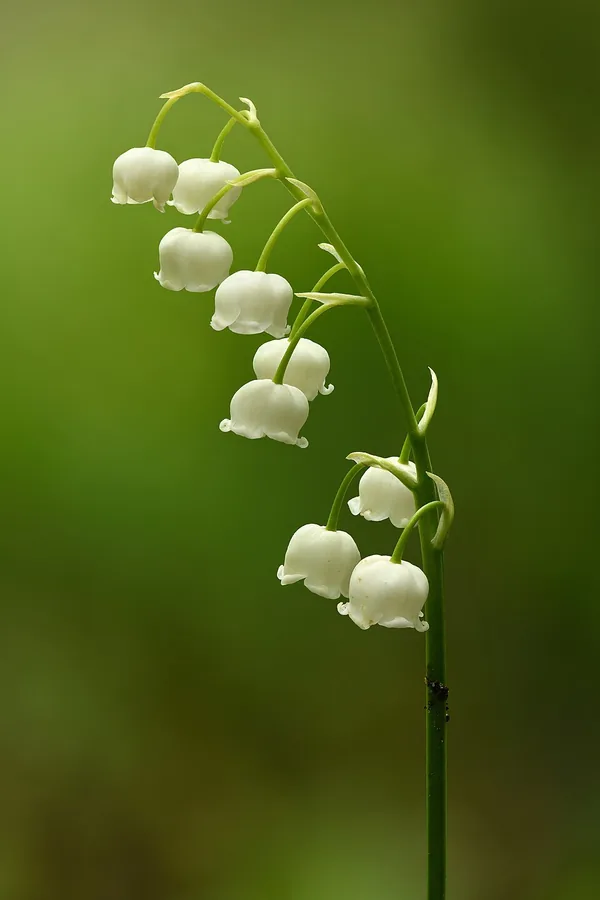
Lily of the valley is a low woodland perennial in the family Asparagaceae, grown for its arching stems of small, white, nodding bells and a fragrance ranked among the finest in the spring garden. It advances underground on creeping rhizomes called pips, forming a dense green groundcover beneath a tree canopy or along a north-facing wall where root competition and shade defeat many other plants. The broad paired leaves persist and hold their form long after anthesis.
Its cultural demands are modest, which follows from its natural range. Hardy from zone 3 to 8, it tolerates severe winter cold and performs in the dappled to full shade that limits sun-dependent species. Supplied with moist, rich soil, its rhizomes extend freely, and that same vigor makes it capable of displacing neighbors and has led to its being flagged as invasive in some regions.
The decisive consideration is toxicity. All tissues, from the scented flowers to the bright red berries, contain cardiac glycosides that act on the heart and can drive it into a dangerous rhythm. It is ornamental and undemanding, but it belongs where pets and children have no access to it.
Care
The short version: establish the pips in dappled to full shade, hold the rich soil evenly moist, and lift and divide congested clumps every few years. Handle it only in gloves.
Light
Site it in dappled to full shade, the low-light ground beneath a canopy or on the cool aspect of a building where few flowering plants succeed. It admits some morning sun, but hot afternoon exposure scorches the foliage and forces the colony into premature decline, which is why a shaded position sustains it longest.
Water
Maintain the rich soil evenly moist, irrigating on roughly a 5 to 10 day interval and more frequently during drought. An established colony withstands summer dry spells, but the foliage deteriorates under water stress, so watering through extended dry periods preserves its condition.
Soil
It requires moist, fertile, organically rich ground that nonetheless drains, since the organic matter supplies both the moisture retention and the fertility it draws on. Heavy clay and drier soils are tolerated, yet the most vigorous, fastest-spreading colonies form where moisture and compost are abundant.
Temperature
Cold hardiness is exceptional. This iron-hard perennial endures winter lows to -40°F (-40°C) and grows well to about 84°F (29°C), beyond which rising heat and sun progressively degrade the foliage.
Humidity
Ambient outdoor humidity meets its needs, so no target figure applies. Air movement is the operative factor, because a congested, stagnant, damp microclimate is precisely what favors the fungal leaf spot that mars the foliage.
Feeding
A single spring application, timed to the resumption of growth, supplies its requirements. A top-dressing of compost or a balanced general-purpose fertilizer suffices, and an annual leaf-mold mulch sustains an established stand over the long term.
Pruning
Intervention is minimal. Remove the spent flowering stems and cut back the declining foliage in late summer or fall as it yellows and its function ends. Wear gloves throughout, since every part of the plant is poisonous to handle and to ingest.
Repotting
In the ground the equivalent operation is division, not repotting. Every 3 to 5 years, lift the congested colonies and separate them to restore vigor, because crowding reduces flowering and thins the central foliage.
Size & spacing
Growth stays low, at 6 to 12 inches (15 to 30 cm) in height, with each plant spreading 9 to 12 inches (23 to 30 cm) before it merges into continuous cover. Space the pips in anticipation of that rhizomatous spread, since they will close the intervals in time.
When to plant
The species keys its cycle to the temperate seasons. Set the pips into the ground in fall or early spring, and the fragrant white bells emerge from April into early summer, after which the colony passes into its summer foliage phase.
Northern hemisphere
Southern hemisphere
Typical months for a temperate climate: start earlier in warm zones, later where spring frosts linger.
- Plant: Plant rhizomes (pips) in fall or early spring.
- Harvest: Blooms early to mid-spring (April to early summer).
Hardiness
USDA hardiness zones: 3–8
Temperature: down to -40°C
Troubleshooting
This is a resilient, low-maintenance species, so most disorders are minor and trace to weather or an overly wet site rather than to persistent disease. Interpret the early symptoms on leaves and stems and you can intervene before a problem advances. Match the presentation below, then correct the underlying cause.
Stems softening and rotting at the crown
Softened, discolored stems indicate stem rot, a decay that develops where soil remains saturated and drainage is inadequate. Excise and dispose of the rotted tissue to remove the inoculum before it advances through the colony. Correcting the drainage and reducing irrigation restores the aerated root zone the planting needs to recover.
Fix:
- Improve soil drainage
- Reduce excess moisture
- Remove and dispose of rotted material
Brownish spotting and blotches across the leaf blades
These lesions are the work of fungal leaf spot, leaf blotch, or anthracnose, pathogens that establish readily in the cool, damp shade this species occupies. The spots begin small and then enlarge and coalesce under prolonged leaf wetness, which is why wet spells worsen them. Remove the affected leaves, clear fallen debris that harbors spores, and direct water to the soil line so the foliage dries between waterings.
Fix:
- Remove and dispose of affected leaves
- Improve air circulation and avoid wetting foliage
- Water at the soil line
Summer yellowing and dieback of the foliage
Summer dieback in this species is generally heat and drought stress rather than pathology, as the foliage senesces early once soil moisture falls and temperatures climb. Excess sun exposure or a shortfall of water accelerates the decline. Mulching conserves soil moisture and supplemental water carries the colony through dry periods, after which it flushes again the following spring.
Fix:
- Provide shade and consistent moisture
- Mulch to conserve soil moisture
- Site in dappled to full shade
Distorted young growth bearing insect clusters or fine webbing
Two sap-feeders account for this distortion. Aphids colonize soft new growth and deform it as they feed, whereas spider mites proliferate in dry conditions and lay down fine webbing. Examine the leaf undersides where both congregate, dislodge them with a strong jet of water, and escalate to insecticidal soap only where populations persist.
Fix:
- Spray with a strong jet of water
- Apply insecticidal soap if needed
- Remove heavily infested foliage
Toxicity
This ranks among the most poisonous plants in cultivation and warrants deliberate handling. Every part holds cardiac glycosides, the fragrant flowers, the leaves, the red berries, and even the water in which a cut stem has stood. Ingestion of any amount can provoke vomiting and dangerous disturbances of heart rhythm, and a sufficient dose can be fatal to pets, livestock, and people alike.
Toxic to
Cats · Dogs · Horses · Rabbits · Livestock · Birds · People
Cats Severe
A trace intake is enough to harm a cat. Early salivation and vomiting give way to weakness as the cardiac glycosides slow the heart and disrupt its rhythm, and a sufficient dose induces cardiac arrest.
Dogs Severe
Expect vomiting, a pulse that runs slow or fast, low blood pressure, and eventual collapse. The cardiac glycosides that poison cats are equally lethal to dogs, so any ingestion warrants emergency treatment.
Horses Severe
A grazing horse may present with colic, a dangerously irregular heartbeat, and ataxia. The intoxication is severe and can prove fatal in the absence of prompt veterinary intervention.
Rabbits Severe
Rabbits respond acutely to the cardiac glycosides, developing gastrointestinal upset, a destabilized heart rhythm, and abrupt weakness. Exclude them from all parts of the plant.
Livestock Severe
Cattle, goats, and sheep are poisoned equally by the leaves, flowers, and berries, with cardiac arrhythmia that can be fatal. The toxins persist in dried material, so plants baled into hay remain hazardous.
Birds Severe
Birds show marked sensitivity to these cardiac toxins, and even a minor intake can precipitate a lethal arrhythmia. Deny them access to the plant and its berries entirely.
People Caution
No portion of this plant is edible. Ingesting the flowers, leaves, or red berries, or drinking the water a cut stem has stood in, can produce vomiting and dangerous disturbances of heart rhythm. Store it away from children and contact poison control after any ingestion.
Wear gloves when handling, and keep all parts including the sweet-smelling flowers and red berries away from pets and children. Wash hands after contact.
Helpline numbers

United States
ASPCA Animal Poison Control: (888) 426-4435 (fee applies)
Poison Control: (800) 222-1222



Canada
Poison Centres: 1-844-764-7669
Varieties
The plain white species accounts for most plantings, but a few named selections are available to growers seeking a departure from the type.
var. rosea
A pink-flowered variant in which the customary white bells are replaced by soft, light pink ones.
Golden Slippers
A foliage selection valued not for its bloom but for leaves in chartreuse to golden yellow.
Companions
Lily of the valley pairs best with shade-loving plants that share its taste for moist, rich soil, the kind of company it keeps on a woodland floor.
Plant near
Hosta: Shares the same shade and moist, rich soil preferences as a woodland groundcover companion.
Ferns: Thrive in the same dappled to full shade and moist conditions.
How to propagate
Increase is straightforward, since the species multiplies of its own accord through its underground rhizomes. You can divide the existing colony or raise plants from seed, though the two methods differ greatly in the time they demand.
DivisionEasy
Fall or early spring · One to two growing seasons
Division is the dependable method and the one most growers employ, since the species propagates naturally from its rhizomes. In fall or early spring, lift an established clump and separate the rhizomes, termed pips, into individual pieces. Replanted divisions establish over one to two growing seasons. Handle with gloves, as every part of the plant is poisonous.
SeedModerate
Fall · Several years
Seed is the protracted route. Sown in fall, germination is erratic and several years pass before the seedlings develop into worthwhile plants. Division reaches maturity far sooner, so most growers forgo seed.
Myths
The perfumed flowers and scarlet berries can be tasted without harm.
In fact, all tissues of this plant are poisonous, the fragrant flowers and the conspicuous berries that draw a child's notice included. Their cardiac glycosides act directly on the heart and can force it into a dangerous rhythm. A taste is never safe, and a larger amount can be fatal.