Bulb · Iridaceae
Spring Crocus
Crocus vernus
Set the corms down in fall and the spring crocus rises to deliver the first color of the year, frequently pushing straight up through snow.
Full sun
Every 7–14 days
USDA 3–8
2–6 in · 5–15 cm
Overview
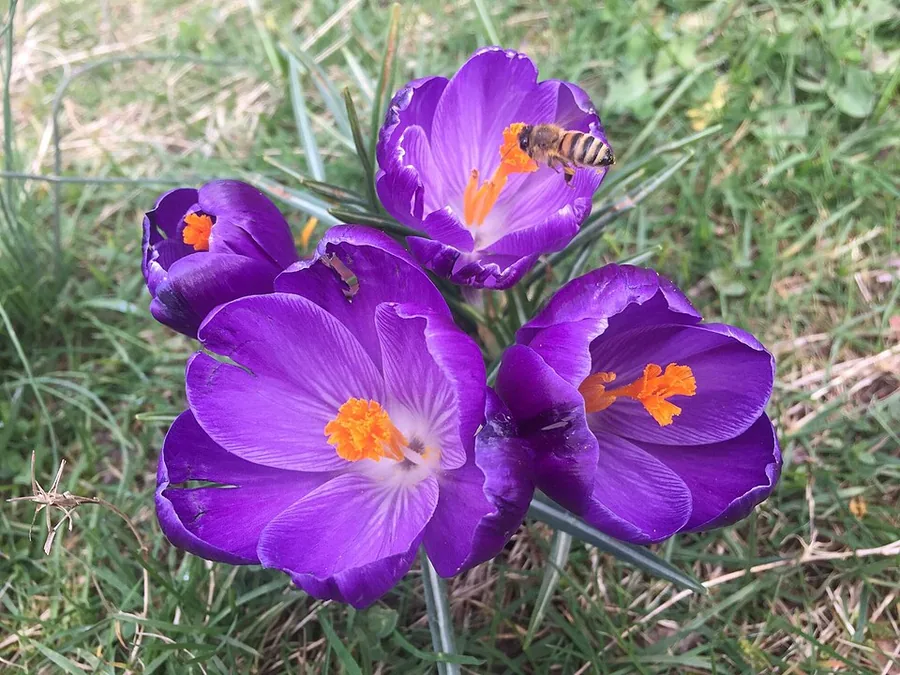
Among the first flowers to interrupt a long winter, the spring crocus opens cups of purple, white, and lilac while the soil is still cold. Its engine is a corm, a thickened underground stem that banks all the resources the plant needs to flower, and that storage organ is why it reliably returns season after season. Look for it threaded through lawns, lining bed edges, and gathered beneath trees where little else has stirred.
A member of the iris family, it keeps a low profile at just 2 to 6 inches (5 to 15 cm) tall, which is exactly why it earns its keep planted in drifts where sheer numbers do the work. Every corm pushes up grassy, pale-striped leaves followed by a brief run of flowers lasting about three weeks, after which the plant retreats below ground for summer. Undisturbed, a planting gradually broadens into a denser, wider sweep.
This is the genuine spring crocus, and it ranks as only mildly toxic to people and pets, in a different league entirely from the lethal autumn crocus it gets mistaken for. Its demands are modest: a sunny site that drains freely and the discipline to leave it be once flowering ends.
Care
The short version: set the corms in fall into a sunny, gritty bed that drains freely, hold medium moisture through flowering, then keep them dry and undisturbed across summer and wait for the leaves to yellow before cutting back.
Light
Site crocuses in full sun to get the heaviest, finest flowering, though they accept partial sun or light shade without complaint. Beneath deciduous trees they do well, because the corms collect their light in early spring before the canopy leafs out overhead.
Water
While they are in active growth and flower, supply medium, steady moisture, watering about every 7 to 14 days when rainfall falls short. After the foliage dies back, hold them on the dry side, since the corms enter summer dormancy and will rot if left in soggy ground.
Soil
Everything hinges on drainage. Set them into gritty, sandy or loamy soil carrying some organic matter at a pH between 6.0 and 7.0, and keep clear of heavy clay, which retains the moisture that destroys corms.
Temperature
These are durable, cold-hardy plants that endure winters as low as -40°F (-40°C) and brush off late frosts. They make their growth in cool conditions and shut down once summer heat sets in, tolerating daytime warmth to roughly 75°F (24°C).
Humidity
Atmospheric moisture is nothing to fuss over. Ordinary outdoor humidity is fine, and the far more decisive factor is preventing the soil from staying wet around dormant corms.
Feeding
Mix a low-nitrogen bulb fertilizer or bone meal into the soil at planting and the job is largely done. Because the corm already carries enough food to flower once, a light application in fall and early spring covers everything it asks for.
Pruning
No genuine pruning is required. Let the leaves remain and yellow naturally for about 6 weeks after the flowers fade, allowing the corm to rebuild its reserves for the coming year, then take away the spent foliage.
Repotting
Planted in the ground, crocuses manage themselves for years on end. Lift and divide a clump every 4 to 5 years once you spot fewer or smaller flowers, congested corms, or a broad loss of vigor.
Size & spacing
These plants stay compact, topping out at just 2 to 6 inches (5 to 15 cm) tall with a comparable spread. Position the corms 3 to 6 inches (8 to 15 cm) apart to give them room to increase into a denser drift.
When to plant
Crocus scheduling reverses the usual order. The corms go in during fall, several weeks ahead of the ground freezing, and they put down roots through winter. Flowering follows in the season's first warm stretch, often as early as February, after which the plant retires by early summer.
Northern hemisphere
Southern hemisphere
Typical months for a temperate climate: start earlier in warm zones, later where spring frosts linger.
- Plant: Plant corms in fall, about 3-4 inches deep and 3-6 inches apart, 6-8 weeks before the ground freezes.
- Harvest: Early spring (February to April), blooming for about three weeks.
Hardiness
USDA hardiness zones: 3–8
Temperature: down to -40°C
Troubleshooting
Few flowers are less demanding than the crocus, and nearly every issue comes down to one of three things: waterlogged soil, foraging rodents, or congestion below the surface. Find your symptom among the cases that follow and the remedy is generally straightforward. Address each one promptly, before it works through the whole planting.
Mushy corms that never break the surface
Sitting water is what finishes them off. Corm rot takes hold wherever heavy clay or a low pocket in the bed traps moisture against the corm, and lifting one confirms it: the tissue turns soft, brown, and foul. Discard every rotted corm, then move the sound ones into gritty soil opened up with sand or compost so water moves through quickly rather than pooling.
Fix:
- Lift and discard rotted corms
- Replant healthy corms in gritty, well-drained soil
- Amend beds with sand or organic matter to improve drainage
Disturbed soil and disappearing corms in the weeks after autumn planting
A freshly set corm reads as buried food to squirrels, chipmunks, mice, and voles, and they will excavate and eat it long before any leaf surfaces. Cover the bed with hardware cloth or wire mesh and leave it in place until shoots break through. Raking off the loose papery husks reduces the problem as well, because that odor is one of the cues that leads rodents to the site.
Fix:
- Cover planting areas with hardware cloth or wire mesh until growth emerges
- Plant corms at the recommended depth and firm the soil
- Remove planting debris and papery corm husks that attract rodents
An aging clump that flowers less each season
A patch that performed for years and then dwindles is almost always suffering from overcrowding, since the corms keep multiplying and start competing with one another below ground. Removing the leaves prematurely produces the same decline, because the corm loses the window it needs to refill its food reserves for the following year. Lift and split the clump once the foliage has died back, reset the corms at correct spacing, and after that let the leaves run their full course before they go.
Fix:
- Dig and divide crowded clumps after foliage dies back
- Replant divided corms at proper spacing
- Allow foliage to remain about 6 weeks after bloom
Toxicity
Reassurance for homes with pets and children: the spring crocus is only mildly toxic. A chewed leaf or corm might bring on some drooling, vomiting, or diarrhea, yet it poses no real danger. The point worth remembering is that it stands wholly apart from the autumn crocus (Colchicum), which is lethal, so be certain which of the two grows in your beds.
Toxic to
Cats · Dogs · Horses · Rabbits · Livestock · Birds · People
Cats Mild
Should a cat take a bite of foliage or a corm, expect drooling, vomiting, or some diarrhea. The episode resolves without treatment, and this species bears no resemblance to its lethal autumn counterpart.
Dogs Mild
A dog that gnaws on the plant usually drools and runs a brief upset stomach. Symptoms stay mild, but a large mouthful warrants a quick call to the vet.
Horses Mild
A horse grazing the leaves may end up with a mild digestive upset and loose manure. The effect is minor and bears no comparison to the severe poisoning brought on by the autumn crocus.
Rabbits Mild
Should a rabbit nibble the leaves, it can develop soft stools and go quiet and off its food for a spell. The safe course is keeping the plant clear of the hutch and run.
Livestock Mild
Cattle, goats, and sheep generally leave it alone, yet an inquisitive bite can produce some short-lived digestive upset that resolves quickly.
Birds Caution
Specific evidence for pet birds is lacking, so the sensible default is to keep it out of reach instead of assuming it is safe.
People Caution
Treat this strictly as an ornamental rather than something edible. Swallowing the corm or leaves can produce mild nausea and stomach upset, so keep curious children from mouthing any part of it.
Keep corms and plants away from pets that chew on plants; wash hands after handling.
Helpline numbers

United States
ASPCA Animal Poison Control: (888) 426-4435 (fee applies)
Poison Control: (800) 222-1222



Canada
Poison Centres: 1-844-764-7669
Varieties
The crocuses sold for the garden are mostly large-flowered Dutch types, marketed by color at least as much as by name. The selections below are the ones you will run into most.
Pickwick
Each pale lilac petal carries strong deep-purple striping, so every flower looks feathered and reads as a clear two-tone.
Flower Record
Big, single-tone deep-purple blooms flare open and stand out as a solid mass of color even at a distance.
Jeanne d'Arc
Clean white flowers naturalize readily on their own, which is why this selection is so often chosen for lawns and the ground beneath trees.
Remembrance
Lustrous deep violet-purple blooms hold a faint sheen that picks up the low light of early spring.
Striped Beauty
Light purple petals run with darker purple stripes, a gentler version of the bicolor effect seen in Pickwick.
How to propagate
DivisionEasy
After foliage dies back in late spring or early summer, replant in fall. · Replanted divisions establish over one season and bloom the following spring.
Dividing is the most reliable route to more plants: every 4 to 5 years, after the leaves have died back, lift a congested clump, separate the individual corms by hand, and reset them that fall at correct spacing. Given a single season to root in, they bloom again the next spring.
Offsets & pupsEasy
Lift in summer dormancy; separate naturally formed cormels. · Small cormels may take 1-2 years to reach flowering size.
A parent corm steadily forms small cormels around its base; lift the clump during summer dormancy and twist these offsets away. Grown on for a year or two, they build up to flowering size.
SeedModerate
Sow ripe seed in containers in late summer or fall. · Seed-grown plants take several years (often 3-4) to reach flowering size.
Ripe seed can be sown into containers during late summer or fall, though the wait is long, with seedlings needing 3 to 4 years to reach flowering size. Cultivars do not breed true from seed, so reserve this method for cases where a mixed batch of seedlings is acceptable.
Myths
Every crocus is one and the same plant, carrying identical risk to pets whether safe or dangerous.
What looks like one plant is in fact two distinct species sharing a common name. The spring crocus grown for early color rates as only mildly toxic and, at worst, brings on minor stomach upset. By contrast the autumn crocus, Colchicum autumnale, sits in an entirely separate family and contains colchicine, an alkaloid capable of causing bloody vomiting, organ damage, and bone marrow suppression in cats, dogs, and horses. Identify which species you are dealing with before assessing the danger.
Crocuses must be fed heavily in order to flower.
Every corm arrives already loaded with the food it needs to bloom that first time, so the opening spring requires nothing from you. A modest, low-nitrogen feed mixed in at planting covers the entire need, and adding more fertilizer yields no extra flowers.