Bulb · Iridaceae
Bearded Iris
Iris germanica
Set the rhizome shallow in full sun, keep it lean and well drained, and the bearded iris flowers reliably each spring for years.
Full sun
Every 7–14 days
USDA 3–10
1–3 ft · 0.2–1 m
Overview
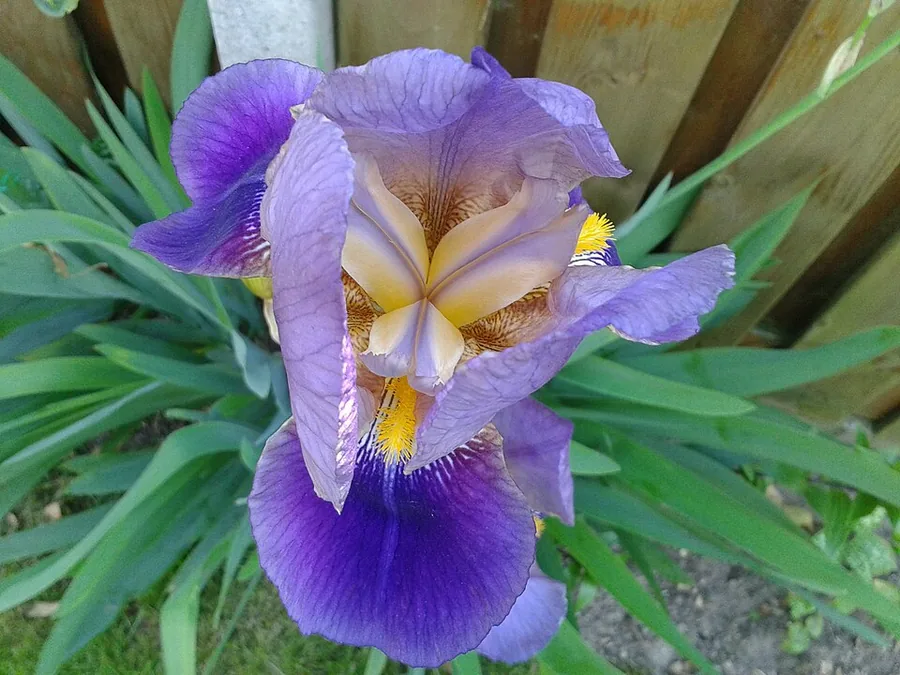
Bearded iris ranks among the most resilient herbaceous perennials in temperate cultivation. It grows from a thickened surface rhizome rather than a true bulb, and that storage organ powers the annual flush of sword-shaped leaves and tall scapes bearing ruffled flowers in late spring. The dense band of hairs along each lower petal, or fall, is the beard from which the group takes its name.
Its tolerance is broad by any measure. The plant withstands winter temperatures to -40°F (-40°C) and summer heat past 100°F (38°C), endures drought once the root system is established, and demands little ongoing input. Its two genuine vulnerabilities are excess soil moisture and excessive planting depth, both of which deprive the rhizome of the aeration it needs and open the door to rot and flower failure.
Sited in full sun on freely draining soil with the rhizome set shallow, it largely manages itself. Periodic division every few years relieves the congestion that suppresses flowering and yields surplus rhizomes for replanting or sharing.
Care
The short version: full sun and freely draining soil, the rhizome set shallow with its back near the surface, watered sparingly once established, and fed lean. Periodic division every few years relieves congestion and sustains flowering.
Light
Bearded iris requires full sun, on the order of six or more hours daily, to flower at full capacity. It tolerates light afternoon shade, but deeper shade shifts the plant's energy into lax foliage at the expense of bloom.
Water
Once established, this is a drought-tolerant species adapted to drier soils. Allow the upper half of the profile to dry between waterings, roughly every 7 to 14 days, and avoid overhead irrigation, which keeps the rhizome wet and predisposes it to rot.
Soil
Drainage is the decisive factor. A well-drained loam amended with organic matter is ideal, sand is acceptable, and heavy clay must be amended with sand or compost to shed water. Maintain the pH between 6.0 and 7.0.
Temperature
This is an exceptionally cold-hardy perennial, performing from -40°F to 100°F (-40°C to 38°C), the range corresponding to USDA zones 3 through 10. Neither severe winters nor typical summer heat limits it.
Humidity
Ambient outdoor humidity is sufficient, so no target value applies. Air circulation is the operative factor, because the still, humid microclimate of a crowded clump prolongs leaf wetness and favors leaf spot.
Feeding
Apply a low-nitrogen fertilizer such as 5-10-10 sparingly, once after bloom and again in early spring. Distribute it around the clump rather than over the rhizomes, since surplus nitrogen promotes soft rot rather than flowering.
Pruning
Remove spent flower stalks after bloom to redirect energy away from seed production. In late fall, cut the foliage back to 3 to 6 inches (8 to 15 cm) to remove the leaf spot inoculum and the borer eggs overwintering in the leaves.
Repotting
Iris is not a container subject, but the clumps require lifting every 3 to 5 years in late summer as they become congested. Diminished flowering, dense clumps, and exhausted central rhizomes that no longer bloom indicate that division is due.
Size & spacing
Mature height ranges from roughly 9 to 39 inches (23 to 100 cm) by class. Space the plants 12 to 24 inches (30 to 61 cm) apart to maintain airflow between the fans and suppress leaf spot.
When to plant
Bearded iris rhizomes are set in late summer to early fall, the window that allows root establishment before dormancy and the cold of winter. Flowering follows the next spring to early summer, with bloom concentrated around May, and a subset of reblooming cultivars produces a second, later flush.
Northern hemisphere
Southern hemisphere
Typical months for a temperate climate: start earlier in warm zones, later where spring frosts linger.
- Plant: Plant rhizomes in late summer to early fall
- Harvest: Spring to early summer (May), some cultivars rebloom
Hardiness
USDA hardiness zones: 3–10
Temperature: down to -40°C
Troubleshooting
The serious disorders of bearded iris develop below the soil line or at the leaf bases, where they remain hidden until the foliage signals distress. Early detection of the borer and of rot determines whether the clump survives. Identify the problem from the descriptions below, then intervene before it advances through the planting.
Dying leaf tips with sawdust-like grains at the base
These symptoms trace to the iris borer, whose larvae hatch in spring, feed downward through the foliage, and finally tunnel into the rhizome. The sawdust-like frass at the leaf bases is the excavated tissue the larva leaves behind, and that early window is when crushing the small larvae inside the leaves still works. Once a larva reaches the rhizome it hollows out the storage tissue the plant lives on, which is why a tunneled, softened rhizome cannot recover and should be dug out and destroyed.
Fix:
- Crush infected leaves early in the season
- Dig up and destroy affected rhizomes
Soft, foul-smelling rhizomes that collapse
A mushy, foul-smelling rhizome indicates bacterial soft rot, an infection that exploits the anaerobic, waterlogged conditions created by poor drainage, deep planting, and the smothering effect of heavy mulch or excess nitrogen. Because the bacteria liquefy the storage tissue from within, an affected rhizome offers nothing to salvage and must be cut out and discarded. Correct the drainage, then replant only firm tissue shallowly, with the tops sitting at or just above the surface so the rhizome can dry and stay aerated.
Fix:
- Remove and destroy infected plants entirely
- Improve drainage and replant healthy rhizomes shallowly
Spotted leaves on a clump in decline
Lesions on the foliage signal fungal leaf spot, a disease whose spread depends on prolonged leaf wetness, which is exactly what a crowded clump with stagnant air sustains. Removing and destroying the spotted leaves cuts the inoculum that would otherwise reinfect new growth. Where the planting has thickened into a dense mass, dividing it restores airflow to each fan, the underlying condition that keeps the foliage dry enough to break the infection cycle.
Fix:
- Remove and destroy affected foliage
- Divide overcrowded clumps to improve air circulation
Toxicity
Bearded iris is not an edible plant. The whole plant is mildly toxic and the rhizome carries the highest concentration, holding irritant terpenoids that provoke gastrointestinal upset on ingestion and can redden or inflame skin on contact. Keep the rhizomes from pets and children, and wear gloves whenever digging or dividing.
Toxic to
Cats · Dogs · Horses · Rabbits · Livestock · Birds · People
Cats Mild
In cats the irritant terpenoids provoke drooling, vomiting, and a period of lethargy and reduced appetite, with diarrhea sometimes following. Because those compounds concentrate in the rhizome, that storage organ is the part to keep beyond a cat's reach.
Dogs Mild
Dogs most often chew the rhizome, where the irritant principle is most concentrated, so the response is drooling, gastrointestinal upset, and lethargy with appetite loss. Loose stools commonly accompany the episode and resolve as the irritant clears.
Horses Moderate
The same terpenoid irritants inflame a horse's gut, producing drooling and diarrhea. Horses seldom seek iris out, but situating clumps away from paddock edges removes the temptation for a bored animal to browse them.
Rabbits Moderate
Iris is not forage for rabbits. The terpenoids distributed through the rhizome and leaves irritate the rabbit's digestive tract, so the plants warrant fencing and trimmings should never be offered as feed.
Livestock Moderate
In cattle, sheep, and goats, grazing the foliage or unearthing a rhizome can cause oral irritation and gastrointestinal upset. These animals generally avoid iris unless pasture is scarce, when browsing pressure rises.
Birds Caution
Evidence for birds is inconclusive, and since the rhizome is a known irritant, the prudent position is to treat iris as off-limits. Prevent poultry and pet birds from pecking the roots or foliage.
People Caution
No part of bearded iris is edible, and the rhizome is the most irritating tissue if ingested. Contact with the sap can redden or itch the skin, so gloves are warranted when digging or dividing, and children should be kept from chewing the leaves.
Wear gloves when handling rhizomes, as the sap can cause minor skin irritation or contact dermatitis.
Helpline numbers

United States
ASPCA Animal Poison Control: (888) 426-4435 (fee applies)
Poison Control: (800) 222-1222



Canada
Poison Centres: 1-844-764-7669
Varieties
Bearded iris is classified into groups by mature height, ranging from dwarf forms a few inches tall to scapes that clear the knee. Selecting a class is principally a matter of the flower height the planting calls for.
Tall Bearded
The tallest and most widely cultivated class, reaching 2.5 to 3 feet (71 to 97 cm) and producing the large, ruffled flowers regarded as the archetype of the group.
Intermediate Bearded
A mid-height class at 16 to 27 inches (41 to 69 cm) occupying the range between the dwarfs and the tall types, with bloom that often opens somewhat earlier.
Standard Dwarf Bearded
A compact class at 8 to 15 inches (20 to 38 cm) suited to the front of a border or to a rock garden.
Miniature Dwarf Bearded
The smallest class, reaching only about 8 inches (20 cm) and the earliest of the group to flower in spring.
How to propagate
Bearded iris propagates readily, since an established clump steadily outgrows its allotted space and benefits from periodic division. Division is the dependable vegetative method, whereas seed is a slow approach reserved for breeding work.
DivisionEasy
Mid to late summer, after flowering · Blooms typically resume the following season
Division is the standard means of propagating bearded iris, carried out in mid to late summer after flowering has finished and the plant is entering its quieter phase. Lift the clump and separate the rhizomes by hand, retaining the young, firm peripheral pieces and discarding the spent central rhizomes that no longer flower. Reduce each fan of leaves to limit transpiration, then replant shallowly with the top exposed, and the divisions reestablish to bloom again the following season.
SeedModerate
Sow after seed ripens; named cultivars do not come true from seed · Several years to flowering
Seed propagation is essentially a breeding exercise, because named cultivars are hybrids and their offspring will not come true from seed. Sow the seed once it has ripened and expect a protracted juvenile phase, since a seedling can require several years to reach first flowering. Where breeding is not the aim, removing the spent flower stalks prevents seed set entirely and conserves the plant's energy.
Myths
Bearded iris should be planted deep like a tulip or daffodil bulb.
Bearded iris develops from a rhizome rather than a true bulb, and that storage organ must sit shallow with its back at or just below the surface to stay aerated. Bury it at tulip depth and the trapped moisture invites rot, suppressing flowering. Plant the rhizome shallow so its top is exposed to the sun.