Bulb · Iridaceae
Japanese Iris
Iris ensata
Supply acidic soil, full sun, and abundant summer water, and Japanese iris produces broad, butterfly-flat blooms.
Full sun
Every 1–3 days
USDA 4–9
2–4 ft · 0.6–1.2 m
Overview
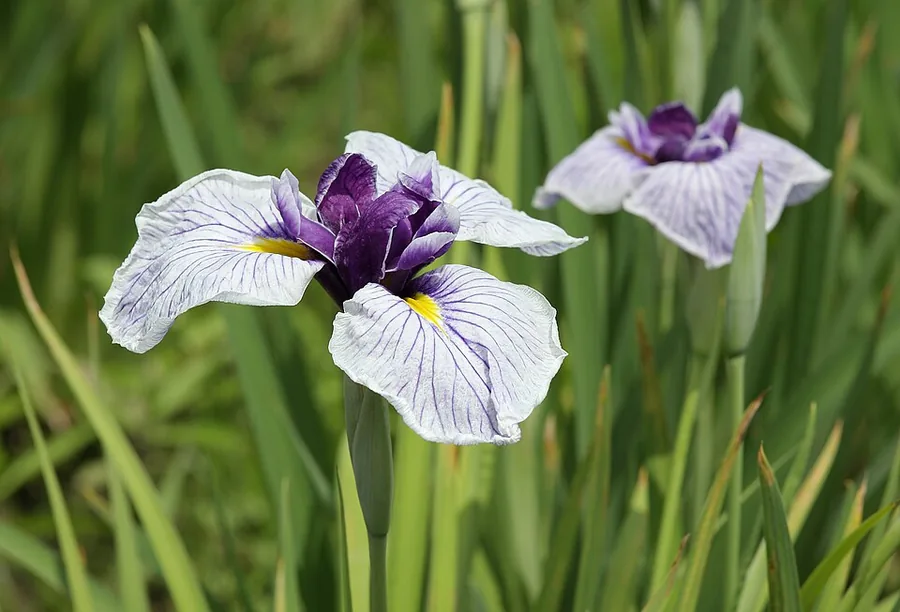
Japanese iris is the most refined member of the genus for the water garden, opening flat, wide flowers above tall, swordlike leaves in early summer. It grows from a spreading rhizome, persists as a perennial, and knits into a dense clump wherever the ground stays reliably damp, such as a pond margin. Individual blooms measure 3 to 6 inches across in blue, purple, pink, lavender, and white.
The species carries a precise cultural profile, and honoring it is the whole of successful culture. It demands acidic, organic, moisture-retentive soil, full sun with tolerance for light afternoon shade, and uninterrupted moisture through the growing season. Lime raises pH beyond its tolerance and blocks iron uptake, while a waterlogged dormant crown suffocates and rots.
Site the plant correctly and Iris ensata proves hardy from zone 4 to zone 9 and largely self-sufficient. Site it in alkaline ground or a winter-wet position and the physiology turns against you, replacing those large flowers with chlorotic foliage and decayed roots.
Care
The short version: full sun to light afternoon shade, rich acidic soil held wet through the growing season but drained in winter, generous feeding during active growth, and division roughly every three years.
Light
Site Japanese iris in full sun to maximize flower initiation, allowing light afternoon shade where summer heat is intense. It persists in partial shade, but reduced irradiance translates directly into fewer blooms.
Water
Sustain consistently moist to wet soil through the growing season, irrigating every one to three days, and the plant will tolerate standing water up to 6 inches (15 cm) deep in summer. Curtail moisture sharply in winter, because a saturated dormant crown loses oxygen and rots.
Soil
Establish it in rich, organic, acidic soil that retains moisture, targeting a pH of 5.5 to 6.5. Lime and alkaline conditions immobilize iron and induce yellowing, so exclude lime from the bed entirely.
Temperature
The species is cold-hardy across a broad span, roughly -29°F to 95°F (-34°C to 35°C). That low-temperature tolerance is precisely what underwrites its survival through winter in zones 4 to 9.
Humidity
Ambient outdoor humidity is adequate, so no target value applies. Root-zone moisture in summer and good air circulation around the foliage matter far more, the latter suppressing pests and foliar disease.
Feeding
As a heavy feeder, it warrants feeding through spring and early summer with a balanced fertilizer or generous organic matter. Withhold any lime-based product, which shifts pH against the plant's requirements.
Pruning
Remove spent flower stalks once bloom concludes, then cut the foliage back in late fall after senescence. Clearing that dead material also eliminates the overwintering refuges for pests and pathogens.
Repotting
Lift and divide the clump roughly every three years after flowering finishes. Diminishing flower size, a congested clump with a hollow center, or declining vigor are the reliable indicators.
Size & spacing
A mature clump attains 2 to 4 feet (61 to 122 cm) in height and 18 to 24 inches (46 to 61 cm) in spread. Allot that footprint per plant so air moves freely and the foliage stays sound.
When to plant
Iris ensata runs on a defined annual cycle. Set rhizomes about 2 inches deep in fall or spring, watch the broad flowers open from June into July, then cut the clump back once the foliage senesces in late fall.
Northern hemisphere
Southern hemisphere
Typical months for a temperate climate: start earlier in warm zones, later where spring frosts linger.
- Sow: Sow seed in fall or stratify; germination is slow and erratic.
- Plant: Plant rhizomes in fall or spring, setting them about 2 inches deep.
- Harvest: June to July (mid-summer)
Hardiness
USDA hardiness zones: 4–9
Temperature: down to -34°C
Troubleshooting
Most disorders in Japanese iris arise from water regime and soil chemistry rather than pests. Read the foliage and the crown, and interpret the early signs below before a manageable problem escalates to a lost clump. Match the symptom, then intervene while intervention still changes the outcome.
Soft, rotting rhizomes with collapsing foliage
A soft crown paired with collapsing leaves signals crown and rhizome rot, the predictable result of a dormant crown held in saturated ground. Iris ensata takes up large volumes of water through active growth, but its rhizome respires poorly once dormant, and standing water starves that tissue of oxygen and invites bacterial breakdown. Lift the clump, excise the soft, foul-smelling tissue back to firm rhizome, and reset the divisions where the soil stays moist through summer yet drains freely in the cold months.
Fix:
- Remove and discard affected rhizomes
- Move or replant divisions in a site that is moist in summer but well drained in winter
- Avoid standing water and boggy soil during dormancy
Chlorotic yellow foliage and weak growth
Yellowing leaves on a slow, weak plant almost always indicate lime-induced chlorosis. As soil pH rises above the acidic range this species requires, iron shifts to forms the roots cannot absorb, chlorophyll production falls, and the leaves pale. Test the soil, drive the pH down with organic matter, hold moisture steady through active growth, and feed this heavy consumer in season. Lime only compounds the problem, so exclude it.
Fix:
- Acidify soil and amend with organic matter
- Increase watering during active growth
- Feed during the growing season
Silvery stippled foliage and marred flowers
Silvery stippling with distorted buds is the diagnostic signature of thrips, whose rasping mouthparts rupture leaf and petal cells and leave that characteristic sheen. Ragged margins and mucous trails point instead to slugs and snails working the foliage after dark. Dislodge a light thrips population with a hose, strip out the moist debris that shelters molluscs, and hold any targeted chemistry in reserve until pressure becomes heavy.
Fix:
- Hose off light infestations
- Remove debris that shelters slugs and snails
- Use appropriate controls if damage is heavy
Toxicity
Regard the entire plant as off limits to animals. The rhizomes and roots hold irisin and irritant pentacyclic terpenoids that provoke salivation, vomiting, and diarrhea in cats, dogs, horses, and grazing stock, and concentration peaks in the rhizome. No tissue is edible, so keep it clear of pets, livestock, and small children, and wear gloves when handling cut rhizomes.
Toxic to
Cats · Dogs · Horses · Rabbits · Livestock · Birds · People
Cats Toxic
In a cat, ingestion typically provokes salivation, vomiting, and lethargy, with diarrhea to follow. Concentration of the toxic terpenoids in the rhizome puts a cat that digs at greatest exposure.
Dogs Toxic
A dog shows profuse drooling, gastrointestinal upset, and dullness after eating any part. Because the rhizome carries the highest toxin load, a dog that excavates and chews one absorbs the largest dose.
Horses Toxic
A horse that grazes foliage or roots develops hypersalivation, inappetence, and loose stools. Irisin concentrates in the roots, so a horse that lifts an entire clump receives the heaviest exposure.
Rabbits Toxic
The same irritant terpenoids that affect cats and dogs disturb a rabbit's sensitive digestive tract, producing salivation and diarrhea. Exclude the entire plant from the hutch and the run.
Livestock Toxic
Cattle, goats, and sheep that browse the leaves or grub up rhizomes may salivate, scour, and refuse feed. Fence the clumps away from any animal on pasture.
Birds Caution
Documented data on avian toxicity is sparse, but the irritant compounds warrant keeping the plant away from pet and backyard fowl rather than risking a curious peck.
People Caution
No part of the plant is edible, and rhizome ingestion can cause gastrointestinal upset, so keep it from small children. Contact with cut rhizomes can also irritate skin, which is why gloves are advisable during division.
Wear gloves when dividing or handling rhizomes, as sap can cause skin irritation; keep cut rhizomes away from pets.
Helpline numbers

United States
ASPCA Animal Poison Control: (888) 426-4435 (fee applies)
Poison Control: (800) 222-1222



Canada
Poison Centres: 1-844-764-7669
Varieties
Commerce favors named hybrids, but two reference points anchor the group.
Variegata
Carries bold white longitudinal stripes along its swordlike leaves, giving it structural interest for weeks on either side of the flowering window.
Iris ensata (species form)
Represents the wild progenitor of the garden hybrids, bearing flat, butterfly-like blooms 3 to 6 inches across in blue, purple, pink, lavender, or white.
How to propagate
The reliable route to more Japanese iris is dividing an established clump, though seed remains an option for the patient.
DivisionEasy
Late summer or early fall, after flowering finishes (about every 3 years) · One to two growing seasons to reach full bloom
Division is the dependable method for both increase and rejuvenation, since it clones the parent and relieves an aging, congested crown. Lift and separate the rhizomes in late summer or early fall once flowering ends, on roughly a three-year cycle, then reset the pieces about 2 inches deep in rich, acidic, moisture-retentive soil. Withhold lime, and allow each division a season or two to build the reserves it needs for full bloom.
SeedModerate
Sow in fall; germination is slow and erratic · Two or more years to flowering from seed
Seed propagation is slow and genetically unpredictable, because the seedlings segregate away from the parent. Sow in fall and anticipate erratic, protracted germination, then expect two or more years before the first flowers. Maintain an acidic, evenly moist medium throughout the establishment period.
Myths
Japanese iris must remain submerged in standing water year-round.
During active growth it thrives in wet, acidic soil and will accept standing water up to about 6 inches deep in summer. The distinction lies in dormancy, when a crown held in saturated ground loses oxygen and rots. Keep it wet while it grows, but well drained once it goes dormant.
Iris poses no risk to pets because it is merely a garden flower.
The ASPCA classes iris as toxic to cats, dogs, and horses, with the irritant compound concentrated in the rhizome. Ingestion drives salivation, vomiting, and diarrhea in exposed animals. Regard every part as off limits to animals, and the roots above all.