Bulb · Iridaceae
Siberian Iris
Iris sibirica
Cold-hardy to the extreme and untroubled by borer or soft rot, Siberian iris turns a moist site into grassy foliage and late-spring bloom.
Full sun
Every 3–7 days
USDA 3–8
2–4 ft · 0.6–1.2 m
Overview
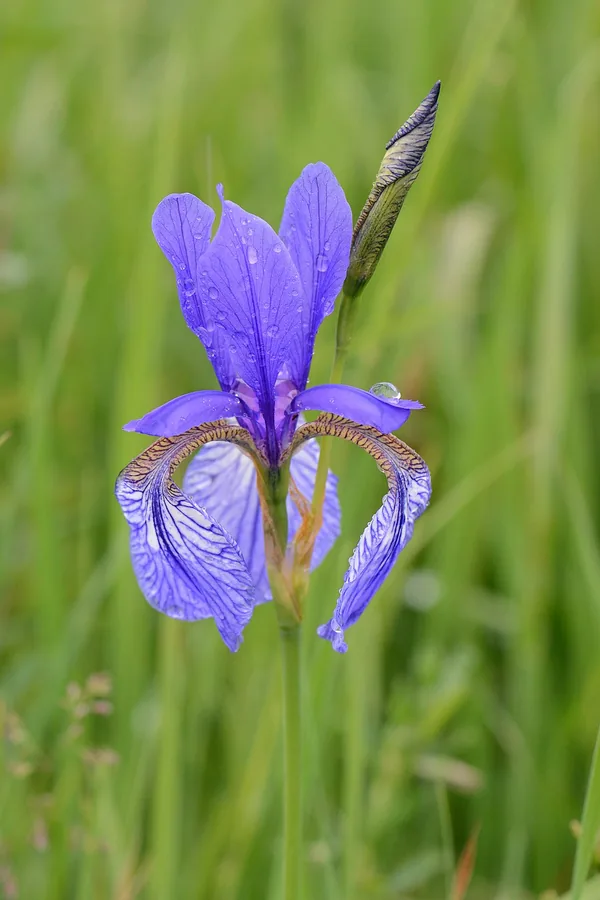
Where bearded iris carries a thick surface rhizome that borers exploit, Siberian iris does not, and that difference explains its easy reputation. It grows as a beardless, clump-forming perennial in narrow, grassy fans and blooms across late spring. With no fleshy rhizome exposed at the soil line, the pests and rots that plague bearded types largely pass it by.
Its cold tolerance is exceptional, reaching down to -40°F (-40°C), which ranks it among the hardiest garden perennials and explains its success across USDA zones 3 to 8. It also adapts to a wide moisture range, from ordinary border soil to genuinely boggy footing that would drown the roots of most perennials. That range makes it one of the few dependable plants for the low, damp corner of a garden.
Grown in sun with steady moisture, it develops a dense, upright clump whose form persists well beyond the flowering period. The narrow, grass-like foliage remains structurally sound through summer, so the plant continues to earn its position in the border after bloom has finished.
Care
The short version: site it in full sun to part shade, hold consistent moisture across the active growing period, and provide rich soil that drains yet still tolerates a boggy position. Lift and divide the clump roughly every 3 years to keep it vigorous, and it demands little else.
Light
Flowering is light-driven, so full sun yields the strongest bloom, though the plant persists in partial shade. Provide a minimum of 6 hours of direct sun; below that threshold, weak stems lodge and the clump sets few flowers.
Water
Because active growth and flowering draw heavily on water, hold even soil moisture from spring emergence until several weeks past bloom. The species tolerates saturated, boggy footing that is lethal to most perennials, and after a season or two an established clump withstands brief drought.
Soil
It performs best in fertile, humus-rich soil with free drainage, yet its tolerance is unusually wide and extends to sites far wetter than typical perennials accept. Target a slightly acidic to neutral pH, between 6.0 and 7.0.
Temperature
Hardiness is the defining trait here: the plant withstands -40°F to 86°F (-40°C to 30°C), a span that covers severe continental winters and typical summer heat without protection.
Humidity
Ambient outdoor humidity meets its needs, so no target applies. Air circulation is the more relevant factor, since dense, moisture-trapping foliage is the precondition for the occasional rot.
Feeding
A single feeding supports the season's growth. Apply a balanced general-purpose fertilizer, or top-dress with compost, in early spring as growth resumes; further feeding through the year adds little.
Pruning
Deadhead the spent flower stems after bloom for appearance. Cut the foliage to 6 to 8 inches at division, or in late fall once it senesces and can no longer feed the crown.
Repotting
Divide roughly every 3 years, or sooner when performance drops. A dead, bare center paired with fewer blooms is the clump signaling overcrowding, the point at which lifting and splitting restores vigor.
Size & spacing
At maturity the clump reaches 2 to 4 feet (60 to 120 cm) in height and 2.5 to 3 feet (76 to 91 cm) in spread. Spacing to that width preserves the air movement that keeps foliage dry and rot-free.
When to plant
The planting window follows regional winter severity. In colder climates, set out new plants or split existing ones in spring so roots establish before summer heat; in the milder southeast, fall avoids that stress. Flowering falls in May and June, after which the foliage sustains the clump into the following year.
Northern hemisphere
Southern hemisphere
Typical months for a temperate climate: start earlier in warm zones, later where spring frosts linger.
- Plant: Spring in cooler-winter regions; fall in the southeast
- Harvest: May to June
Hardiness
USDA hardiness zones: 3–8
Temperature: down to -40°C
Troubleshooting
Compared with bearded iris, this species presents few disorders, a direct consequence of its resistance to borer and soft rot. The issues that do appear track back to insufficient light, an aging overcrowded clump, or prolonged wet. Identify the sign below and the corrective action is usually straightforward.
Soft, foul-smelling breakdown at the crown
Soft, malodorous collapse at the crown indicates bacterial soft rot, a disease Siberian iris resists far better than bearded iris. Excise all affected tissue and dispose of it, then correct the drainage and set the crown shallow rather than deep. The bacterium exploits injured, waterlogged tissue, so clean cuts and free drainage are the effective controls.
Fix:
- Remove and destroy affected tissue
- Improve drainage and avoid burying the crown too deeply
Poor flowering with lax, sprawling foliage
Two causes account for shy flowering and lax foliage: inadequate light or an overcrowded clump. Confirm the site receives at least 6 hours of direct sun, and inspect the crown for a dead center that signals congestion. Lifting and splitting on a 3 year cycle prevents both, since each division restores room and root vigor to every fan.
Fix:
- Relocate or thin surroundings to provide full sun
- Divide the clump and replant healthy fans with at least two fans each
Notched, ragged margins on the leaf blades
Irregular notching along the leaf margins, accompanied by mucus trails, identifies slugs and snails as nocturnal feeders. The injury is superficial and rarely threatens the plant, so remove them by hand after dark and eliminate the damp litter that shelters them by day. Reducing moisture around the crown removes the humid refuge they depend on.
Fix:
- Hand-pick slugs and snails
- Reduce moist hiding spots near plants
Toxicity
This is an ornamental, not an edible, and its chemistry warrants care around animals. All tissues contain irisin and terpenoids, concentrated most heavily in the rhizome, so a pet that ingests it can show salivation and gastrointestinal upset. The cut sap can also irritate skin, so gloves are sensible during division.
Toxic to
Cats · Dogs · Horses · Rabbits · Livestock · Birds · People
Cats Mild
A cat that ingests the plant characteristically salivates and vomits, then becomes lethargic and anorexic. The rhizome carries the greatest toxin concentration, so cats that dig and chew roots present the most pronounced signs.
Dogs Mild
Expect profuse salivation and gastrointestinal upset, frequently with diarrhea and reduced activity. Dogs that excavate and chew the rhizomes absorb the highest dose and react most strongly.
Horses Mild
Grazing produces salivation, abdominal discomfort, and loose manure. Horses seldom choose to eat it, but the plant should still be kept out of reach of pasture.
Rabbits Toxic
The irisin and terpenoids responsible for the signs in cats and dogs make rabbits equally vulnerable, so exclude iris from any hutch or run.
Livestock Toxic
Cattle, goats, and sheep may salivate and develop digestive upset after consuming foliage or roots, so the plant should be fenced away from grazing land.
Birds Toxic
The same toxins pose an equivalent hazard to birds, so poultry and companion birds should be prevented from pecking foliage or rhizomes.
People Caution
No part is edible, and the rhizome holds the highest toxin concentration, so children should be kept away from it. Contact with cut roots can produce skin irritation, making gloves advisable during division.
Wear gloves when dividing or handling, as the sap can cause skin irritation.
Helpline numbers

United States
ASPCA Animal Poison Control: (888) 426-4435 (fee applies)
Poison Control: (800) 222-1222



Canada
Poison Centres: 1-844-764-7669
Varieties
The species has been bred into a broad palette of colors and statures, from purple giants to dwarf whites. The cultivars below represent well-established, widely grown selections.
Caesar's Brother
A vigorous, long-cultivated selection carrying rigid stems of deep purple bloom to roughly 3 feet, and a recognized Plant of Merit.
Butter and Sugar
A bicolor cultivar that sets white standards above pale yellow falls on a single flower.
White Swirl
A uniformly pure white selection valued for brightening shaded sections of a planting.
Baby Sister
A dwarf cultivar reaching only 1 to 1.5 feet, suited to border fronts and confined spaces.
How to propagate
Two routes produce new plants: vegetative division and seed. Division is the faster method and the only one that preserves a cultivar's traits, since seed-raised hybrids segregate and do not reproduce the parent.
DivisionEasy
Late summer or early spring (after bloom) · 6 to 8 weeks to root; may take more than one season to bloom
Division is the standard propagation method and, given the plant's tolerance of disturbance, more forgiving than the equivalent operation on bearded iris. Carry it out in late summer or early spring after flowering: reduce the foliage to 6 to 8 inches, part the clump with a clean, sharp blade into sections retaining two or more fans, replant at a depth of 1 to 2 inches, and keep the soil damp. Rooting takes about 6 to 8 weeks, though a newly divided section commonly withholds bloom for a season.
SeedModerate
Sow when ripe · Several seasons to reach blooming size
Seed propagation is slow and appropriate only for the species, because hybrid seedlings do not breed true. Sow at once upon ripening, and expect several seasons of growth before a seedling attains flowering size.
Myths
Siberian iris requires the same routine division and borer treatment as bearded iris.
Not so. Its habit and physiology differ fundamentally: it forms discrete clumps, presents no thick surface rhizome for the iris borer to mine, and carries strong resistance to the soft rot that afflicts bearded cultivars. Division about every 3 years is sufficient, and it remains essentially pest-free between times.
Iris presents no toxic risk to pets.
It does. Iris is toxic to cats, dogs, and horses, with the toxin load highest in the rhizome. Ingestion typically produces salivation and vomiting, progressing to diarrhea and lethargy, which is why access to the plant, and the roots in particular, should be limited.