Bulb · Iridaceae
Dutch Iris
Iris × hollandica
Seat the bulbs in fall and Dutch iris responds with tall, sleek blooms the following spring.
Full sun
Every 5–7 days
USDA 6–9
15–24 in · 38–61 cm
Overview
Dutch iris is the slim, erect iris of spring borders and the florist trade. It departs from its bearded relatives in its storage organ, rising from a true bulb rather than a creeping rhizome. That bulb overwinters underground and then drives narrow blue-green leaves and a single poised flower up a straight stem.
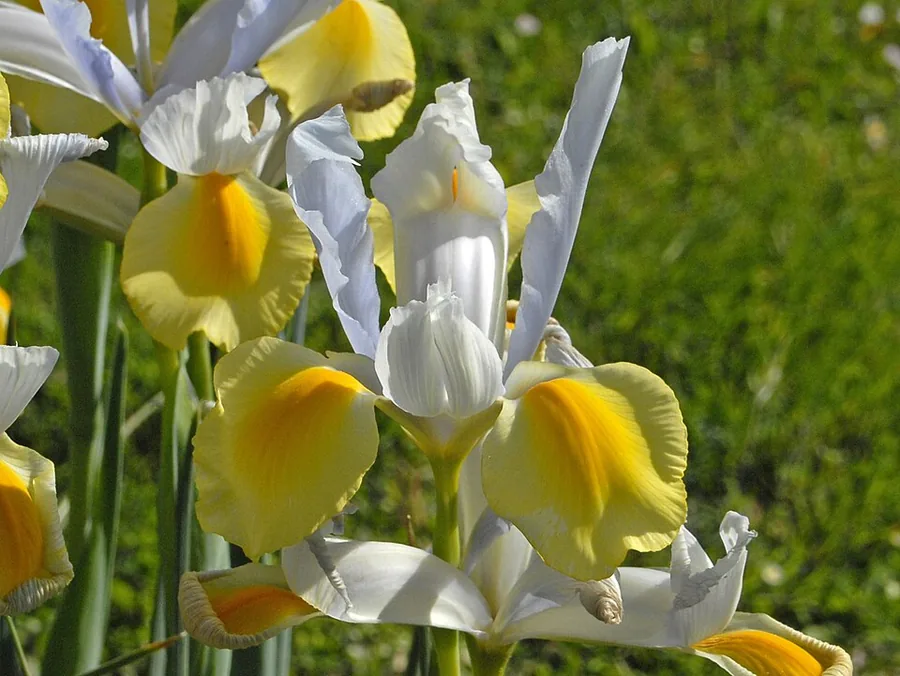
Its biology is tuned to a short, vivid season. Flowering runs from mid to late spring, after which the foliage senesces, yellows, and the bulb enters a dry summer dormancy. The color range spans deep violet-blue through white and yellow, frequently with a contrasting blotch on the falls, and the stems are long enough to harvest for the vase.
Cultural demands are modest. Provide full sun and freely draining soil, plant the bulbs in fall, and withhold water once dormancy begins. Because the bulbs are short-lived, many gardeners manage them almost as annuals and install fresh stock each autumn.
Care
The short version: full sun and fast-draining soil, even moisture through the spring growing season, and a dry rest once the foliage yellows in summer to protect the dormant bulb.
Light
Site Dutch iris in full sun to develop the sturdiest stems and the heaviest flowering. Light afternoon shade is tolerated in hot regions, but excessive shade reduces stem rigidity and suppresses bloom, so favor the open exposure.
Water
Maintain the soil evenly moist through spring during active growth and flowering, supplying roughly every 5 to 7 days when conditions are dry. After bloom, as the leaves yellow, taper irrigation so the bulb dries for its summer dormancy.
Soil
Drainage governs success. Use sandy loam or any average soil that drains freely, because a bulb held in saturated soil rots. Heavy clay is the principal substrate to avoid.
Temperature
The plant tolerates a broad range, roughly 39°F to 86°F (4°C to 30°C). The bulb requires winter chilling to initiate buds, and mild spring temperatures then carry it into bloom.
Humidity
Ambient outdoor air is adequate, so no humidity target applies. Airflow matters more than moisture in the air, since a crowded, damp canopy favors fungal leaf spot.
Feeding
Incorporate a balanced bulb fertilizer into the soil at fall planting, then apply a second feeding in early spring as growth resumes. That regimen meets the bulb's nutritional needs for the season.
Pruning
Retain the foliage after bloom, despite its tired appearance, because photosynthesis through that period is how the bulb recharges for next year. Cut the leaves only after they yellow and die back, and deadhead spent flowers as they fade.
Repotting
Dutch iris calls for periodic renewal rather than repotting. Lift and divide the clumps every few years after bloom as flowering declines, or replant fresh bulbs each fall given the short life of the existing stock.
Size & spacing
Mature plants reach 15 to 24 inches (38 to 61 cm) in height on a narrow footprint of only 3 to 6 inches (8 to 15 cm) across. That slim profile suits tight spaces or dense, closely set drifts.
When to plant
Dutch iris follows a fall-to-spring cycle. Plant the bulbs in autumn, around October to November, allowing them to root before cold sets in, then expect bloom from mid to late spring. After flowering, the plant withdraws resources into the bulb and rests through a dry summer.
Northern hemisphere
Southern hemisphere
Typical months for a temperate climate: start earlier in warm zones, later where spring frosts linger.
- Plant: Plant bulbs in fall, roughly October to November, 3-6 inches deep
- Harvest: Mid to late spring, April to June
Hardiness
USDA hardiness zones: 6–9
Temperature: down to -23°C
Troubleshooting
Most Dutch iris disorders originate at the bulb or register on the foliage. Early diagnosis usually preserves the remainder of the planting. Match the symptom below, identify the cause, and intervene before it moves through the bed.
Soft, fetid rot at the leaf base and bulb
Water-soaked, foul tissue at the bulb signals bulb rot, a breakdown that follows when soil holds water the bulb cannot tolerate. Saturated ground, or irrigation continued through the summer dormancy, denies the bulb the dry rest it requires and the flesh turns to mush. Lift the planting, cull every soft or sour bulb, and reset only firm stock into a sandy bed that sheds water quickly.
Fix:
- Discard affected bulbs
- Replant healthy firm bulbs in a sandy, well-drained site
- Withhold water once foliage has died back for dormancy
Hollowed bulbs with wilting or collapsing plants
Internal tunneling that hollows the bulb and stem is the work of the iris borer, a larva that mines the tissue from within; bulb mites and narcissus bulb fly maggots produce comparable injury. Because the feeding is internal, the plant wilts or topples once the vascular core is severed. Open a suspect bulb to confirm tunnels or grubs, then destroy infested stock, strip the spent foliage that harbors overwintering stages, and replant clean bulbs.
Fix:
- Remove and destroy infested bulbs and larvae
- Clean up plant debris where pests overwinter
- Replant clean, firm bulbs
Leaf spotting or mottled, distorted growth
Discrete, well-margined lesions are typical of fungal leaf spot, which establishes where a film of moisture lingers on the foliage long enough for spores to germinate. Diffuse mottling paired with stunted, distorted growth indicates mosaic virus, a systemic infection that aphids transmit as they feed from plant to plant. Remove the lesioned leaves, irrigate at the soil so the canopy dries, and rogue out any virus-infected plant, since the infection cannot be cured.
Fix:
- Remove affected leaves
- Improve air circulation and avoid overhead watering
- Destroy virus-infected plants and control aphids
Toxicity
Dutch iris is toxic, and the bulb carries the highest concentration of the toxic principle. It holds irisin and terpenoids that induce drooling, vomiting, and diarrhea in cats, dogs, horses, and other animals that ingest it. No part is edible, so keep the bulbs away from pets and children and handle them in gloves.
Toxic to
Cats · Dogs · Horses · Rabbits · Livestock · Birds · People
Cats Mild
A cat that ingests foliage or unearths a bulb commonly salivates and vomits within a short interval. Loose stools and lethargy follow, and because the toxic terpenoids concentrate in the bulb, that organ provokes the strongest reaction.
Dogs Mild
Ingestion in dogs presents as marked drooling, gastrointestinal upset, and diarrhea, and chewing a dug-up bulb delivers the heaviest dose. Lethargy persists until the irritant clears the gut.
Horses Mild
A horse grazing foliage or roots may salivate, refuse feed, and pass loose manure. The pentacyclic terpenoids account for the dullness and gastrointestinal discomfort that follow.
Rabbits Mild
The same irisin and terpenoids irritate the rabbit gut, producing salivation and loose droppings. Exclude bulbs and foliage from any run or hutch to remove the exposure.
Livestock Mild
Cattle, goats, and sheep generally reject iris, yet a hungry animal that consumes it develops gastric irritation and diarrhea. Fence beds sited near a paddock to prevent incidental grazing.
Birds Caution
The literature offers little on iris ingestion by birds, so the prudent reading is a probable irritant rather than a confirmed safe plant. Keep pet birds away from the bulbs pending better evidence.
People Caution
No part of this plant is edible, and the bulb in particular can cause gastric upset on ingestion. The sap is a dermal irritant, so handle in gloves and keep the bulbs out of reach of children.
Wear gloves when handling bulbs, and wash hands after to avoid skin irritation from the sap.
Helpline numbers

United States
ASPCA Animal Poison Control: (888) 426-4435 (fee applies)
Poison Control: (800) 222-1222



Canada
Poison Centres: 1-844-764-7669
Varieties
Dutch iris is offered in a defined palette of named colors, and a few cultivars recur reliably in catalogs and the cut-flower trade.
Blue Magic
A widely planted cultivar valued for deep violet-blue flowers and strong vase life as a cut stem.
Casablanca
Bears large white flowers accented by a yellow blotch on the falls.
Symphony
Presents a bicolor form with crisp white standards held above yellow falls.
How to propagate
The dependable approach is to plant purchased bulbs, though an established clump can be divided into its offsets, and seed remains an option for the patient grower.
Bulbs & cormsEasy
Plant bulbs in fall, October to November · Blooms the following spring after fall planting
The most reliable method is autumn planting of fresh bulbs, roughly October to November, which yields flowers the following spring. Dutch iris grows from a true bulb rather than a rhizome, and because the bulbs are short-lived, many growers simply source and set new ones each fall.
DivisionEasy
After bloom, when foliage yellows in summer · Offset bulblets take several years to reach flowering size
Once the foliage yellows in summer, lift a clump and detach the small offset bulblets formed against the parent bulb, then replant them. The method costs nothing, but the timeline is long, since those offsets take several years to grow big enough to flower.
SeedModerate
Sow ripe seed · Several years to reach flowering size
Ripe seed will germinate, but the approach is slow and rarely justified. Seedlings require several years to reach blooming size, and because the named hybrids do not come true from seed, the resulting flowers will not match the parent.
Myths
Dutch iris grows from a rhizome like bearded and Siberian iris.
The structure differs at the species level: Dutch iris arises from a true bulb that produces small offset bulblets, not the creeping rhizome of bearded or Siberian iris. You plant the bulbs in fall, as with daffodils, rather than seating a rhizome at the soil surface in summer.