Bulb · Iridaceae
Montbretia
Crocosmia × crocosmiiflora
Established corms drive arching sprays of fiery summer color whose tubular form is built for hummingbird pollination.
Full sun
Every 3–7 days
USDA 5–9
2–4 ft · 0.6–1.2 m
Overview
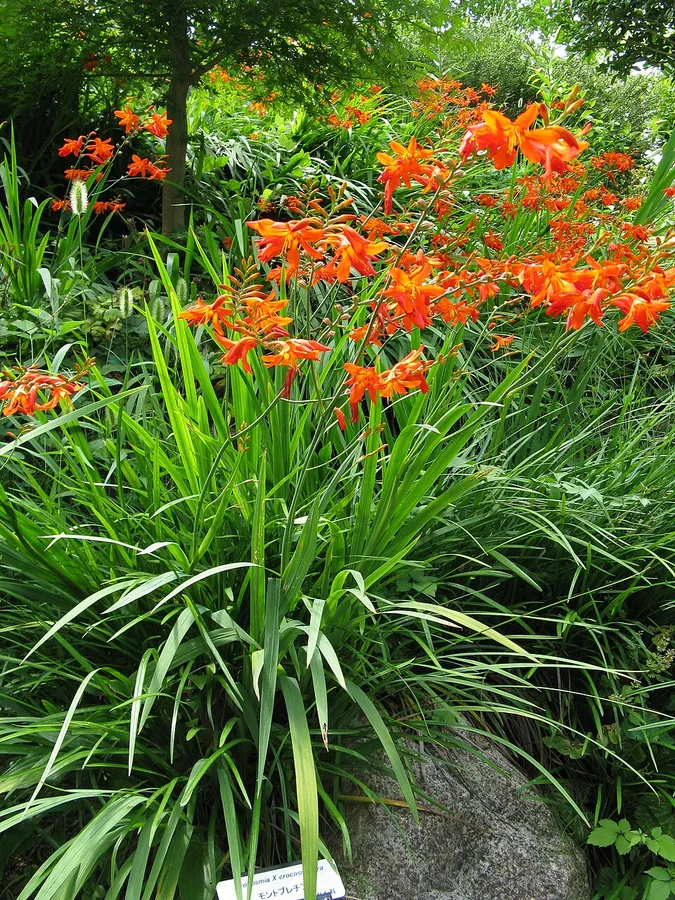
Crocosmia, the plant trade's montbretia, is a summer-flowering perennial geophyte in the family Iridaceae that grows from a corm rather than a true bulb. Its southern African origin shapes its needs, and its garden value rests on the arching stems of tubular flowers in reds, oranges, and yellows produced from June into August. The sword-shaped, two-ranked foliage reads as iris-like, and the inflorescence arranges its flowers along one side of each arching stem.
Cultural demands are modest. Sited in full sun to light shade on well-drained soil, a clump expands clonally, multiplying its corms in chains as each corm produces offsets below ground. That same clonal vigor explains a documented liability: in mild regions crocosmia spreads aggressively and has escaped cultivation along the US Pacific coast, so a clump benefits from periodic containment.
Because the corolla is tubular and nectar-rich, the flowers draw hummingbirds, the trait that earns the plant its ornamental keep. The record carries no toxicity warning, so it is safe around pets, children, and grazing animals. Across zones 5 to 9 the corms overwinter in place and the clump returns with increasing vigor each season.
Care
The short version: full sun to light shade for the strongest stems, free-draining soil that stays moist without waterlogging, corms set a few inches deep in spring, and division every few years to relieve the congestion that depresses flowering.
Light
Flowering is strongest in full sun, though the plant tolerates partial sun and light shade. Higher light yields sturdier stems and heavier bloom because more photosynthate supports both structural tissue and reproductive output, so an open exposure is preferable.
Water
Hold the soil evenly moist through the growing season, since the plant resents drought and checks growth when it dries. The constraint is drainage, because standing water deprives the corm of oxygen and induces rot, so water every 3 to 7 days in dry spells and reduce frequency where the soil retains moisture.
Soil
Use humus-rich, well-drained soil, since clay, loam, and sand all serve provided water percolates rather than pools. Crocosmia is pH-indifferent across 6.0 to 8.0, a wide tolerance that makes most garden beds suitable without amendment.
Temperature
The plant withstands a broad thermal range, from about 28°F to 86°F (-2°C to 30°C). Heat poses little risk, but temperatures below the hardiness range cause cold injury to the corm tissue, which is the reason colder zones lift the corms for overwinter storage.
Humidity
Ambient outdoor humidity is sufficient, so no atmospheric moisture target applies. The relevant stressor is dry, baking conditions, which weaken the foliage and predispose it to spider mite colonization on the stressed tissue.
Feeding
Apply a balanced general-purpose fertilizer at planting and again in spring as growth resumes. That seasonal supply meets demand because crocosmia is not a heavy feeder, and excess nitrogen favors vegetative growth over flower initiation.
Pruning
After bloom, cut the flower stems back to the point where they meet the leaves. Retain the foliage until it dies back naturally, since the leaves continue moving reserves into the corm, then cut to ground level once they have senesced.
Repotting
Rather than potting, crocosmia self-crowds in the bed as offsets accumulate. Divide the corm clumps every 2 to 3 years to sustain vigor, reading congested clumps, reduced flowering, and smaller or fewer blooms as the signs of corm competition.
Size & spacing
Mature clumps reach 2 to 4 feet (61 to 122 cm) in height with a spread of 12 to 24 inches (30 to 61 cm). Plant the corms about 6 inches apart so the developing offsets fill the interval and form a continuous stand within a season or two.
When to plant
Crocosmia follows a predictable temperate calendar. Corms go in during spring after the last frost, and flowering occupies the warmth of midsummer, roughly June to August. Where winter cold exceeds the corms' hardiness, lift and store them before hard freezes, since cold injury below the hardiness range is the limiting factor.
Northern hemisphere
Southern hemisphere
Typical months for a temperate climate: start earlier in warm zones, later where spring frosts linger.
- Plant: Plant corms in spring after the last frost date, 3-5 inches deep and about 6 inches apart.
- Harvest: Summer bloom, roughly June to August.
Hardiness
USDA hardiness zones: 5–9
Temperature: down to -29°C
Troubleshooting
Crocosmia is low-maintenance and largely trouble-free, so problems are the exception. What does occur concentrates on the foliage or the corm, the two tissues most exposed to mites, browsing, and waterlogging. Match the symptom below and intervene early, before the cause compounds.
Soft corms and failure to emerge
Corm rot develops when waterlogged soil starves the corm of oxygen or when cold below the hardiness range injures the tissue, after which the plants fail to emerge or collapse. Lift suspect corms and inspect for soft, discolored tissue to confirm. Correct the drainage to address the primary cause, and in zones colder than 5 either mulch heavily or lift and store the corms dry like gladiolus.
Fix:
- Improve drainage and avoid standing water
- In cold zones, lift and store corms dry over winter or apply winter mulch
Stippling and bronzing under fine webbing
Stippled, bronzing foliage veiled in fine webbing indicates spider mites, which proliferate under the hot, dry conditions that stress the plant and speed their reproduction. Dislodge them with a strong jet of water, then restore even soil moisture and shelter the plant from dry wind to remove the conditions they favor. Insecticidal soap or horticultural oil resolves persistent infestations.
Fix:
- Spray foliage with a strong jet of water to dislodge mites
- Improve air moisture and avoid drought stress
- Apply insecticidal soap or horticultural oil as needed
Grazed foliage and suppressed flowering
Foliage cropped to clean cuts near ground level with flowering suppressed points to rabbits, confirmed by browsing damage and droppings. Because the loss is mechanical rather than physiological, exclusion is the effective response. A wire cage or fence around the clump is the reliable control where browsing pressure is high, with repellents as a supplement.
Fix:
- Protect plants with fencing or wire cages
- Use repellents where appropriate
Toxicity
For households with pets and small children, the verdict is favorable: crocosmia is not toxic. No reputable extension or botanical source flags any part as poisonous, and it is cultivated specifically as a hummingbird plant on the strength of that safety. Wash your hands after handling the corms as routine garden hygiene rather than any toxin precaution.
Safe for
People · Cats · Dogs · Horses · Rabbits · Livestock · Birds
Cats None
Cats are unaffected. One that bats at the foliage or ingests a leaf sustains no toxic injury.
Dogs None
Dogs are safe around it. A nibble of the leaves or flowers produces no poisoning, though ingestion of any plant in quantity can briefly irritate a sensitive stomach.
Horses Safe
Horses may graze near a clump without harm, as crocosmia contains no toxin known to affect them.
Rabbits Safe
Rabbits readily consume the foliage and suffer no ill effect, so the consequence falls on the flowering rather than the animal.
Livestock Safe
Cattle, goats, and sheep face no poisoning risk from browsing it, since the plant is not listed among forage hazards.
Birds Safe
Birds are safe in its presence, and hummingbirds in particular work the tubular flowers for nectar, the pollination relationship that underlies its ornamental use.
People Safe
No toxicity is reported for people. Wash your hands after handling the corms as standard hygiene, the practice appropriate to any garden plant.
Generally considered safe to handle; wash hands after gardening as a routine precaution.
Varieties
A small set of named cultivars accounts for most commercial offerings, differentiated chiefly by flower color and bloom timing. The following are the ones most worth knowing.
Lucifer
Lucifer, an Alan Bloom hybrid, bears scarlet-red tubular flowers along arching stems and is rated among the hardiest and most widely grown selections.
Emily McKenzie
Emily McKenzie produces large orange flowers marked with mahogany-red throats and flowers later in the summer than most cultivars.
Solfatare
Solfatare combines soft apricot-yellow flowers with distinctive bronze-tinted foliage.
Star of the East
Star of the East is distinguished by its large, soft orange blooms.
How to propagate
Crocosmia propagates itself efficiently through its corm chains, so additional stock is rarely a purchase. Division is the rapid, dependable method and exploits the plant's natural offsetting, while seed is slower and genetically unreliable, suited only to the patient.
DivisionEasy
Early spring before new growth begins. · One growing season; flowering typically the same or following summer.
Division is the easiest and most reliable method because it exploits the plant's natural corm offsets. In early spring, before new growth begins, lift the congested clumps and separate them, repeating every 2 to 3 years to forestall the crowding that suppresses flowering. The divisions establish within one growing season and commonly flower the same or the following summer.
Bulbs & cormsEasy
Spring, after the last frost. · One growing season.
Each parent corm forms a vertical chain of offsets that can be detached and grown on independently. In spring once the frost has passed, separate the offset corms and replant them 3 to 5 inches deep and about 6 inches apart. They root and establish over a single growing season at that depth and spacing.
SeedModerate
Collect ripe seed from capsules; sow when available. · Two or more seasons to reach flowering size; some seed may not be viable.
Seed propagation is slower and genetically unpredictable. Collect ripe seed from the capsules and sow it when available, but anticipate two or more seasons to reach flowering size. Hybrid seedlings rarely come true to the parent, and a fraction of the seed will not be viable.
Myths
Crocosmia corms are true bulbs like tulips and must be replanted every year.
Crocosmia grows from corms, a stem-derived storage organ distinct from the true bulb of a tulip, which alters its overwintering behavior. Within zones 5 to 9 the corms persist in place and naturalize, returning annually without replanting. Lifting and storage become necessary only below that hardiness range, following the same protocol used for gladiolus.