Bulb · Iridaceae
Reticulated Iris
Iris reticulata
Set the small bulbs in fall and they open in icy blues and golds while winter still lingers.
Full sun
Every 7–14 days
USDA 5–9
4–6 in · 10–15 cm
Overview
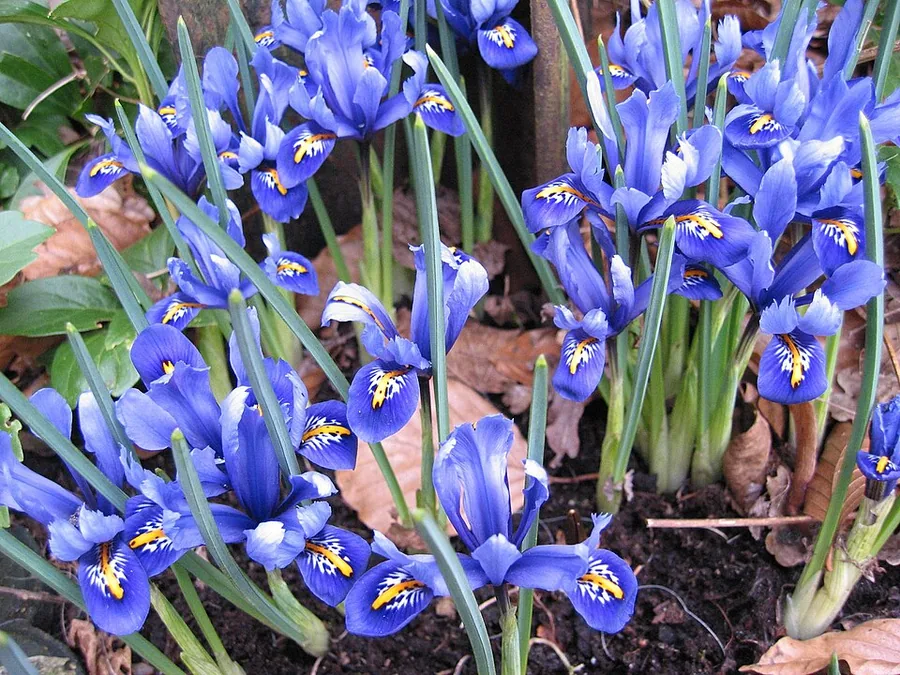
Reticulated iris ranks among the earliest flowers to interrupt the late-winter gray. It arises from a small bulb sheathed in a netted tunic, the feature that gives the species its name, and it opens in early spring ahead of most other garden plants. Standing only 4 to 6 inches tall, it suits a rock garden, the front edge of a border, or a container near an entrance.
The flower reproduces the classic iris form at reduced scale, in blues, purples, and pale icy tones, frequently accented by a streak of orange or gold along the falls. Blooms emerge with the narrow, square leaves and persist for roughly two weeks. Since each flower is small, the planting performs best as a generous drift rather than as scattered individuals.
Care
The short version: set the bulbs in fall in full sun and sharply drained soil, water through spring growth, then withhold water and let them bake dry during summer dormancy.
Light
Provide full sun for maximum flowering, though the plant tolerates partial shade. An open, sunny position also promotes summer drying of the soil, the condition the dormant bulbs require to ripen.
Water
Maintain moist soil through spring while the plant is in active growth and bloom, then reduce watering. Once foliage senesces and the bulb enters summer dormancy, keep the ground fairly dry so it can differentiate next year's buds. It withstands summer drought without harm.
Soil
Sharp drainage is the governing requirement. Plant in average, well-drained soil across a pH of 6.1 to 7.8, and avoid positions that remain saturated, since summer waterlogging drives bulb rot.
Temperature
The bulbs are exceptionally cold-hardy, rated from about -20°F to 100°F (-29°C to 38°C), so winter poses no risk. That winter chilling is in fact necessary for reliable spring flowering.
Humidity
Ambient outdoor air is entirely adequate, so no humidity target applies. Far more decisive for this plant is dry summer soil, not atmospheric moisture.
Feeding
Incorporate a low-nitrogen bulb fertilizer or bone meal into the soil at fall planting, with a light supplementary feed in early spring. Restrict nitrogen, since an excess favors foliage at the expense of bloom.
Pruning
Retain the foliage after flowering and let it die back naturally, because the green leaves are replenishing the bulb for the following season. Remove only leaves that have fully withered.
Repotting
The bulbs resent disturbance and need lifting only as flowering declines, generally every few years. Divide them once the foliage has died back, separating the crowded clumps and the small bulblets.
Size & spacing
Individual plants remain compact at 4 to 6 inches (10 to 15 cm) tall and 3 to 5 inches (8 to 12 cm) wide. Space the bulbs roughly 3 to 4 inches (8 to 10 cm) apart so the planting reads as a coherent drift.
When to plant
The species follows a fall-to-spring cycle. Plant the bulbs in autumn so root systems establish ahead of hard cold, and expect flowers in March to early April while surrounding plants remain dormant.
Northern hemisphere
Southern hemisphere
Typical months for a temperate climate: start earlier in warm zones, later where spring frosts linger.
- Plant: Plant bulbs in fall, 3-4 inches (8-10 cm) deep and 3-4 inches apart
- Harvest: March to early April (early spring)
Hardiness
USDA hardiness zones: 5–9
Temperature: down to -29°C
Troubleshooting
Nearly every problem on this iris presents in one of two places: at the bulb below ground or on the tender spring foliage. A short list of disorders accounts for the trouble, and recognizing them makes them manageable. Match the symptom below and intervene early.
Basal rot softening the bulb from below
Soil that holds water through summer dormancy is the condition fusarium basal rot exploits, entering at the basal plate and advancing upward as brown or pinkish discoloration. Sectioning a suspect bulb confirms it, since the basal tissue reads soft and stained. The pathogen leaves no salvageable tissue, so discard the bulb, correct the drainage, and reestablish clean stock on a drier site.
Fix:
- Discard affected bulbs
- Improve drainage and avoid summer irrigation
- Plant healthy bulbs in a new, well-drained site
Full bloom in year one, then flowerless growth
A bulb going blind is the classic outcome with this iris and follows directly from its habit of dividing. After flowering, the parent bulb fragments into small offsets, and none of those offsets carries enough stored reserve to flower for several seasons. Counter it by planting at 3 to 4 inches to slow the splitting, keeping the soil dry through summer so reserves build, and refreshing the display with new bulbs each fall.
Fix:
- Replant supplemental bulbs annually for consistent bloom
- Plant bulbs deeper (3-4 inches) to discourage splitting
- Lift and grow on small bulblets in a nursery bed until they reach flowering size
Irregular chewing damage on leaves and buds
Soft, fast spring growth is exactly what draws slugs and snails, and their feeding leaves the torn holes and silvery slime trails you find on the foliage. Confirm them by scouting after dark or turning over nearby debris where they shelter through the day, then remove them by hand. Because they depend on moisture, clearing damp cover and sharpening drainage around the planting suppresses the population.
Fix:
- Hand-pick slugs and snails
- Remove garden debris and mulch near plants
- Use iron-phosphate slug baits if needed
Toxicity
Regard the entire plant as unsafe for pets and people. All tissues carry irritant compounds identified as irisin and terpenoids, with the highest concentration in the bulb, so a chewed bulb induces drooling, vomiting, and diarrhea. Handle bulbs with gloves and store any surplus where pets and children cannot reach.
Toxic to
Cats · Dogs · Horses · Rabbits · Livestock · Birds · People
Cats Mild
A cat that ingests bulb or leaf tissue typically shows salivation and vomiting first, then becomes subdued and refuses food, with diarrhea developing shortly after. The bulb is the critical part, since the irisin and terpenoid content peaks there.
Dogs Mild
In dogs the irritant load produces marked drooling and vomiting once a bulb is unearthed and chewed, followed by diarrhea and lethargy. Habitual diggers face the greatest exposure, which is why both stored and planted bulbs must stay inaccessible.
Horses Mild
A grazing horse may hypersalivate, scour, and lose vigor after consuming any part of the plant. The pattern mirrors the smaller species, with the bulb carrying the highest irritant concentration.
Rabbits Mild
The same irritant compounds disturb a rabbit's gut, so both the plant and its bulbs should stay out of reach. Because a rabbit's gut motility fails easily, any salivation or loose droppings warrants a prompt veterinary call.
Livestock Mild
Cattle, goats, and sheep usually avoid the bitter foliage, yet a hungry animal that samples it can drool and scour. Fence stock off from beds and never dispose of lifted bulbs on pasture.
Birds Caution
Evidence on iris toxicity in birds is thin, so the prudent reading is to classify it as a hazard rather than assume safety. Keep inquisitive pet birds away from cut stems and stored bulbs.
People Caution
No part of this iris is edible, and because the bulb holds the greatest toxin load, ingesting it causes abdominal pain, nausea, and vomiting. Contact with the bulbs can also inflame sensitive skin, so gloves are advisable and children should be kept from mouthing any part.
Wear gloves when handling bulbs; sap can cause skin irritation/contact dermatitis in sensitive people. Store bulbs out of reach of pets.
Helpline numbers

United States
ASPCA Animal Poison Control: (888) 426-4435 (fee applies)
Poison Control: (800) 222-1222



Canada
Poison Centres: 1-844-764-7669
Varieties
A limited set of named selections accounts for most commercial availability, each favoring a distinct shade of blue. The following are the ones worth knowing.
Harmony
Its sky-blue to royal-blue flowers are identified by the bright yellow-orange ridge running down each fall.
Clairette
It couples pale blue standards with darker blue falls that carry a scattering of white flecks.
Gordon
Light blue flowers set against a bold orange blotch on each fall mark this selection.
Katharine Hodgkin
This widely grown hybrid combines icy pale blue with soft yellow, overlaid throughout by fine dark veining.
Companions
This iris looks best beside other early bulbs that flower at the same time and want the same sun and sharp drainage.
Plant near
Galanthus (snowdrops): Blooms at the same early-spring time and shares full sun, well-drained conditions for layered early color.
Crocus: Early-spring bulb with matching light and drainage needs; combines for naturalized rock-garden displays.
Chionodoxa (glory-of-the-snow): Early-blooming companion bulb that thrives in the same sunny, well-drained sites.
How to propagate
The simplest increase comes from letting the bulbs offset on their own, though crowded clumps can be divided and seed offers a slow alternative.
Offsets & pupsEasy
After foliage dies back in late spring or early summer · Several years for bulblets to reach flowering size
Offsets are the plant's natural means of increase, so this method simply directs a process already underway. After the leaves die back in late spring or early summer, lift the clump and you'll find the parent bulb has divided into small offsets, the effect more pronounced on shallow plantings. Detach and replant the bulblets, but expect a wait, since each needs several years to attain flowering size and most stay blind through the first spring.
DivisionEasy
After foliage dies back, when flowering declines · 1-3 seasons
Divide once a mature clump crowds and its flowering falls off. Allow the foliage to wither first, then lift the bulbs, separate them cleanly, and replant at the correct depth and spacing. Reestablishment follows over the next one to three seasons.
SeedModerate
Sow ripe seed in fall; requires cold stratification · Several years to flowering
Seed is the protracted route. Sow ripe seed in fall so winter cold satisfies the required stratification, then expect a long interval, because seedlings need several years to reach blooming size.
Myths
Reticulated iris bulbs reliably return in force each spring unaided.
In practice most plantings flower well the first year and then decline as the parent bulbs fragment into small bulblets that require several seasons to mature. Interplanting a few fresh bulbs each fall is what sustains a dependable display, since the original planting will not consistently repeat on its own.
A small ornamental iris poses no risk to pets.
Stature is irrelevant to toxicity. Every iris is toxic to cats, dogs, and horses, and the bulb concentrates the most irritant compounds, producing drooling, vomiting, and diarrhea if an animal chews it.